

After an explosive expansion in 2024, the long-duration energy storage sector slowed sharply in 2025. A new Wood Mackenzie report highlights financing pressures, rising competition for capital and persistent cost gaps with lithium batteries.

LDES growth slows after the boom year of 2024
The year 2024 marked a breakthrough moment for long-duration energy storage technologies. With growth exceeding 800% compared with 2023, the sector appeared to be entering a promising medium-term phase for solutions such as compressed air energy storage and redox flow batteries.
In 2025, however, the outlook began to shift. Although the sector continued to expand, its growth rate slowed dramatically and investment momentum weakened. That trend emerges clearly in the new Long Duration Energy Storage Trends report released by Wood Mackenzie.
The report outlines a series of mounting challenges for the LDES sector, the group of technologies capable of delivering electricity or heat over extended periods, typically longer than four hours.
A market that should be thriving, given the global focus on energy storage, instead revealed significant vulnerabilities throughout 2025.
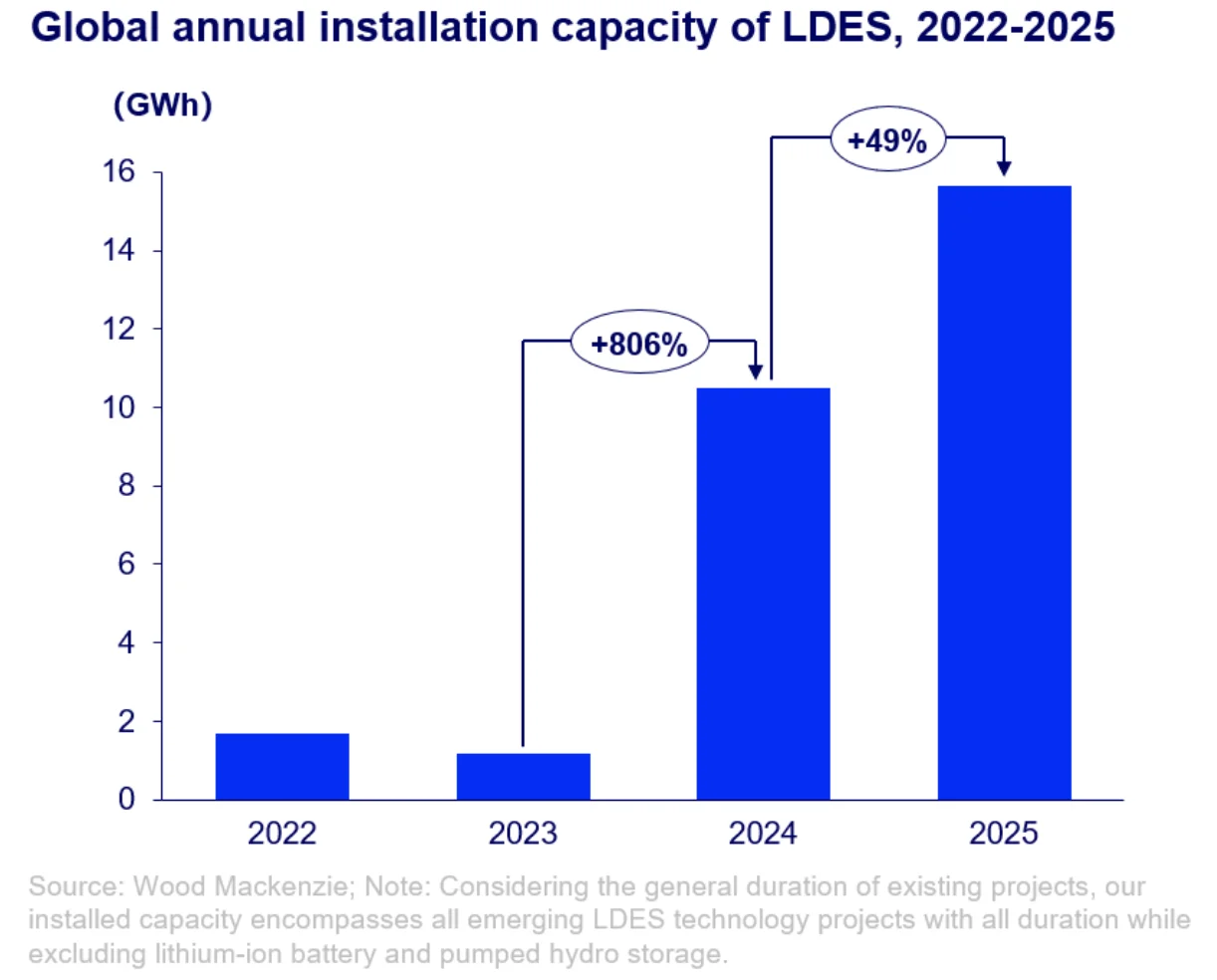
“Despite the impressive growth in installations last year (+49%), LDES technologies are caught in a strategic squeeze,” said Jiayue Zheng, energy storage management consultant at Wood Mackenzie.
“Lithium-ion batteries have captured the economically critical four-to-eight-hour storage market thanks to cost advantages and stronger supply chains, while LDES still lacks sufficient demand and pricing mechanisms to achieve commercial profitability.”
What is slowing investment in LDES?
According to the analysis, three major factors are discouraging investors from backing long-duration energy storage projects:
- High interest rates, which penalize projects with long payback periods
- Competition for capital from AI data centers and grid infrastructure investments
- Falling lithium prices combined with longer-duration lithium batteries, reducing the economic advantage of alternative storage technologies
As a result, even though global LDES capacity surpassed 15 GWh last year, the growth rate dropped by 93.9% and overall financing declined by 30%.
Venture capital funding suffered an even steeper contraction, falling 72% and placing significant financial pressure on many startups working in the long-duration energy storage sector.
There are, however, notable exceptions. Some markets remain more attractive than others.
China dominates the global LDES market
China continues to dominate the sector, accounting for 93% of cumulative global deployments. The country’s leadership is largely driven by strong government support, including the Special Action Plan for the Development of New Energy Storage Systems (2025-2027).
It is no coincidence that the most recent global records for flow batteries and compressed air energy storage facilities have been achieved there.
The Wood Mackenzie report also identifies financial attractiveness in markets such as the United Kingdom, Italy, the United States and Australia, where revenue certainty mechanisms provide stronger investment signals.
Technology-specific procurement programs have also emerged in Spain, Ireland and Germany.
However, most markets still lack dedicated capacity mechanisms, and multi-day energy arbitrage alone is not enough to justify large-scale investment in LDES technologies.
LDES costs remain the main barrier
Cost remains the main barrier, even in a major investor like China.
In the country, four-hour lithium battery energy storage systems cost around 107 $/kWh. By comparison, thermal energy storage and compressed air energy storage, currently among the cheapest LDES options, cost roughly 190 $/kWh and 201 $/kWh respectively.
This represents a price premium between 78% and 88%.
The gap continues to reinforce lithium’s dominance and, according to Wood Mackenzie analysts, that trend is likely to persist in the medium term.
By 2034, lithium batteries are still expected to hold roughly 85% of the energy storage market, while storage technologies capable of delivering electricity for more than two days will remain limited.
That said, several major projects are moving forward. Examples include the CO₂ battery developed by Energy Dome in Italy (20 MW / 200 MWh) and the liquid air energy storage project led by Highview Power in the United Kingdom.
According to the analysis firm, meeting global net zero targets will require the average duration of energy storage worldwide to increase from about 2.5 hours today to roughly 20 hours.


