
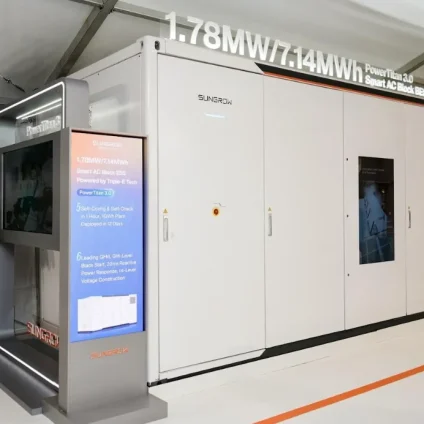

At the PV & ESS Summit in Madrid, Sungrow introduced PowerTitan 3.0, a next-generation grid-forming battery energy storage system designed to support Europe’s evolving utility-scale market.

PowerTitan 3.0 sets a new benchmark for utility-scale battery storage
Sungrow, a global leader in photovoltaic inverters and energy storage systems (ESS), unveiled two major innovations for the European market at the PV & ESS Summit in Madrid: the utility-scale battery energy storage system PowerTitan 3.0 and a single-platform design for DC-coupled PV and ESS solutions.
The summit brought together more than 300 partners and industry professionals, including representatives from SolarPower Europe. The event provided an opportunity to assess the central role of integrated PV and ESS technologies in shaping the future of the energy transition.
“Europe will remain a strategic market for Sungrow in 2026 as well,” said James Li, vice president of Sungrow Europe and head of the ESS business. “We will strengthen our commitment through a robust, localized service infrastructure.”
Sungrow’s European operations are supported by a service network that includes more than 280 engineers, five repair centers, 14 service warehouses, and over 220 service partners. “Looking ahead, we will continue to expand our presence in Europe through strategic partnerships and next-generation technologies, with a clear focus on supporting the continent’s transition to clean energy,” Li added.
Among Sungrow’s most recent large-scale BESS projects across continental Europe are an 800 MWh installation in Belgium, the 330 MWh Bramley ESS project in the United Kingdom, a 70 MW photovoltaic plant in Finland, and a 70 MW hybrid project in Turkey.
The growing importance of BESS in Europe
In 2025, Europe’s battery storage market entered a phase of maturity. With 27.1 GWh of newly installed capacity, the European Union recorded its twelfth consecutive year of growth, confirming battery storage as the fastest-growing clean energy technology in the region.
According to SolarPower Europe, total EU solar capacity reached 406 GW in 2025, exceeding expectations. However, to meet 2030 climate and energy targets, the EU will need to scale battery storage capacity to 750 GWh within the next five years. Current annual installation levels remain insufficient.
SolarPower Europe estimates that system flexibility needs will increase by 40% by 2030, making large-scale battery storage deployment essential. In 2025 alone, more than 26 GWh of BESS capacity was installed, allowing utility-scale systems to surpass residential installations for the first time. Looking ahead, the association forecasts average annual BESS growth of 30% through 2030, reaching 412 GWh.
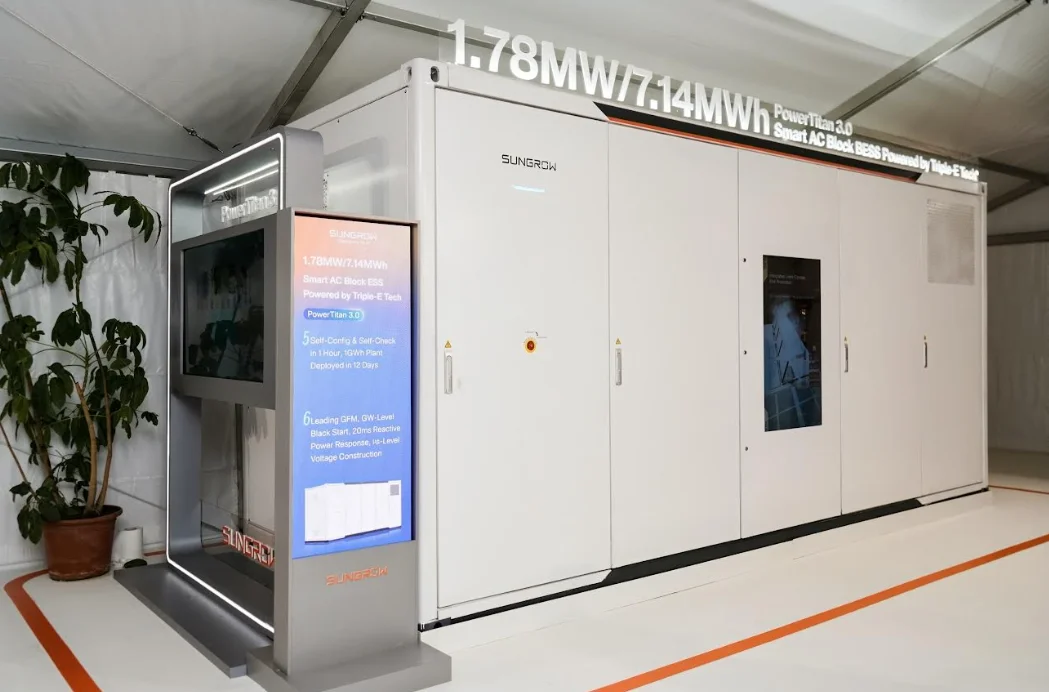
PowerTitan 3.0, next-generation storage for the utility sector
PowerTitan 3.0 is designed to address three key challenges facing the European market: profitability, safety, and reliability. Project viability increasingly depends on balancing CAPEX and OPEX, while larger and more complex installations demand higher safety standards and long-term operational reliability.
PowerTitan 3.0 represents the first large-scale application of a fully liquid-cooled silicon carbide power conversion system, reducing operational energy losses and achieving a maximum efficiency of 99.3%. Thanks to higher-capacity battery cells, the system delivers increased energy density while cutting total footprint requirements by nearly 20%, reaching up to 483 kWh per square meter.
The platform also integrates self-diagnostic and self-configuration software. For a 1 GWh installation, self-configuration can be completed in less than one hour, with full plant deployment reduced to just 12 days. According to Sungrow’s estimates, these technological improvements can translate into nearly €16 million in additional revenue over the lifetime of a 1 GWh plant.
In terms of reliability, PowerTitan 3.0 is engineered to operate across Europe’s full climatic range, from -40°C in northern regions to 45°C in southern Europe. It features IP55 protection and C5 corrosion resistance for saline environments. The system also includes grid-forming capabilities, enabling it to anticipate and mitigate grid disturbances before they escalate.
Grid-forming technology and the energy transition
Grid-forming technology is increasingly seen as essential for resilient and stable power systems. As future grids become dominated by power-electronics-based generation, overall system stability is reduced. While the European regulatory framework is still evolving, Brussels is considering making grid-forming requirements mandatory for new energy storage systems above 1 MW, requiring them to actively support grid stability.
During the Madrid summit, Henry Liu, director of Sungrow’s Grid Solution department, outlined why grid-forming capability is critical:
- For voltage stability, the technology reacts instantly to external disturbances, such as sags or surges, by injecting reactive current.
- It provides flexible inertia, adjustable from 2 to 20 seconds, with frequency response measured in milliseconds.
- Power oscillations are suppressed faster than with conventional systems.
- Thanks to black start capability, batteries can restore the grid within 30 seconds after a blackout, compared with up to 8 hours for a coal plant or 30 minutes for a gas turbine.
These capabilities have already been validated in multiple projects, including a 7.8 GWh installation in Saudi Arabia, currently the world’s largest grid-forming energy storage facility.
A single-platform design for DC-coupled PV and ESS solutions
Alongside PowerTitan 3.0, Sungrow also introduced a single-platform design for DC-coupled PV and ESS solutions. The system combines a modular 1+X inverter with a dedicated storage interface, PowerTitan 3.0 with an integrated DC/DC module, and the PV-ESS Synergy Management System.
The modular 1+X inverter merges the flexibility of string inverters with the simplified maintenance of centralized inverters. Its scalable power architecture allows customized block configurations for large plants, while the separated module design enables component replacement in under one hour.
This integrated architecture supports discharge durations of up to 8 hours and offers flexible storage-to-power ratios of up to 100%, while optimizing system-level costs. It enables effective energy arbitrage and improves grid compatibility. To date, Sungrow’s DC-coupled solution has been deployed in more than 90 projects across 10 countries.
Case study, Delta Capacity and Sungrow in Sweden
One of the most notable case studies presented in Madrid was Delta Capacity’s project in Ånge, in central-northern Sweden, a 70 MW/160 MWh installation that is currently the largest energy storage system in the country. Delta Capacity and Sungrow collaborated to strengthen the grid and enable greater integration of renewable energy.
The site is located in a challenging climatic environment, with temperatures dropping to -28°C. Key challenges included snow loads on container structures and repeated freeze-thaw cycles. As a result, containers had to be structurally reinforced to withstand heavy snow, and components required an extended operating temperature range. On the positive side, the site offers ample space, a large area surrounded by forest. The current installation occupies only about two thirds of the available land, leaving room for future expansion.


