

The World Nuclear Industry Status Report 2025 highlights aging reactors, delayed projects, and limited investment, signaling risks for the sector’s future.

Report outlines challenges for global nuclear industry
The nuclear industry will need a substantial effort to maintain the momentum of 2024. With delayed or canceled projects, reactors nearing retirement, and uncertain investment plans, the sector risks losing generation capacity after last year’s record.
This is the central message of the World Nuclear Industry Status Report 2025, one of the most authoritative global publications on nuclear trends. Presented today in Rome, the report has been providing a yearly overview of operating, under-construction, and decommissioned reactors for nearly two decades, alongside insights on abandoned projects.
Fewer countries building new reactors
According to the World Nuclear Industry Status Report 2025, as of mid-2025 nuclear power plants were operating in 31 countries, one fewer than in 2024 after Taiwan completed its phase-out program in May.
Globally, 408 reactors were operational, excluding 33 classified as Long-Term Outages (LTOs), including 19 in Japan and 6 in Ukraine.
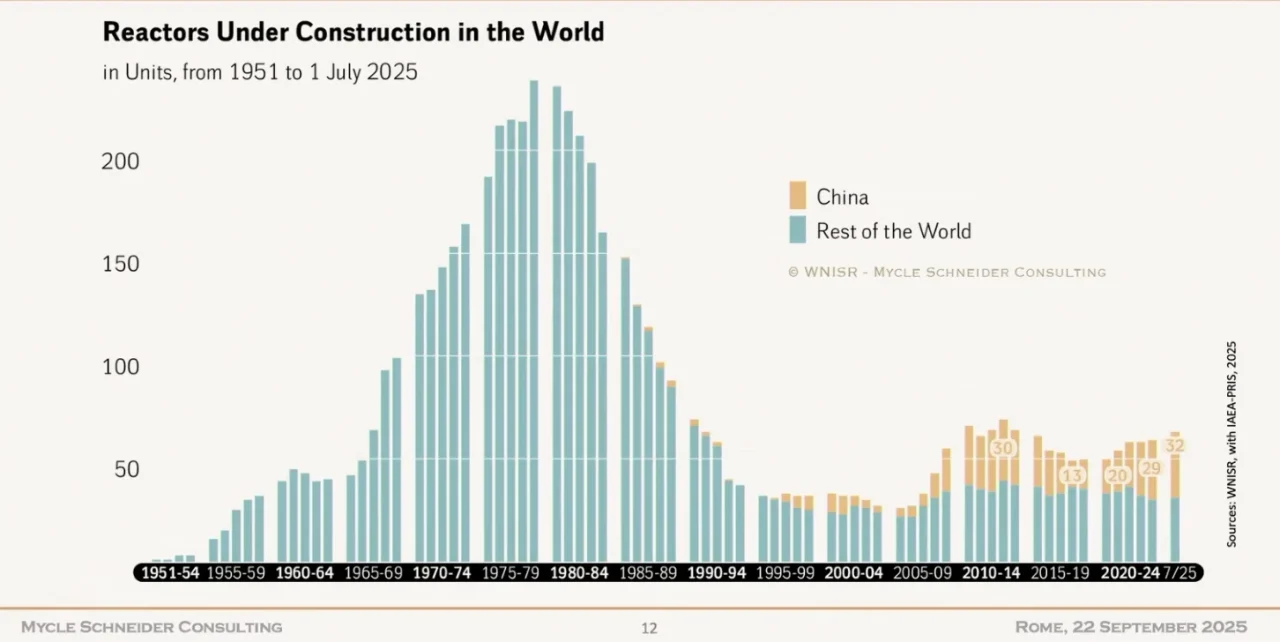
The number of countries engaged in new nuclear construction also declined. Only 11 nations were building reactors, two fewer than mid-2024 and five fewer than mid-2023, for a total of 63 projects. Of these, 32 were in China, though 26 are already behind schedule. Russia continues to dominate nuclear exports, with 20 units under construction abroad and just 7 at home.
In this context, it is worth noting that, to date, there is only one Design Certification and one Standard Design Approval, both granted to NuScale in the United States, for small modular reactors (SMRs). No projects are currently under construction, and two of Europe’s largest nuclear startups, Newcleo and Naarea, are facing financial difficulties.
Nuclear generation dips after 2024 record
Although new projects are underway, global nuclear generation has declined slightly in 2025. After the 2024 record of 2,677 TWh, 14 TWh above the previous high set 18 years earlier, the sector slowed due to reduced operating capacity. Seven new reactors came online in 2024, but four were closed, lowering global nuclear capacity from 369.4 GW at the end of 2024 to 368.7 GW by mid-2025.

Nuclear power accounted for 9% of global commercial electricity generation in 2024, its lowest share in four decades, reflecting the unprecedented growth of solar power worldwide.
China, with a 3.7% output increase, outproduced France for the fifth consecutive year, securing its position as the world’s second-largest nuclear generator after the United States.
Aging fleet and slow decommissioning
The average age of the world’s 408 operating reactors is now 32.4 years. Of these, 266 have been in service for more than 31 years, and 141 have exceeded 41 years.
By mid-2025, 218 reactors had been permanently shut down, representing about 110 GW of retired capacity, in addition to the 33 LTO units. Yet decommissioning remains slow: only 23 reactors have been fully dismantled, and just 9 sites have been cleared of all regulatory oversight.


