


Updated guide to photovoltaic module prices shows current solar panel costs in Europe. High-efficiency modules have climbed to €0.115/Wp and are expected to rise further. Here’s why.

Photovoltaic module prices in 2026, a market analysis
What will happen to photovoltaic module prices in 2026? A close look at solar panel costs comes from Germany’s pvXchange Trading through its monthly Price Index and ongoing trend analysis.
The latest update suggests the market remains complex. After a 2025 that marked an all-time low for solar module prices, the new year has opened with a series of notable increases, driven largely by recent commercial moves in China and higher raw material costs.
The good news for buyers is that, compared with January 2025 indices, the situation still appears broadly stable, highlighting just how deep the recent price crisis has been. That downturn pushed industry giants such as JA Solar, JinkoSolar, Trina Solar and TCL Zhonghuan to report significant losses for fiscal year 2025. A severe imbalance between supply and demand, caused by the rapid expansion of Chinese manufacturing capacity across the photovoltaic value chain, rising trade protectionism and a slowdown in solar installations across Europe, has left visible scars.
Still, 2026 has begun with a rebound, posting month-on-month increases of 4% to 5% across almost all market segments. Below is a closer look at what the index shows and the factors driving this trend.
Solar panel categories
The reference market is Europe, which pvXchange Trading has monitored since 2009 using a unique price index. The tool highlights sector trends by grouping products into three main categories:
- High-efficiency crystalline silicon modules
This segment includes panels with mono or bifacial heterojunction (HJT) cells, n-type TOPCon or back contact (BC) technologies, or combinations thereof, provided they achieve efficiencies above 23%. - Mainstream crystalline silicon modules
This category covers “standard” modules, primarily monocrystalline PERC or TOPCon panels used in commercial systems, with efficiencies up to 23%. Since 2025, selected HJT and BC products have also been included. - Low-cost crystalline silicon modules
Defined as remaining inventory, lower-performance modules, grade-B stock, insolvent goods, used photovoltaic modules and products with limited or no warranty, typically lacking bankability.
Compared with the 2024 index, pvXchange Trading raised the efficiency threshold from 22.5% to 23% to reflect the latest technological advances.
The return of full black modules
In 2025, pvXchange Trading reintroduced a fourth category that had previously been removed because it overlapped with the high-efficiency segment:
- Full black modules
These panels feature completely black cells and frames and include mono or bifacial HJT, n-type TOPCon or BC technologies, along with their combinations.
How much do solar panels cost today?
- High-efficiency modules: The average price has risen to €0.130/Wp. Compared with January 2026, this represents a 13.0% increase, while the year-on-year comparison with January 2025 shows a 4.0% rise.
- Full black modules: The average price stands at €0.145/Wp. This category recorded an 11.5% increase over the past month, bringing the gap compared with a year ago to the same +11.5%.
- Mainstream modules: The average price is now €0.115/Wp. Prices have grown 9.5% month-on-month, which is exactly the same increase recorded year-on-year.
- Low-cost modules: The average price is €0.060/Wp. Despite a 9.1% increase compared with January 2026, this category remains the only one showing a negative annual trend, with –7.7% compared with January 2025.
Solar panel price trends in February 2026
The increase in solar panel prices on the European wholesale photovoltaic market in February was stronger than expected. The company recorded generalized increases ranging between 1 and 1.5 euro cents per watt-peak, with a greater impact on modules intended for small residential systems than on those used for large-scale projects.
Compared with the low reached in December 2025, the overall rebound already stands between 15% and 18%.
Unlike previous market movements, the drivers of this price increase are not linked to raw material costs or new Chinese export policies. On the contrary, silicon wafer prices declined during the month, while silver prices stabilized.
The current dynamic appears instead to reflect a strategic move by manufacturers to recover profit margins after a prolonged period of losses. In the price lists of some suppliers, structural increases of up to 20–30% have been recorded.
That ultra-low prices could not last forever was evident. However, while manufacturers attempt to restore margins, the market is entering an increasingly uncertain phase. Early applications of the European Net-Zero Industry Act (NZIA) and national rules on grid connections could introduce new challenges that may further reduce demand.
On the other hand, energy storage could help support the market, although it is still too early to make reliable forecasts.
| Module Class | Average Price (€/Wp) | Trend vs January 2026 | Trend vs January 2025 |
|---|---|---|---|
| High Efficiency | 0.130 €/Wp | +13.0% | +4.0% |
| Full Black | 0.145 €/Wp | +11.5% | +11.5% |
| Mainstream | 0.115 €/Wp | +9.5% | +9.5% |
| Low Cost | 0.060 €/Wp | +9.1% | –7.7% |
How much do solar panels cost in January 2026?
- High-efficiency modules: the average price stands at €0.115/Wp. This represents a 4.5% increase compared with December 2025, while still remaining 8 percentage points below January 2025 levels.
- Full black modules: the average price is €0.130/Wp, up 4.0% month on month, but unchanged year on year.
- Mainstream modules: now averaging around €0.105/Wp, this segment recorded the strongest monthly increase at 5%, while remaining flat compared with January 2025.
- Low-cost modules: the average price is €0.055/Wp, stable versus December 2025 but down 15.4% year on year.
What is driving the new photovoltaic price dynamics? As ever, developments in China are central. The Asian giant, which played a key role in the 2025 price collapse, is also shaping the current rebound. One of the main triggers is Beijing’s decision to eliminate export tax rebates on solar products.
On January 9, China’s Ministry of Finance announced that, starting April 1, 2026, value-added tax rebates on photovoltaic exports will be permanently abolished. The measure applies to monocrystalline silicon wafers with diameters above 15.24 cm, both above and below 220 micrometers in thickness, as well as individual solar cells and finished modules.
Combined with rising prices for silicon, silver and aluminum, the policy has pushed up wholesale prices and prompted many Chinese manufacturers to accelerate module shipments ahead of April in an effort to recover previously eroded margins.
The impact on the European photovoltaic market could be significant, with cost increases for large-scale projects potentially reaching 20%.
A Reintroduction in 2025: Full Black Solar Panels
In 2025, pvXchange Trading reintroduced a fourth product category that had previously been removed due to its overlap with the “High Efficiency” category: Full Black solar modules. These sleek, fully black panels, characterized by a completely black frame and cells, include advanced technologies such as mono- or bifacial HJT, type-N TOPCon, BC, and their combinations, with efficiencies reaching up to 22.5%.
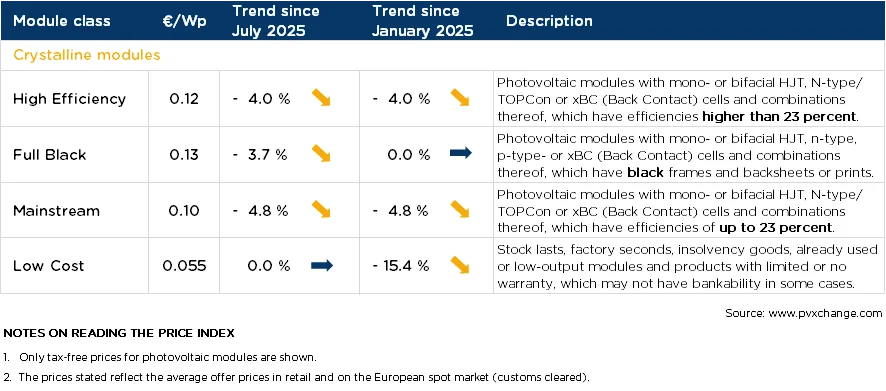
How much do solar panels cost in August 2025?
The company recorded price reductions of around 4%, with only low-cost photovoltaic modules escaping the trend. Specifically, in August 2025, the Price Index showed:
- about €0.12 per watt peak (€/Wp) for high-efficiency photovoltaic modules, down 4% compared to July;
- about €0.13/Wp for all-black photovoltaic modules, down 3.7% from July 2025;
- about €0.10/Wp for mainstream photovoltaic panels, a 4.8% decrease month over month;
- about €0.055/Wp for low-cost photovoltaic modules, unchanged from July prices.
“Manufacturers are moving quickly to end the devastating price war. The Chinese government is gradually phasing out tax incentives and subsidized solar module exports. Efforts to stabilize prices have so far failed, but they are intensifying and should be taken seriously.”
“Polysilicon prices are rising due to deliberate production cuts across Asia. In Europe, prices for ordered modules, those not yet produced, are already higher than for products in local warehouses or in transit,” added Schachinger. “This suggests that, at least in the spot market, high-efficiency solar modules are currently at their lowest prices and may not fall further anytime soon. So follow the rule: buy now, because it won’t get any cheaper.”
How much do solar photovoltaic modules cost in January 2025?
As of January 2025, solar module prices have remained relatively stable across all categories, including ultra-high-efficiency products and other module classes. While there have been minor price increases in the two lower categories—partially due to the updated classification, the overall market has yet to see significant price changes.
However, analysts are raising concerns over certain trends in the solar market. Supply shortages for specific high-power modules, which have historically been limited and often sold exclusively to select clients, are becoming more pronounced. This challenge also extends to modules designed for large-scale installations, where availability is increasingly tight.
Another pressing issue for the industry is the difficulty in sourcing some inverters and energy storage systems. Many suppliers are now steering customers toward alternative products to address these shortages. According to industry experts, the delays are attributed to post-holiday shipping bottlenecks and potential intentional production slowdowns.
But let’s take a closer look at the figures recorded in January 2025:
| Module Category | €/Wp | Trend Since December 2024 | Trend Since January 2024 | Description |
|---|---|---|---|---|
| High Efficiency | €0.13 | Stable | -45.70% | Photovoltaic modules with monocrystalline or bifacial HJT cells, N-type/TOPCon or xBC (Back Contact) and their combinations, with efficiencies above 22.5%. |
| Full Black | €0.13 | Stable | -40.90% | Photovoltaic modules with monocrystalline or bifacial HJT cells, N-type/TOPCon or xBC (Back Contact) and their combinations, with efficiencies up to 22.5%. |
| Mainstream | €0.11 | +10.5% | -25.00% | Photovoltaic modules with monocrystalline or bifacial HJT cells, N-type/TOPCon or xBC (Back Contact) and their combinations, with efficiencies up to 22.5%. |
| Low Cost | €0.07 | +8.3% | -27.80% | Warehouse stock, factory seconds, defective products, used modules, or low-power modules with limited or no warranty, which in some cases may not be bankable. |
Only the prices of tax-free photovoltaic modules are shown.
The values given reflect average prices offered at retail and on the European spot market.
December 2024 Solar Panel Price Update
As we analyze the latest available data—December 2024—the solar panel market has seen a continued price decline, though trends indicate that the downward curve is starting to flatten. Here’s a detailed breakdown:
- High-Efficiency Solar Panels: The average price was €0.125/Wp, marking a 3.8% decrease compared to October 2024.
- Mainstream Solar Panels: Prices averaged €0.095/Wp, experiencing a 5% decline from October 2024.
- Low-Cost Solar Panels: Prices remained stable at €0.060/Wp, unchanged from the previous month.
Despite limited room for further price reductions across all solar module categories, manufacturers and distributors still hold large inventories that must be cleared before the year-end to balance their books.
As Engineer Martin Schachinger wrote just before Christmas, “The industry’s goal was to start 2025 with the emptiest warehouses possible.” This led to an influx of exceptionally low-price offers throughout December, often disconnected from the real value of the products.
Will Solar Panel Prices Increase in 2025?
All indicators point to a rise in photovoltaic module prices in the first quarter of 2025. However, the extent of this increase remains uncertain.
“How high prices will go,” writes industry expert Martin Schachinger, “depends on whether the artificial export restrictions allegedly coordinated by Chinese manufacturers are broadly enforced and on the level of demand in the European market over the coming months.”
If demand drops significantly, the expected shortage may not materialize, keeping prices low. However, if supply constraints are fully implemented and demand remains stable or rises, we could see a notable price surge in the first part of 2025.
Photovoltaic Module Prices: November 2024
In November 2024, the price of solar panels saw another significant drop, continuing the annual trend. However, analysts at pvXchange Trading believe this trend might not persist much longer. According to engineer Martin Schachinger, “The sharp price drop in November could be the last of its kind for now. The pain threshold appears to have been reached, or even surpassed, and all indications point to a recovery.”
What remains undeniable is that prices fell significantly from October to November, with an average month-on-month decline of 8%. Schachinger notes, “An average price drop of around 8% across all technology classes effectively erases any margin that could still be achieved, even with recently purchased modules.”
Current Solar Panel Prices
Breaking down the specifics:
- High-Efficiency Photovoltaic Modules: Average price of €0.13/Wp, down 7.1% compared to October 2024.
- Mainstream Photovoltaic Panels: Average price of €0.10/Wp, down 9.1% month-on-month.
- Low-Cost Photovoltaic Modules: Average price of €0.060/Wp, a decrease of 7.7% compared to the previous month.
These figures underscore the significant pressures in the photovoltaic market, as price reductions strain margins to unprecedented levels.

Photovoltaic Module Prices: Stabilization in Sight Amid Turbulent 2024
According to Martin Schachinger, the downward spiral in photovoltaic module prices may finally be nearing its end. “Currently, there are several indications that prices are stabilizing and even beginning to rise again. One reason could be the end of high tax rebates on exported solar modules. Many readers may not realize that China taxes the export of certain goods, such as raw materials and energy products. For solar modules, the standard tax rate is 13%, but it was discounted to 0 for a long time. Starting December 1, the tax rebate for newly exported modules will be reduced to 9%, increasing exporters’ costs by 4%.”
Impact on Pricing
What does this mean? “Considering the current low base prices,” Schachinger explains, “this doesn’t have severe consequences. Nonetheless, this measure alone is expected to result in a price increase of 0.3 to 0.5 cents per watt-peak.”
October 2024 Price Trends
An analysis by pvXchange reveals significant monthly and yearly price reductions across almost all categories in October 2024:
- High-Efficiency Modules: Average price of €0.14/Wp, down 6.7% from September 2024 and 39.1% from January 2024.
- Mainstream Modules: Average price of €0.11/Wp, stable compared to September but 21.4% lower than January 2024.
- Low-Cost Modules: Average price of €0.065/Wp, a 7.1% decrease from September and 27.8% from January 2024.
Challenges Facing the Industry
These trends are exerting mounting pressure on the photovoltaic sector. “Things are not going well for the PV industry right now,” Schachinger notes. “Corporate bankruptcies are on the rise, reflecting a broader trend visible across all industries in Germany. According to Deutsche Wirtschaftsnachrichten, the number of insolvencies in Q3 2024 reached a grim level not seen since 2010.”
Inventory Devaluation
One significant challenge is the depreciation of stock, particularly for high-performance modules. “Contrary to all expectations, the average price of high-efficiency modules dropped another 1 cent per watt-peak, while other module categories saw minimal change. It seems that many suppliers are still so desperate to sell that they continue to devalue their panel inventory, including the most sought-after types, just to boost sales,” explains Schachinger.
However, the expert warns that this strategy may not be sustainable. “The last six to nine months show that this approach doesn’t always work. Even as components and turnkey systems become cheaper, demand—and consequently sales volumes—doesn’t necessarily increase.”
The industry’s resilience will be tested as it navigates these turbulent dynamics and the potential for a price rebound in the months ahead.
Article from December 12, 2024, updated on February 10, 2026


