

The IEA warns that the 2026 energy shock could permanently reshape global energy markets, accelerating investment in renewables, nuclear power and electrification while exposing persistent climate challenges.
-By Laura Contemori

World Energy Outlook 2026: How the Hormuz crisis is reshaping energy security
The 2026 energy crisis could permanently alter the balance of global energy markets. That is one of the central findings of the International Energy Agency’s (IEA) World Energy Outlook 2026, which examines how tensions in the Middle East and disruptions to shipping through the Strait of Hormuz are prompting governments to rethink their energy supply strategies.
According to the IEA, the 2026 crisis represents the largest energy supply shock on record, with cumulative losses of 2.8 billion barrels of oil and 60 billion cubic meters of natural gas from the Gulf. The disruption has driven up prices and strained supplies, particularly in countries heavily dependent on energy imports.
Energy security is consequently becoming an increasingly decisive factor in government policymaking. For energy-importing countries, efforts to reduce exposure to international markets are becoming more closely aligned with the objectives of the energy transition.
“I see no credible pathway for the energy world to return to where it was before,” said IEA Executive Director Fatih Birol. “The longer the crisis lasts, the deeper its impacts will be.”
Renewables and nuclear power take center stage in energy strategies
The response to the crisis is largely centered on making greater use of domestic energy resources. Renewable energy is expected to expand under every scenario examined by the IEA. Its share of global electricity generation, currently around one-third, could reach 45% to 50% by 2035 under scenarios reflecting existing and announced policies.
Solar photovoltaic power is expected to lead this expansion, followed by onshore and offshore wind. Nuclear energy is also poised to play a larger role. Nearly 90 GW of new nuclear capacity was under construction as of mid-2026, the highest level in more than 35 years.
At the same time, electricity will account for a growing share of final energy consumption. Under the Stated Policies Scenario (STEPS), the global electrification rate rises from 23% in 2025 to 29% in 2035. Under the Net Zero Emissions Scenario, which outlines a pathway to net-zero emissions by 2050, that share reaches 35%.
The push toward electrification is already evident in government policies. Since March 2026, the IEA has identified 25 countries that have announced new intentions to introduce measures aimed at accelerating electrification. Examples include the European Union’s electrification action plan and Vietnam’s new tax policies supporting electric vehicles.
However, upgrading energy infrastructure remains essential. Growing renewable electricity generation will require greater investment in power grids, energy storage systems and flexibility resources to maintain reliable electricity supplies.
Electricity costs present another major obstacle.
During a briefing following the report’s publication, Laura Cozzi, the IEA’s director of sustainability, technology and outlooks, highlighted the economic challenges facing building electrification in the European Union.
According to Cozzi, electrification is already economically competitive for roughly one-third of energy demand for building heating. Another third is not competitive at current relative electricity and gas prices, while the remaining third falls somewhere in between.
If governments want electrification to advance more quickly and on a larger scale, they need to address electricity affordability, Cozzi explained. That includes ensuring electricity consumption patterns reflect periods when supply is more abundant and affordable, while also considering the relative prices of electricity and gas.
The Strait of Hormuz and the future of global oil markets
The duration of the Middle East crisis will be critical in determining the future direction of energy markets.
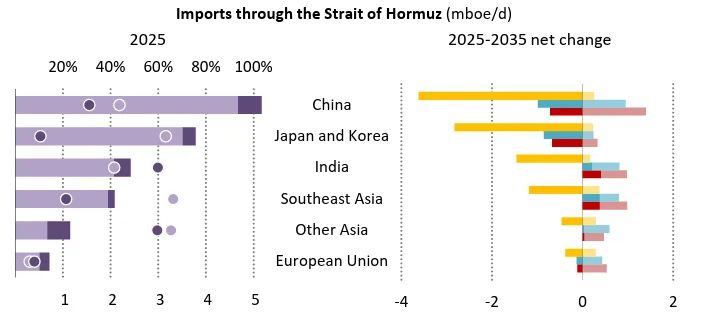
Under a scenario in which risks to maritime shipping through the Strait of Hormuz persist, investment in alternative pipelines, new sources of supply and measures to reduce oil demand could substantially reduce the volume of crude transported through the strategic waterway.
Before the crisis, approximately 20 million barrels of oil passed through the Strait of Hormuz each day. Under this scenario, flows could fall to 8.5 million barrels per day by 2030 and less than 2 million barrels per day by 2035.
Even in that case, the Middle East would remain the world’s largest oil-exporting region.
The IEA also considers an alternative outcome. A resolution of the conflict could support a recovery in oil and gas supplies, particularly as new liquefied natural gas (LNG) capacity enters the market.
An increase in available supply could, in turn, put downward pressure on energy prices.
The energy transition is still falling short of global climate goals
Despite the accelerating deployment of low-emission technologies, the world remains far from achieving the objectives of the Paris Agreement.
According to IEA projections, scenarios based on current and announced policies would lead to approximately 2.9°C and 2.5°C of global warming, respectively, by 2100.
Both outcomes remain significantly above the pathway needed to limit global temperature increases to 1.5°C.
The agency also examined a scenario in which new energy policies currently under consideration by governments are fully implemented.
Under those conditions, global energy trade could decline by approximately 5 million barrels of oil per day and 300 billion cubic meters of natural gas by 2035.
The growing alignment between energy security and decarbonization is one of the report’s defining themes.
As Birol emphasized, policies designed to strengthen energy security, including investments in solar, wind, nuclear power and electric vehicles, are increasingly converging with measures to combat climate change.
In most cases, the two objectives are now closely aligned.


