
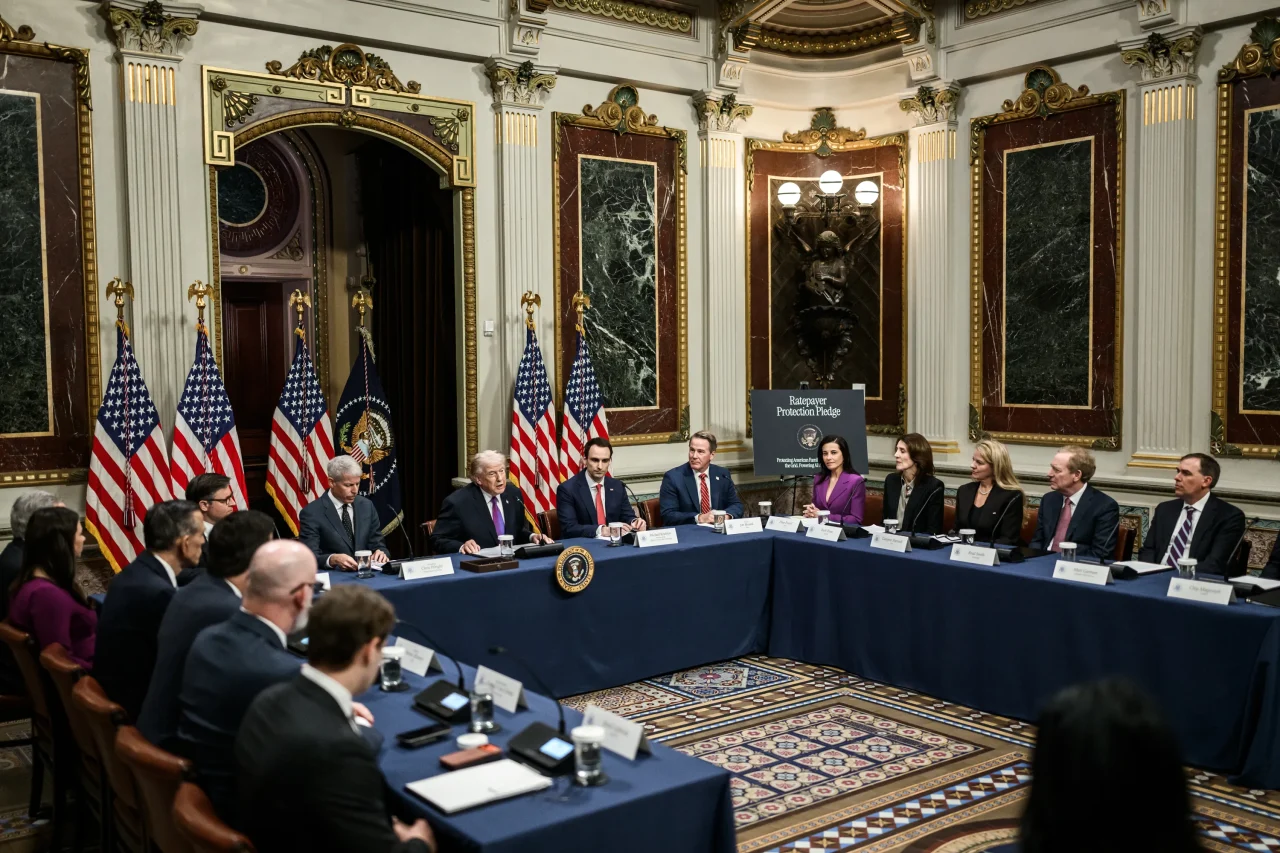

Major technology companies including Amazon, Google, Meta and Microsoft have pledged to cover the electricity costs of new AI data centers in the United States. The initiative aims to ensure that the rapid expansion of artificial intelligence infrastructure does not increase electricity bills for households or place additional financial pressure on utility customers.
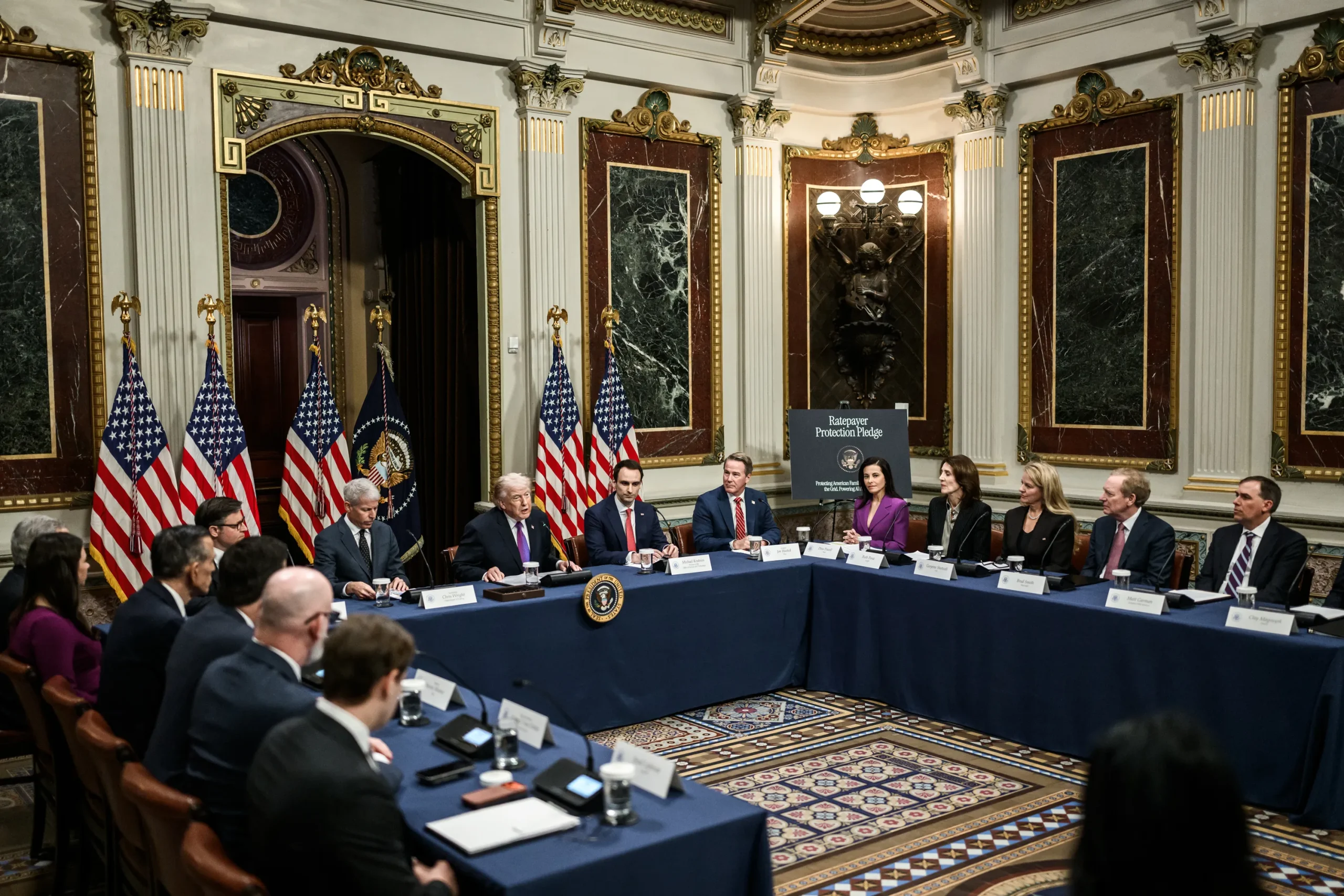
Major U.S. technology companies have pledged to cover the electricity costs associated with new artificial intelligence data centers, responding to growing concern that the rapid expansion of AI infrastructure could place additional pressure on the power grid and eventually raise household electricity bills.
The commitment emerged from a meeting at the White House with several of the companies building the largest AI computing infrastructure in the United States. During the event, firms agreed to what the administration has called the “Ratepayer Protection Pledge,” a framework designed to ensure that the electricity required to power new data centers is financed by the companies themselves rather than passed on to residential customers.
According to the White House, the pledge requires companies to “build, bring, or buy” new electricity generation to meet the power needs created by their facilities. Participating firms also commit to covering the cost of grid upgrades and transmission connections, while negotiating separate electricity rate agreements with utilities. Even if a company does not fully use the capacity reserved for its data center, it must still pay for that power.
The companies involved include Amazon, Google, Meta, Microsoft, OpenAI, Oracle, and xAI, all of which have expanded investments in artificial intelligence infrastructure as demand for computing power accelerates.
President Donald Trump presented the agreement as a way to support the growth of artificial intelligence without increasing electricity costs for households.
“This means the tech companies will get the electricity they need without driving up electricity costs for consumers,” Trump said during the meeting.
AI infrastructure and rising power demand
Electricity demand tied to artificial intelligence has quickly become a central issue for U.S. utilities and regulators. Data centers have always consumed significant amounts of power, but the scale required for large AI models is changing the equation.
A single advanced data center can require hundreds of megawatts of electricity, enough to power a small city. Multiply that across dozens of new facilities, and the impact on regional power systems becomes substantial.
Utilities are already seeing this shift. After years of relatively flat electricity demand, forecasts are now trending upward again. Data centers are widely viewed as one of the main drivers behind that change.
Meeting the new demand will likely require additional generation capacity, transmission lines, and new grid connections. Without new investment, some utilities have warned that the cost of expanding infrastructure could ultimately be spread across all ratepayers.
That possibility has raised concern among regulators and policymakers.
Under the White House pledge, technology companies say they will instead finance the electricity required for their projects. In practice, that could mean building new power plants, purchasing dedicated generation capacity, or funding transmission upgrades needed to connect large computing campuses to the grid.
In some cases, companies may even sell excess electricity back to utilities once their own energy needs are met.
Local concerns around data centers
The rapid expansion of data centers has also begun to generate pushback in some communities.
Concerns often center on electricity demand, land use, and the strain that large industrial facilities can place on local infrastructure.
“People think that if a data center goes in, their electricity prices are going to go up,” Trump said during the White House event, referring to the political sensitivity surrounding new projects.
Several states have already become major hubs for the industry. Virginia, Texas, Arizona, and Ohio host large clusters of data centers thanks to access to land, fiber networks, and energy infrastructure.
Northern Virginia is often described as the world’s largest data center market. Facilities in the region already consume a significant share of the local electricity supply.
Grid operators are increasingly factoring similar developments into long-term planning. Large concentrations of data centers can reshape regional demand patterns, forcing utilities to accelerate infrastructure investments.
Regulation, costs, and the energy transition
Not everyone is convinced the voluntary pledge will fully resolve those concerns.
Because electricity markets in the United States are regulated primarily at the state level, public utility commissions ultimately decide how grid upgrades are financed and how those costs are allocated among customers.
Some energy analysts argue that clearer rules may still be necessary as AI infrastructure expands.
Another open question involves how the additional electricity demand will be supplied. Technology companies frequently highlight their commitments to carbon-free electricity and have signed major renewable energy contracts to power data centers.
But analysts note that AI infrastructure is expanding extremely quickly, and the pace of renewable energy deployment may not always keep up with demand.
Meeting the power needs of future data centers could require a mix of generation sources, including renewable energy, nuclear power, and natural gas.
For policymakers, the situation reflects a broader challenge. Artificial intelligence is increasingly viewed as a strategic economic sector, yet its growth depends on large amounts of physical infrastructure, particularly electricity.
The administration has presented the pledge as an attempt to balance those priorities.
Trump described the agreement as “a historic win for countless American families,” arguing that the expansion of AI can move forward without increasing electricity costs for households.
Whether the voluntary commitment will be enough remains uncertain. Much will depend on how utilities, regulators, and technology companies manage the intersection between digital infrastructure and the power grid in the years ahead.


