

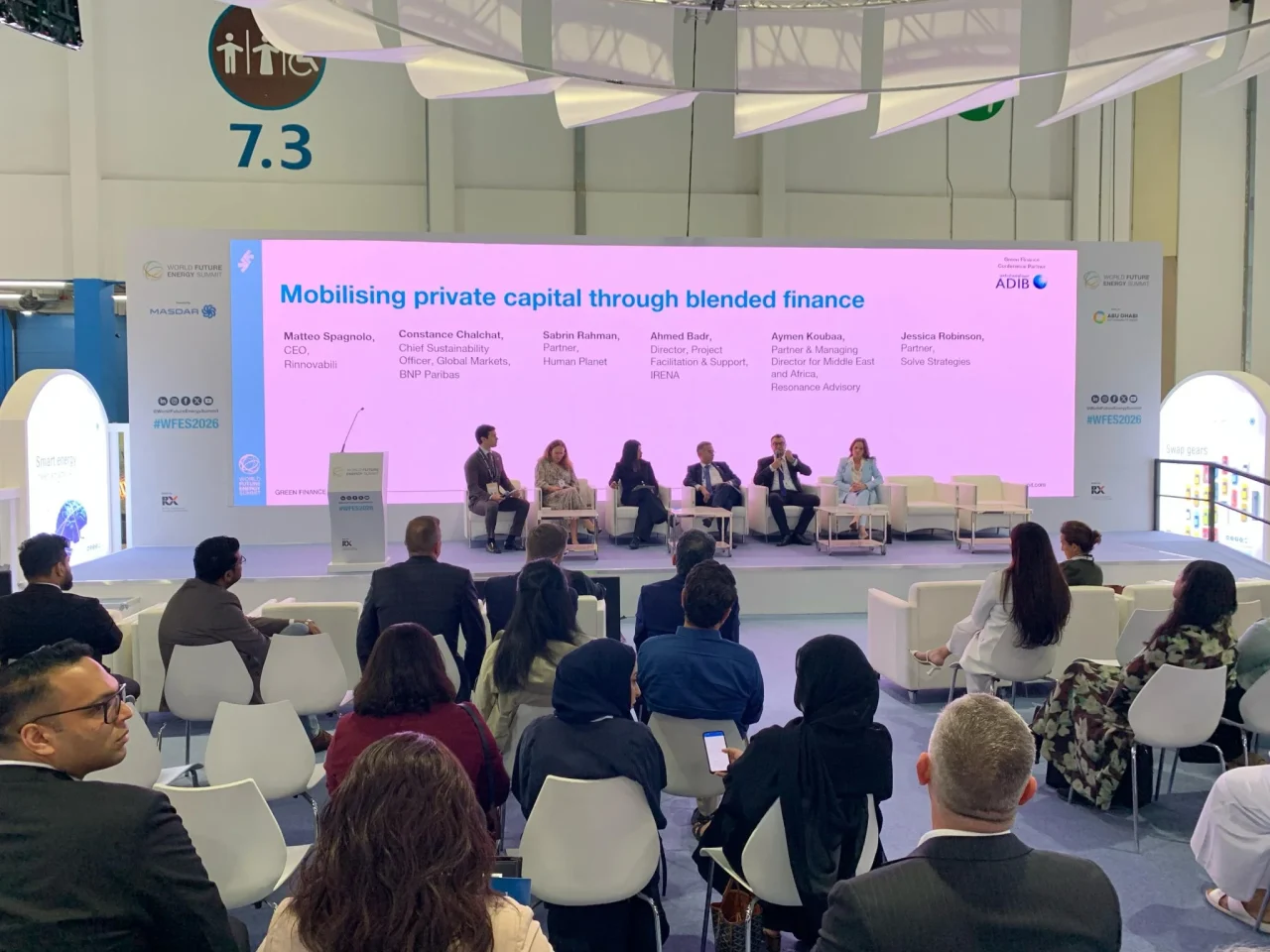
Blended finance is increasingly central to unlocking private capital for the energy transition. The issue was discussed in a dedicated panel moderated by Matteo Spagnolo, CEO of Rinnovabili, on the main stage of the World Future Energy Summit 2026 in Abu Dhabi.

Blended finance and the architecture of risk in the energy transition
The challenge is not a lack of capital, but the way risk is structured. This was the core message that shaped the debate on blended finance at the World Future Energy Summit 2026. Despite more than $18 billion mobilized globally in 2024, the gap between financial commitments on paper and the actual delivery of projects, especially in emerging economies, remains one of the main barriers to the energy transition.
Setting the context was Matteo Spagnolo, CEO of Rinnovabili, who moderated the roundtable on the main stage in Abu Dhabi titled “Mobilising Private Capital Through Blended Finance.” His opening message was unambiguous, blended finance should not be seen as a substitute for private capital, but as a strategic accelerator capable of absorbing first losses and improving the bankability of projects otherwise considered too risky.
“On paper, capital allocated to climate and energy has never been so abundant,” Spagnolo said in his opening remarks. “But in practice, too much of this capital still struggles to reach real projects. This gap between commitment and execution is not a technical detail, it is one of the central constraints of the energy transition.”
Mobilizing private capital at scale
The panel examined the issue from several expert perspectives. Sabrin Rahman of Majra was asked to assess the effectiveness of existing models for mobilizing capital at scale, while the discussion with Ahmed Badr of IRENA focused on the institutional innovations required to make blended finance a mainstream financial tool rather than a niche solution.
Blended finance, risk allocation, and long-term sustainability
Risk, a central element of any structured finance operation, was at the heart of the discussion with Jessica Robinson of Solve Strategies and Constance Chalchat of BNP Paribas. Spagnolo challenged the panelists to address how competitive market returns can be balanced with long-term sustainability outcomes, and which factors truly enable alignment between global banks and development finance institutions.
From structuring to financial close
With Aymen Koubaa of Resonance Advisory, the focus shifted to the final stretch of the process, the critical factors that determine whether a transaction successfully reaches financial close.
In his closing remarks, Spagnolo summarized the shared sentiment of the discussion. The current limitation is neither technological nor purely financial, but lies in coordination between public and private actors. If the tools already exist, the priority for the next three years will be simplification.
“The greatest risk today,” the CEO of Rinnovabili concluded, “is not investing too early, but arriving too late.”


