


The global solar inverter market remains highly concentrated. According to Wood Mackenzie, just 10 manufacturers account for nearly 90% of worldwide inverter supply in the first half of 2025.

Solar inverter manufacturers: the global ranking for H1 2025
Who are the largest solar inverter manufacturers in the world? The answer comes from the latest analysis by Wood Mackenzie, which has updated its global top ten in the report Global Solar Inverter Manufacturer Rankings H1 2025.
The ranking evaluates 23 leading companies that together represent around 90% of total global inverter shipments. Each manufacturer was assessed using eight weighted criteria, giving greater importance to specific strategic factors.
The evaluation criteria include:
- ESG performance (Environmental, Social, Governance/Corporate Social Responsibility), 30%
- After-sales service, 15%
- Research and development activities, 15%
- Supply chain stability, 15%
- Manufacturing capacity utilization, 10%
- Certifications, 5%
- Financial strength, 5%
- Industrial experience, 5%
The solar inverter market outlook
The rankings are published twice a year to reflect the most recent financial and operational performance. The latest results offer a clear snapshot of a market entering a more complex phase.
After record shipment volumes in 2024, the solar inverter market is now facing a slowdown. Analysts expect a 2% decline by the end of 2025, followed by a further 9% contraction in 2026. The main drivers are regulatory and incentive changes affecting solar markets in China, Europe, and the United States.
China’s central role remains undisputed, but manufacturing geography is gradually expanding. Innovation has become a core pillar of investment strategies. High-performance products alone are no longer sufficient. Manufacturers must continuously invest in research and development, accelerate technology upgrades, and adapt to shifting demand patterns. In an increasingly protectionist policy environment, localized production has also become a key competitive factor.
The top 10 solar inverter manufacturers worldwide
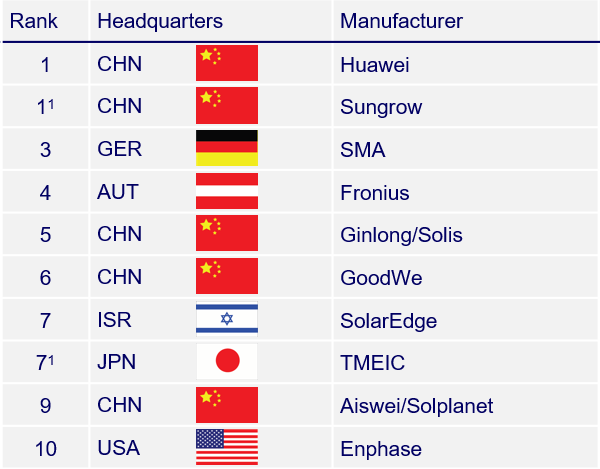
So, who leads the global market today? According to Wood Mackenzie, the top 10 solar inverter manufacturers are:
- Huawei, China
- Sungrow, China
- SMA, Germany
- Fronius, Austria
- Ginlong Solis, China
- GoodWe, China
- SolarEdge, Israel
- TMEIC, Japan
- Aiswei Solplanet, China
- Enphase, United States
Huawei and Sungrow once again take the top positions, with scores of 93.9 and 93.7 respectively. Both companies have led the ranking for 11 consecutive years. Europe’s established manufacturers, SMA and Fronius, secure fourth and fifth place, reaffirming their relevance at the high end of the market.
Beyond the ranking numbers
Some of the most meaningful insights lie beyond the headline positions. Six of the top 10 solar inverter manufacturers have achieved EcoVadis ratings of Silver level or higher, reflecting strong performance in environmental impact, labor practices, ethics, and sustainable procurement.
In addition, all 10 companies now offer product warranties of 20 years or more, a clear signal of increased confidence in long-term reliability and efficiency.
Reinvesting in research and development
Despite continued price pressure driven largely by Chinese manufacturing competition and technological progress, innovation remains the main battleground. According to Wood Mackenzie, eight of the top 10 manufacturers reinvest more than 6% of their annual revenue into research and development, expanding their patent portfolios and accelerating digitalization and product upgrade cycles.
“The global inverter landscape in 2025 is led by a diverse group of power electronics leaders that combine scale with innovation,” said Timothy Shen, senior research analyst at Wood Mackenzie. “Competitive advantage is increasingly defined not just by shipment volumes, but by ESG leadership, service quality, and resilient supply chains.”
Shifting industrial geographies
Manufacturing footprints are also evolving in response to global trade dynamics. Four of the top 10 solar inverter manufacturers now operate globally distributed production networks, with facilities in China, Europe, India, the United States, Southeast Asia, and Israel.
“The strongest performers are those leveraging regionalized assembly strategies,” Shen added. “This approach allows manufacturers to meet local content requirements and navigate import barriers while maintaining supply reliability.”


