


A new study quantifies the global economic damage from individual country emissions. The US emissions impact is substantial, costing over $10 trillion globally since 1990.

Precisely quantifying the global economic damage: the US emissions impact
A new study, published in Nature, has attempted to quantify in monetary terms the concept of “loss and damage” or L&D, an expression used to refer to the harm suffered by societies due to the rise in global temperatures caused by fossil fuels. Until now, there was no quantitative definition of L&D, nor a framework to link past and future emissions from specific sources to localized, monetizable damages.
Thus, the novelty of the study, led by Marshall Burke of Stanford University, is this: it has calculated for the first time in precise monetary terms the global economic damage caused by individual countries’ emissions.
Using empirical estimates of the relationship between temperature and aggregate economic output, the study demonstrated that future damages stemming from past emissions, a fundamental component of L&D, are greater than historical damages caused by the same emissions.
For example, it emerged that:
- one ton of CO2 emitted in 1990 caused $180 in global damages by 2020 and will cause another $1,840 by 2100.
- A single long-haul flight per year, taken in the last decade, will result in almost $25,000 in future damages by 2100.
- Clear national responsibility: the United States’ emissions since 1990 have caused estimated damages of $500 billion in India and $330 billion in Brazil.
The US emissions impact: $10 trillion in global climate damages
Greenhouse gas emissions from the United States since 1990 have caused over $10 trillion in global economic damages (up to 2020). This figure exceeds that of any other country. China follows, responsible for $9 trillion in global GDP damage since 1990. Nearly 25% of this GDP contraction occurred within the United States itself. Thus, a quarter of the damage impacted the US. Low-income countries have paid a heavy price because economic losses have disproportionately affected them.
The research explains that settling debts for past damages is not equivalent to settling debts for past emissions. In summary, it is not enough to repair the damage already caused, because yesterday’s emissions will continue to erode the world economy for decades to come. In this context, carbon removal stands as an alternative to monetary transfers for regulating L&D but becomes increasingly less effective in limiting damages as the time interval between emission and capture increases.
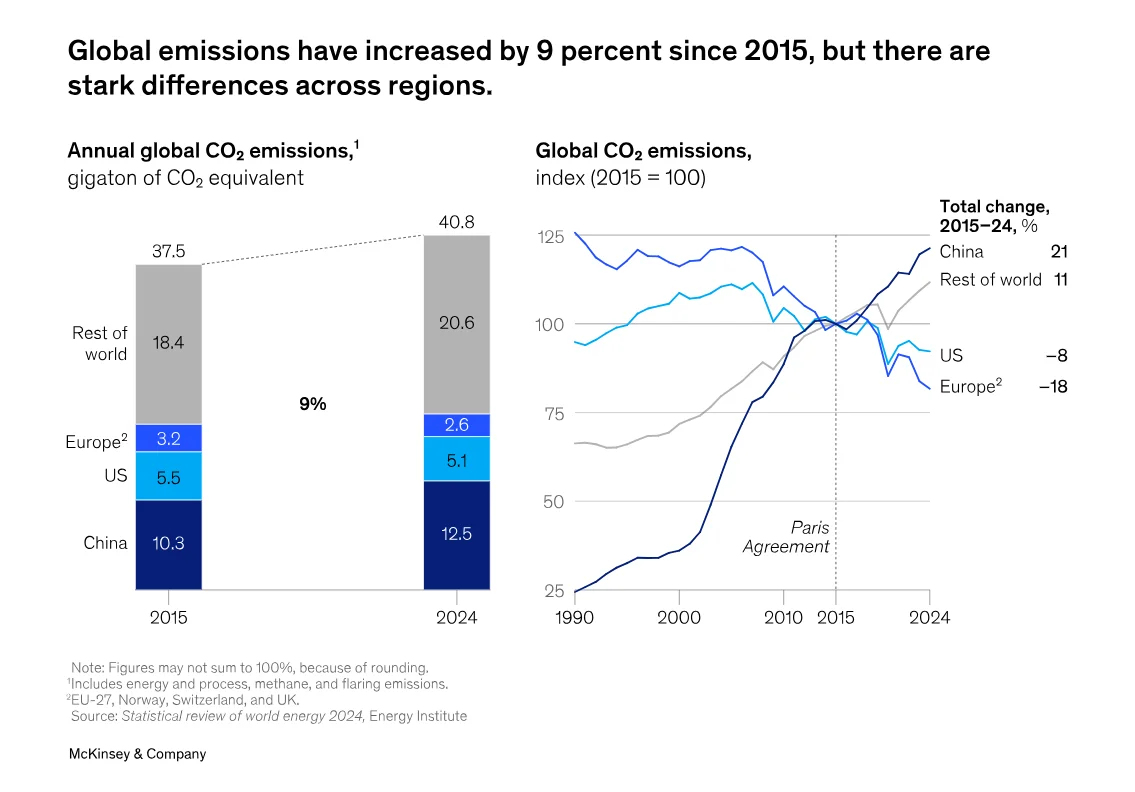
Global CO2 emissions increased 9% since 2015, highlighting the ongoing US emissions impact
Amidst all this, another analysis revealed that global CO2 emissions have increased by 9% since the 2015 Paris Agreement. The world is therefore not yet in line with decarbonization targets for 2030 or 2050. However, the overall figure conceals divergent trajectories across different regions of the planet. Analysts at McKinsey observe that while Europe and the United States have reduced their emissions by 18% and 8% respectively, these cuts have been more than offset by increases recorded elsewhere. Although China’s emissions have recently been stable, since 2015 they have generally increased by 21%. Those of the rest of the world, on the other hand, have grown by 11%. Furthermore, according to the latest WMO report, the years between 2015 and 2025 have emerged as the 11 warmest years since records began.
Go to the study published in Nature


