


A new Carbon Majors analysis shows that a small group of fossil fuel producers is driving world CO2 emissions, raising questions about accountability and political will.

World CO2 emissions concentrated in a handful of fossil fuel producers
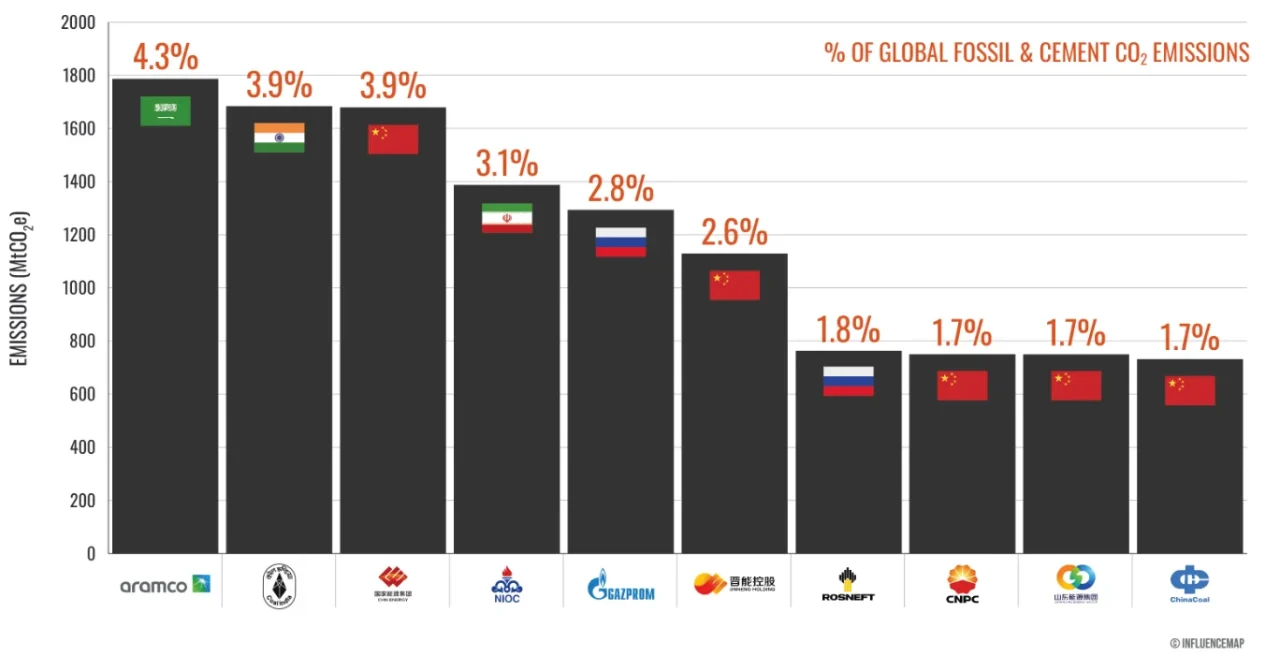
Only 32 companies were responsible for more than half of world CO2 emissions from fossil fuels in 2024. According to the latest Carbon Majors data, the top 10 companies alone accounted for 27.6% of global fossil CO2 emissions. All of these leading emitters were fully or majority state owned.
The Carbon Majors database attributes 34.7 billion metric tons of CO2 equivalent in 2024 to 166 oil, gas, coal, and cement producers, an increase of 0.8% compared with 2023.
State owned fossil fuel producers dominate the global rankings
State owned fossil fuel producers make up 17 of the world’s top 20 emitters, according to the Carbon Majors report. All 17 are controlled by governments that opposed proposals to phase out fossil fuels during COP30. These include Saudi Arabia, Russia, Iran, and the United Arab Emirates, despite support for the plan from more than 80 countries.
The database shows that state owned fossil fuel companies caused 54.0% of world CO2 emissions in 2024, while 93 privately owned companies accounted for 23.7%. This year’s analysis also finds that most state owned companies, 54%, increased emissions year over year. By contrast, a majority of private companies, 57%, reduced their emissions.
Historical responsibility for world CO2 emissions
Historically, about 70% of global CO2 emissions from fossil fuels and cement between 1854 and 2024 can be traced back to 178 producing entities. More than one third of that total is attributable to just 22 companies.
The report also shows that emissions from investor owned companies declined in the 1970s during the oil crisis and only rebounded in the 1990s. Emissions linked to state controlled fossil fuel companies, by contrast, have grown steadily over the decades.
Corporate accountability and the climate crisis
The findings underline how global emissions are increasingly concentrated among a shrinking group of producers. In 2024, just 32 companies were responsible for more than half of global fossil CO2 emissions, down from 38 companies five years earlier, even as total production continues to rise.
This concentration helps explain why political momentum to tackle global warming is lacking in some countries. The report highlights the central role of corporate responsibility in addressing climate change. A recent study linked 213 heat waves to emissions from 180 fossil fuel companies, showing how the activities of major carbon producers have directly contributed to extreme events that would not have occurred without global warming.
Christiana Figueres, former executive secretary of the UNFCCC and co founder of Global Optimism, said: “The latest Carbon Majors data once again show that the biggest emitters are on the wrong side of history. We should be accelerating progress toward a clean energy future that delivers greater energy security, affordability, and freedom. Instead, these emitters continue to block the way. While clean energy and electrification already receive nearly twice the global investment of fossil fuels, major carbon producers cling to outdated and polluting products and continue to mislead the public about the urgent real world consequences of their actions. They will not stop us for long.”
Who are the biggest polluters
In 2024, Saudi Aramco was the largest state owned polluter, while ExxonMobil was the largest investor owned emitter. Saudi Aramco was responsible for 1.7 billion metric tons of CO2, much of it linked to oil exports. ExxonMobil’s fossil fuel production generated about 610 million metric tons of CO2.
The five largest private companies, ExxonMobil, Chevron, Shell, BP, and ConocoPhillips, accounted for 5.5% of global fossil CO2 emissions in 2024. This is far below the 18% share attributed to the five largest state owned entities: Saudi Aramco, Coal India, CHN Energy, National Iranian Oil Co., and Gazprom.


