


Global climate data from Copernicus show that 2025 was the third warmest year ever recorded, confirming a sustained warming trend that is pushing the planet beyond critical thresholds.

Copernicus data confirm 2025 as the third hottest year ever recorded
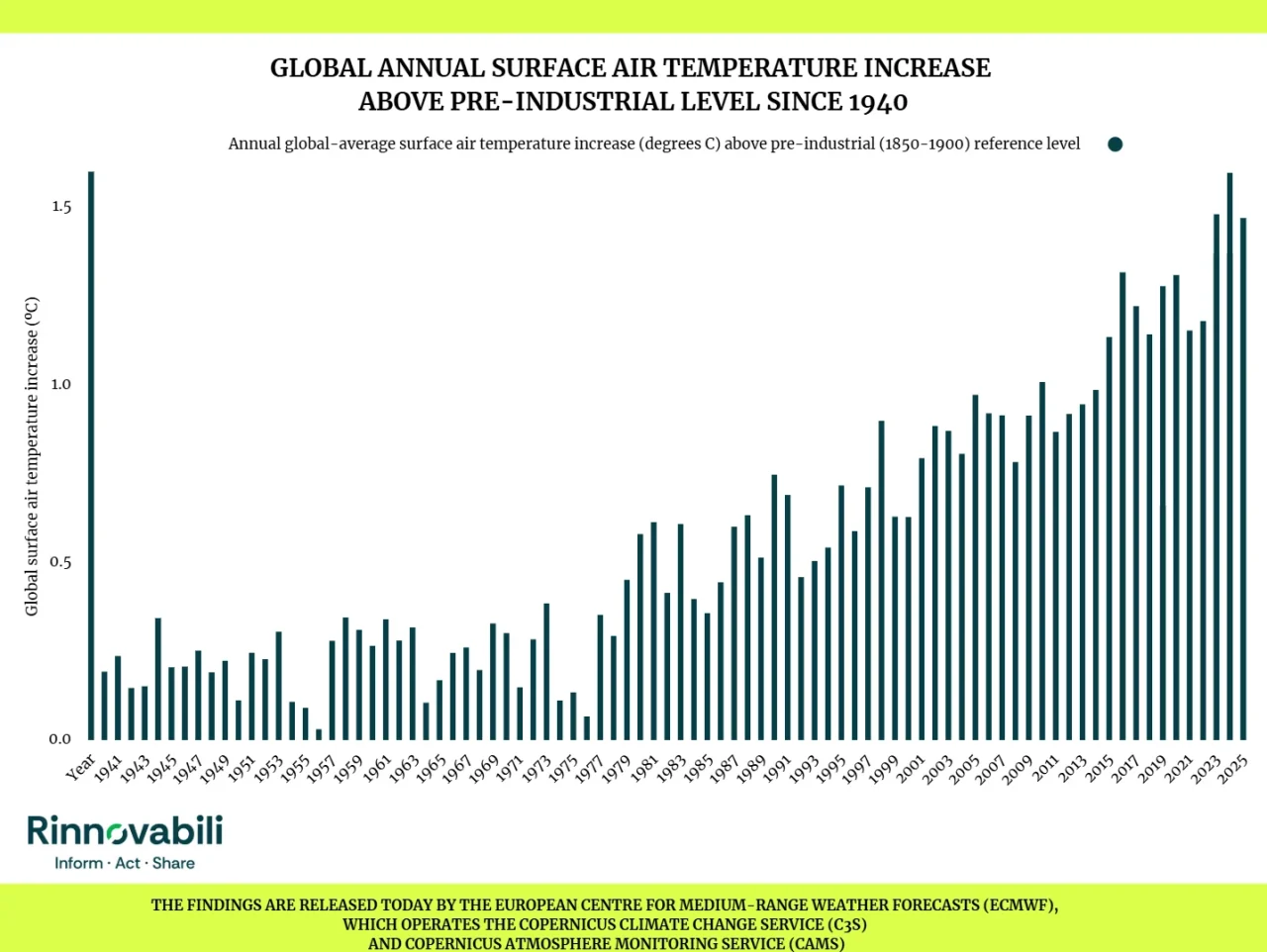
According to data from the European Copernicus program, 2025 ranked as the third hottest year ever recorded, just 0.01 °C cooler than 2023 and only 0.13 °C cooler than 2024, which remains the warmest year on record. The figures also show that the last eleven years have been the eleven warmest ever observed globally.
A three-year period above the 1.5 °C threshold for the first time
Global temperatures over the last three years, from 2023 to 2025, averaged more than 1.5 °C above pre-industrial levels, defined as the 1850–1900 baseline. This is a significant milestone, as it marks the first time a three-year period has exceeded the 1.5 °C limit identified as the upper safety threshold for global warming.
Land surface air temperatures reached record highs worldwide. Antarctica recorded its warmest annual temperature ever, while the Arctic experienced its second warmest year on record.
The findings were published on January 14 by the European Centre for Medium-Range Weather Forecasts, which operates the Copernicus Climate Change Service and the Copernicus Atmosphere Monitoring Service on behalf of the European Commission.
Heat stress and wildfires intensified in 2025
In 2025, roughly half of the Earth’s land surface experienced more days than average with at least strong heat stress, defined as a perceived temperature of 32 °C or higher. According to the World Health Organization, heat stress is the leading cause of weather-related deaths worldwide.
In dry and windy regions, extreme heat also contributed to the spread and intensification of wildfires. This occurred in parts of Europe, where total annual emissions from wildfires were particularly high, as well as in North America. These emissions significantly degraded air quality, with potentially harmful effects on human health both locally and across wider regions.
The year was also marked by major extreme events across multiple continents, including record-breaking heatwaves, severe storms in Europe, Asia, and North America, and large wildfires in Spain, Canada, and Southern California. While these individual events are not analyzed in detail in the report, they provide important context for understanding the scale of climate-related damage observed in 2025.
Carlo Buontempo, Director of the Copernicus Climate Change Service, said:
“The fact that the last eleven years have been the warmest on record provides further evidence of the unequivocal trend toward a warmer climate. The world is rapidly approaching the long-term temperature limit set by the Paris Agreement. We are on track to exceed it, the choice we face now is how best to manage that inevitable overshoot and its consequences for societies and natural systems.”
Temperature anomalies driven by greenhouse gases and ocean warming
The exceptional warmth recorded between 2023 and 2025 can be attributed to two main factors. The first is the accumulation of greenhouse gases in the atmosphere, driven by ongoing emissions and a reduced capacity of natural carbon sinks to absorb carbon dioxide. The second factor is unusually high sea surface temperatures across global oceans.
Scientists link this ocean warming to the effects of El Niño and other modes of ocean variability, all of which are being amplified by human-driven climate change. As in 2023 and 2024, large portions of the globe recorded above-average temperatures throughout 2025.
Lower tropical temperatures compared with 2023–2024 are explained by the persistence of La Niña conditions. By contrast, the higher temperatures observed in the previous two years were partly influenced by a strong El Niño event, which tends to raise global temperatures on top of long-term anthropogenic warming. In 2025, sea surface temperatures in the tropical Atlantic and the Indian Ocean were also less extreme than in 2024.
Higher temperatures in polar regions partially offset cooler conditions in the tropics. Annual average temperatures reached record highs in Antarctica and the second-highest level ever recorded in the Arctic. Other regions also experienced record annual temperatures, including parts of the northwestern and southwestern Pacific, the northeastern Atlantic, Eastern and Northwestern Europe, and Central Asia.
Europe and the world are experiencing the warmest decade on record
“This report confirms that Europe and the world are going through the warmest decade ever recorded, and that the European Commission’s investment in the Copernicus program remains essential,” said Florian Pappenberger, Director General of the ECMWF. “As an international organization serving 35 countries, ECMWF provides world-leading scientific knowledge to support informed decision-making and, ultimately, concrete action to adapt to climate change. Every year and every degree matter. Preparedness and prevention remain possible, but only when action is guided by robust scientific evidence.”


