

Strategic copper, vital for global growth and energy transition, faces critical supply shortfalls. Production struggles to meet soaring demand from tech and renewables.
The critical state of the strategic copper market
Copper (Cu): in use for at least 10,000 years and now more than ever a strategic element for economic growth and global development. Yet today, this metal is experiencing a critical phase that could pose a systemic risk to global industries and the growth in electricity demand, directly impacting the successful outcome of the energy transition. Despite the enormous global copper reserves – estimated at around 1014 tons in the first kilometer of the Earth’s crust – in the medium term, supply may not keep pace with demand. So much so that several industry analysts now fear the possibility of an imminent supply deficit, which could become structural in just 4 years.
The cause? The convergence of several factors, primarily increasing energy hunger and still limited mining production, severely impacted in 2025, particularly by strikes, technical failures, and natural disasters.
In reality, the difficulties faced by the copper market are not entirely unexpected. That the metal needed special attention, at least in Europe, has been known since 2023 when the EU Commission decided to include it for the first time on the list of critical strategic raw materials for the transition. And it is not the only power to have raised its awareness threshold on the issue.
“Over the past five years, several countries have classified copper as a ‘critical metal,’ including, in 2025, the United States. And for good reason,” said Carlos Pascual, Senior Vice President for Geopolitics and International Affairs at S&P Global Energy. “Copper is the connecting artery between physical machinery, digital intelligence, mobility, infrastructure, communication, and security systems; the future availability of strategic copper has become a matter of strategic importance.”
Strategic copper: Who controls the supply chain?
Looking at the supply chain, not all problems may be immediately identifiable. As anticipated, potential mineral reserves make it a substantial and theoretically well-distributed resource (it is the 26th most abundant element in the Earth’s crust). Current extraction activities themselves appear geographically diversified, albeit dominated by a few large global players.
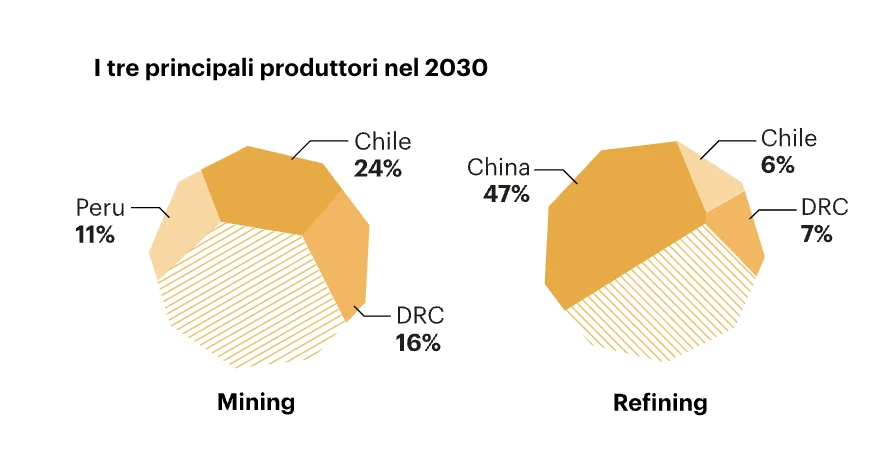
Chile is indisputably positioned as the leading global producer with a share of approximately 24% of total mining extraction (2024 data). This is followed by the Democratic Republic of Congo, Peru, and China (which, however, controls strategic investments in Africa and Latin America). Completing the list of main extracting countries, but with smaller shares compared to the top four, are the United States, Australia, Indonesia, Russia, Zambia, Canada, and Mexico.
Refining activity appears more concentrated. In this case, China dominates, controlling between 45% and 51% of global smelting and purification capacity. Two years ago, the Congo supplanted Chile (7%), becoming the world’s second-largest copper refiner, with an 8% share of global supply, while Japan and India complete the top five.
This market distribution is not expected to change significantly in the near future.
Production challenges
On paper, it’s a powerful machine, annually producing approximately 26.9 million tons of refined copper (2024 data, up from 25 million in 2021).
Production side problems are hidden in the structural or non-structural fragilities of the supply chain, which in 2025 were particularly exacerbated by a series of incidents, which in turn triggered an unprecedented crisis for smelters.
| Mining Asset | 2025 Disruption Event | Impact on Production/Outlook |
|---|---|---|
| Kamoa-Kakula (DRC) | Seismic activity and flooding (May 2025) | 30% reduction in projected output for 2026 |
| El Teniente (Chile) | Structural collapse of an operational tunnel (July 2025) | Severe constraints on concentrate supply from the world’s largest producer |
| Grasberg (Indonesia) | Major landslide at the mining site (September 2025) | Immediate supply shock; primary driver of record LME prices in January 2026 |
It should be noted that production suffers from chronic and well-known problems, intensified recently. The geological quality of the mines and thus of the extracted metal appears to be in constant decline, especially in South America. The need to dig at ever-greater depths, combined with the effects of inflation and high energy costs in recent years, has led to a 37% increase in marginal production costs between 2019 and 2025.
It is also not easy to inaugurate new extraction sites: on average, it takes 17 years for a new copper mine to go from discovery to production.
But the climate crisis also weighs heavily. In 2024, approximately 7% of the global copper supply was considered at risk of disruption due to drought or floods, a risk that industry estimates suggest will increase by 30% by 2030, endangering almost 2 million tons of annual production.
What’s happening to copper smelters?
Last year, the treatment and refining charges that smelters levy on miners plummeted, becoming negative in 2025. In practice, plants began paying miners for ore just to keep facilities active, consequently reducing the profitability of these structures. This pushed Chinese smelters, in particular, to announce a production cut (-10% for 2026).
If all this were not enough, geopolitical tensions further complicate the situation. Primarily those caused by the tariff battle between the United States and China, but also the Middle East conflict will have its effects, although not directly.
Iran, in fact, is a relatively small copper supplier, and production has so far not suffered major repercussions, as most facilities are located far from war zones. Other extractive activities in the region, particularly in Oman and Saudi Arabia, also appear small and distant from conflict-affected areas. “The copper market’s exposure largely stems from the indirect effects of a broader conflict impacting economic growth more widely,” WoodMac analysts write.
What appears certain, however, is that after a probable production peak in 2030 (up to 27 Mt of Cu), supply will decline. Without massive new investments in mining, between aging sites and declining ore quality, production is destined to drop drastically to 15-22 Mt by 2040.
Global demand for strategic copper
While production stumbles between historical fragilities and new incidents, copper demand runs relentlessly, and this is where the real problems begin.
The global demand for Cu is evolving from an indicator of traditional economic cycles into a litmus test for the energy transition, national security, and digitalization. The main driver of overall demand, however, remains, and will continue to be, linked to general economic development, relying on “legacy” segments such as construction, industrial machinery manufacturing, household appliances, traditional transport, and grid infrastructure. Excluding power infrastructure, total cumulative demand across these segments is expected to grow at around 2% annually, reaching 23 million tonnes by 2040.
On top of this, new intensity multipliers are emerging, from electric vehicles to renewable energy, as well as data centers and defense modernization.
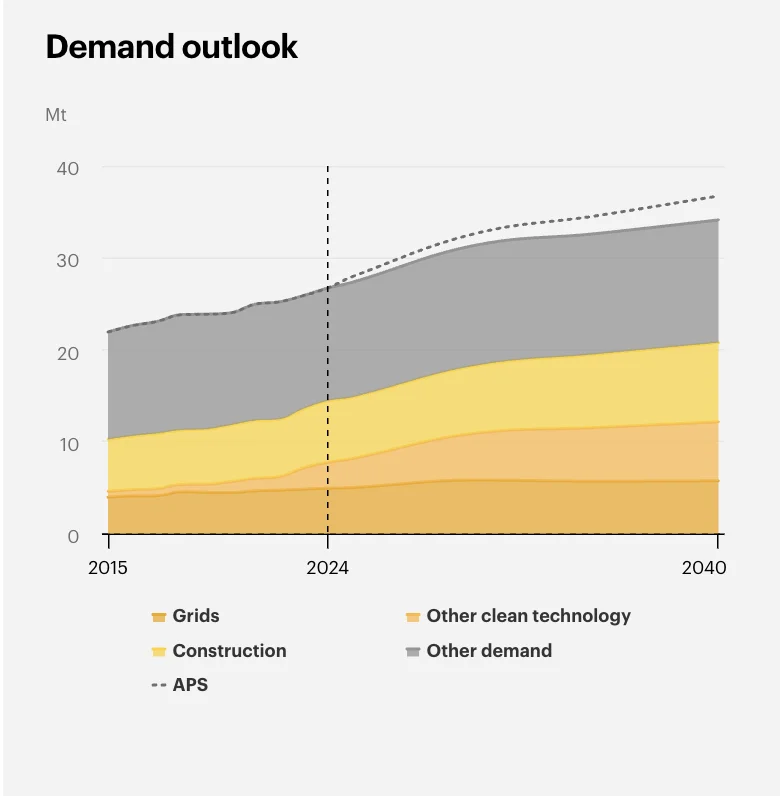
Specifically, the energy transition sector – which also includes a massive expansion of electricity transmission and distribution networks – is expected to generate the largest net increase in copper demand by 2040 (+7.1 million tons). Demand for data centers will double, rising from 1.1 to 2.5 million tons by 2040. Demand related to defense (advanced weapon systems, on-board electronics, munitions, drones, submarines, etc.) is projected to triple by 2040, reaching approximately 1 million tons annually.
Ultimately, global copper demand is expected to increase by 50% by 2040, rising from 28 million tons in 2025 to 42 million tons.
“Economic demand, grid expansion, renewable energy generation, AI, digital industries, electric vehicles, and defense are growing simultaneously, and supply cannot keep pace,” Daniel Yergin, Vice Chairman of S&P Global, stated. “At stake is whether copper will continue to be an enabler of progress or become a bottleneck for growth and innovation.”
Bridging the supply gap
What clearly emerges from these initial data is how a conspicuous gap between supply and demand will form by 2040, only partially covered by secondary supply. It is estimated that copper scrap recycling will double its contribution to reach approximately 10.4 Mt by 2040, leaving approximately 10 million tons or more uncovered.
“Primary production – meaning mining – remains the irreplaceable foundation of copper supply,” said Eleonor Kramarz, Global Head of Critical Minerals and Energy Transition Consulting at S&P Global Energy. “Closing the imminent supply deficit depends not only on geology, engineering, logistics, and investment, but also on governance and policy. This translates into rapid permitting and consultations, tight timelines for litigation, and stability in governance and regulation. The alternative is uncertainty, and uncertainty comes at a high cost.”


