


Artificial intelligence has become a global economic force, but its future as a common good depends on how it consumes and transforms energy. Balancing innovation with sustainability is now the defining challenge.

The energy behind artificial intelligence
Hans Georg Gadamer (1900–2002) once said that culture is the only primary good that increases in value when shared. He could not have foreseen the disruptive rise of artificial intelligence (AI). Yet, if we imagine a future where AI truly serves the common good, representing collective interests, subsidiarity, and reciprocity, it must advance in harmony with social well-being and environmental protection. The key to achieving that balance lies in the energy that powers AI.
Over the past decade, artificial intelligence has evolved from an academic pursuit into an industry worth trillions in market capitalization and venture capital. The market value of AI-linked companies in the S&P 500 has soared. By the end of 2024, U.S. stocks had an exceptional year, with the S&P 500 gaining 24% in dollar terms. The rapid growth of AI has turned it into a central force in corporate strategy, economic policy, and geopolitics, despite ongoing uncertainty about its long-term impact.
Among the most strategic of these uncertainties is AI’s relationship with energy. Consider this: the one trillion messages exchanged annually on ChatGPT account for just 1% of global data center electricity consumption, yet they generate around 200,000 tons of CO₂ emissions each year.
Artificial intelligence requires enormous amounts of energy, but it also has the potential to accelerate the clean energy transition toward decarbonization.
Powering AI sustainably
The possibility of defining AI as a common good depends largely on its energy source and how it is distributed. What type of energy will it use? How will it be delivered? What will the operational model look like?
A responsible approach to AI development demands sustainable, affordable, reliable, and secure electricity. AI data centers are massive and energy-intensive: a typical facility today consumes as much power as 100,000 households. Within the next decade, that figure is expected to rise twentyfold.
In 2024, data centers accounted for about 1.5% of global electricity use, roughly 415 terawatt-hours per year, 30% more than Italy’s total electricity consumption. The United States represented 45% of global data center energy use, followed by China (25%) and Europe (15%). Worldwide, data center electricity consumption has increased by about 12% annually since 2017, four times faster than overall electricity demand.
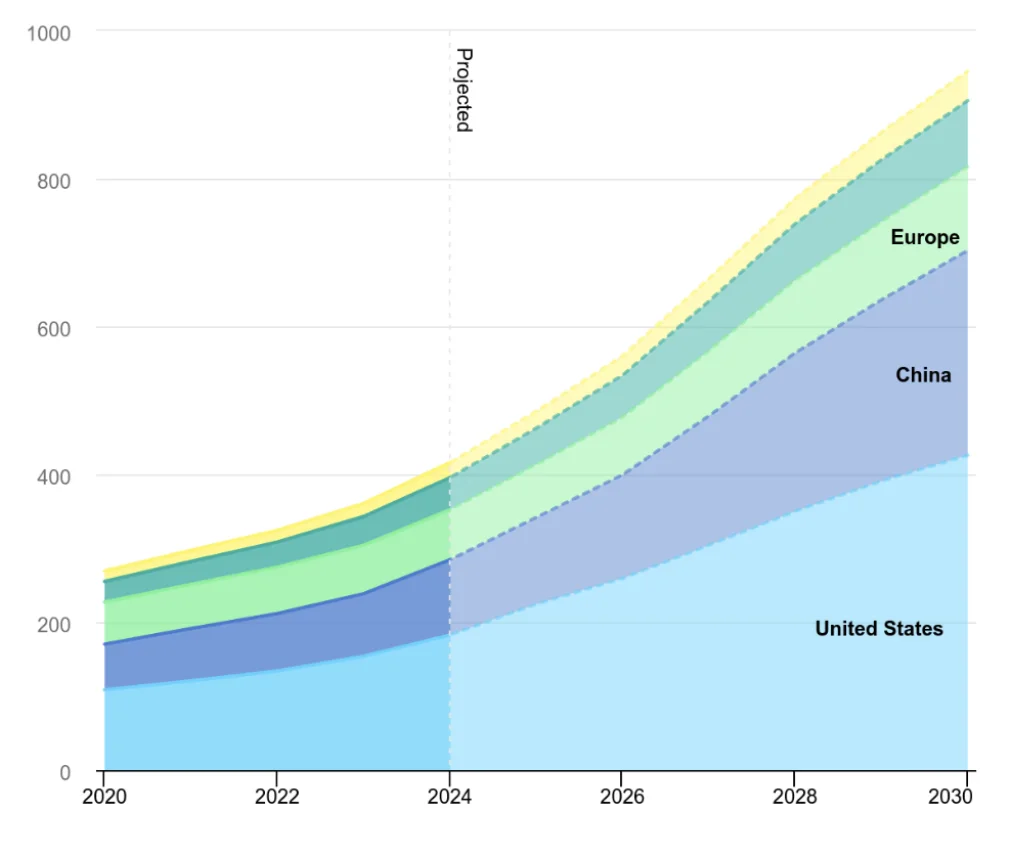
According to the International Energy Agency (IEA, 2025), global data center electricity demand is projected to more than double by 2030, reaching about 1,200 TWh per year by 2035. AI is the primary driver of this growth, alongside the expanding digital economy. In the United States, data centers could account for nearly half of total electricity demand growth through 2030. By the end of the decade, they may consume more power than the entire U.S. production of aluminum, steel, cement, chemicals, and other energy-intensive goods combined.
Ideally, the total projected electricity demand of data centers by 2035, around 4.5% of the global total, should be supplied by renewable energy. That equates to 1,200 TWh per year out of roughly 17,000 TWh generated from renewables, significantly exceeding the IEA’s 50% coverage forecast. Achieving this will depend on expanding storage capacity and strengthening the grid to meet security requirements, supported by the growing economic competitiveness of renewable sources.
Because data centers will drive 10–20% of the world’s electricity demand growth through 2030, their expansion must align with decarbonization strategies. Otherwise, they risk conflicting with other priorities such as electrification, industrial growth, and affordability.
Key risk-mitigation strategies include siting new data centers in high-capacity regions, ensuring sufficient grid availability, and promoting flexible management of servers, on-site generation, and energy storage.
AI as an accelerator for energy efficiency
At the same time, AI itself can transform the energy sector by improving efficiency, reliability, and operations. According to the IEA (2025), utilities are increasingly using AI to cut costs, improve supply chains, extend asset life, reduce downtime, and lower emissions through smarter production, maintenance, and management systems.
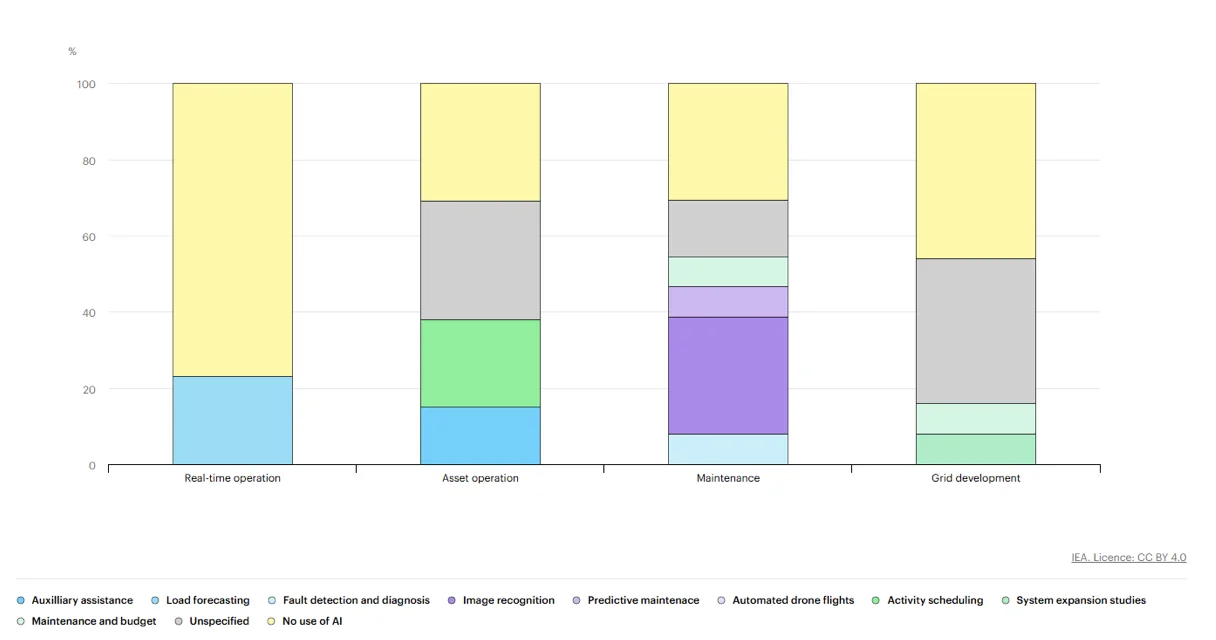
Artificial intelligence can help balance increasingly complex, decentralized, and digitalized power grids. It can enhance the forecasting and integration of variable renewable generation, reducing curtailment and emissions. AI-based fault detection can identify and locate grid failures faster, shortening outages by 30–50%. Remote sensors and AI-driven management systems can increase transmission line capacity, potentially unlocking up to 175 gigawatts of additional capacity, without building new lines. This gain could offset much of the additional data center energy demand expected by 2030.
AI applications in transport and buildings can also deliver major efficiency gains and cost savings when deployed strategically. Accelerating innovation may be one of AI’s most profound long-term contributions to the energy sector, provided it aligns with decarbonization goals. Examples include faster and more accurate weather forecasting for wind and solar production, real-time monitoring and optimization of transmission lines, and AI-driven discovery of new battery materials.
Artificial intelligence thus represents a crucial asset for scientific progress, shortening technology learning cycles and advancing research into next-generation materials and critical raw supplies. Closer collaboration between the technology and energy sectors will be essential, supported by robust data and analysis to guide decisions and prepare both industries for the expanding adoption of AI.


