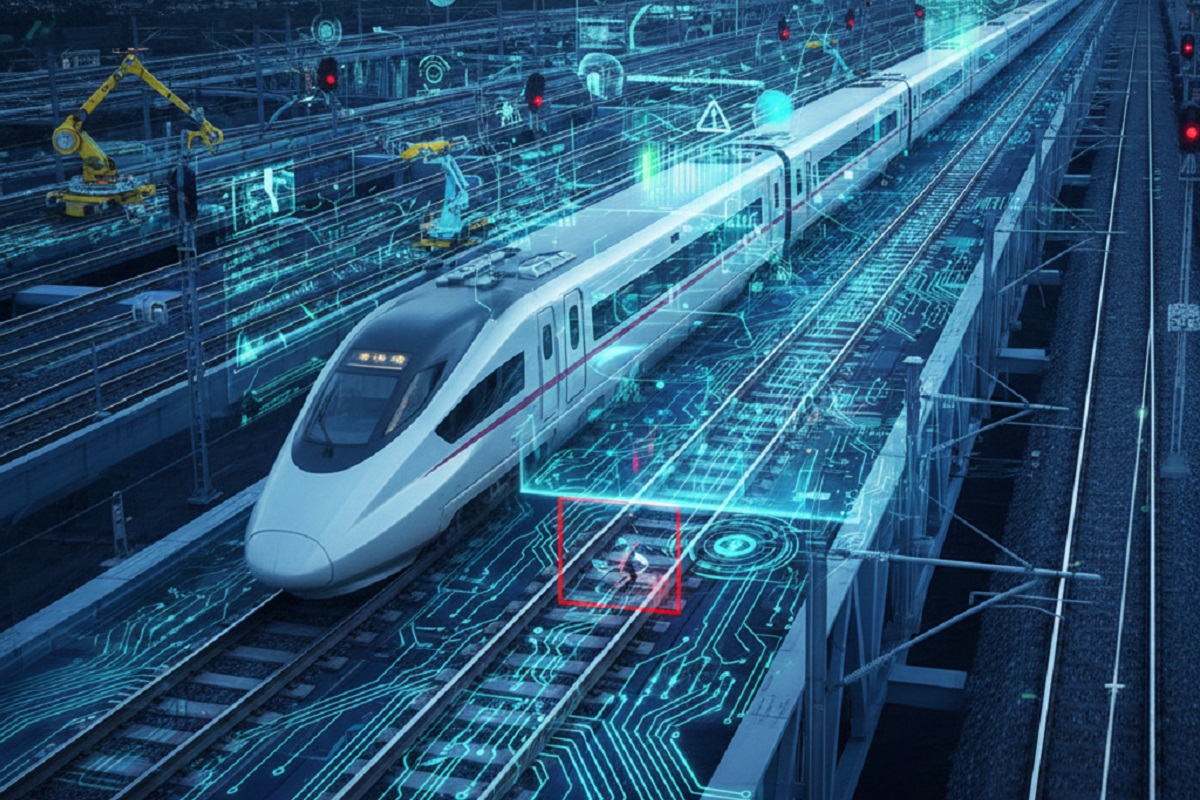
How AI enhances rail safety through predictive maintenance
Rail infrastructure forms a complex system constantly exposed to stress from wear, aging, and environmental conditions, all of which can lead to failures that compromise rail safety. Traditionally, inspection and maintenance of critical assets such as tracks, bridges, tunnels, and signaling equipment have relied on conventional methods. These approaches are manual and periodic, which makes them costly, time consuming, and inherently vulnerable to human error.
How AI applies to track maintenance
The periodic nature of these inspections severely limits operators’ ability to detect rail safety issues in their earliest stages, delaying intervention and increasing the likelihood of unexpected disruptions or, in the worst cases, accidents. Modern mobility demands real-time monitoring and more efficient predictive maintenance.
A recent study published in the International Journal of Information and Communication Technology introduces an innovative solution powered by artificial intelligence. A longstanding challenge in this field has been the scarcity and imbalance of failure data, since some anomalies occur so infrequently that training a reliable machine learning model becomes extremely difficult.
AI techniques improving fault detection for rail safety
At the core of the new methodology is the ability to overcome data scarcity through advanced Deep Learning and Data Synthesis techniques. The system integrates two pioneering methods to build a more robust and balanced training dataset:
- ESMOTE (Enhanced Synthetic Minority Over-sampling Technique):
This synthetic oversampling technique increases the diversity of minority classes, such as rare faults. By grouping similar samples and interpolating between them, ESMOTE generates new data that enrich the representation of underreported fault categories. - CSGAN (Class-Conditional Generative Adversarial Network):
This generative adversarial network produces synthetic samples that accurately mirror the distinctive features of each fault class.
Together, these approaches reduce reliance on manually labeled data and strengthen model stability. After the dataset is prepared, the system extracts key characteristics from operational signals using a Multiscale Residual Network (ResNet), a neural architecture effective at capturing fine-grained patterns while remaining robust to variations in operating conditions.
To ensure the model remains applicable across different rail environments, the study employs an adaptive transfer-learning strategy. This makes it possible to apply knowledge learned from one dataset to another, enabling accurate fault detection even in slightly different contexts.
Benefits for rail operators
The system’s effectiveness was validated through extensive testing, achieving nearly 94 percent diagnostic accuracy. This marks a substantial improvement over earlier models that struggled with manual feature extraction and imbalanced datasets.
Higher precision and real-time detection capabilities provide several practical advantages for rail operators:
- Resource optimization:
Accurate early fault detection allows maintenance teams to prioritize limited resources more effectively, intervening precisely where and when needed. - Reduced service disruptions:
Identifying issues before they escalate into critical failures minimizes unplanned outages, improving network reliability and passenger satisfaction. - Enhanced safety:
Automation and diagnostic accuracy contribute directly to safer, more resilient rail infrastructure.
The research outlines a future in which artificial intelligence evolves from a supportive tool to a foundational element of predictive maintenance and operational management across the rail sector.