


For the first time since 2016, new solar capacity installations in the European Union declined year on year. The latest SolarPower Europe outlook shows why the European photovoltaic market is entering a more fragile phase, and what it will take to stay on track for 2030.

European photovoltaic market data from the new SolarPower Europe report
The European photovoltaic market added 65.1 GW of new solar capacity in 2025, a 0.7% decline compared with the 65.6 GW installed in 2024. The figures come from the latest report by SolarPower Europe, the leading EU solar industry association representing more than 320 organizations across the value chain.
While the contraction is modest, it is symbolically significant. It marks the first annual decline since 2016, ending nearly a decade of uninterrupted growth in Europe’s solar sector.

A first contraction in ten years for Europe’s solar market
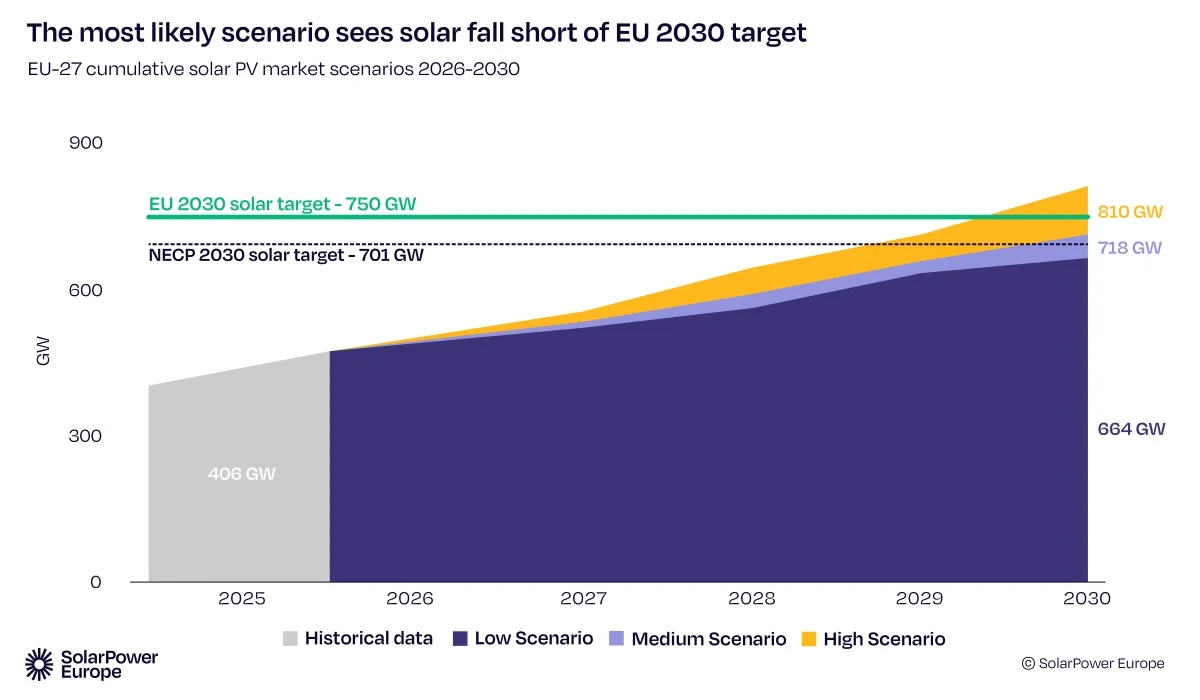
Despite the slowdown, the European Union still met its interim target of 400 GW of installed solar capacity by 2025, set under the EU Solar Strategy adopted in 2022. Total cumulative capacity is now estimated at 406 GW.
This confirms solar’s central role in the European energy mix, but it does not eliminate emerging structural weaknesses. According to the central scenario of the EU Solar Market Outlook 2025–2030, the current trajectory is no longer sufficient to reach the EU’s 750 GW target by 2030.
Under the most likely scenario, installed capacity would reach 718 GW, leaving a sizeable gap versus political objectives. The report also warns that the market is expected to remain weak in 2026 and 2027, with a recovery only starting in 2028. Annual installation levels seen in 2025 would not return until the end of the decade.
How much new solar capacity is Europe installing today
In 2025, solar accounted for 13% of total electricity generation in the European Union, confirming its position among the bloc’s leading power sources. In June, solar was the EU’s top electricity source, outperforming all others during that month.
This highlights how solar generation is no longer marginal or seasonal, but increasingly critical to power system balance. However, SolarPower Europe stresses that higher electricity output does not automatically translate into market growth.
The end of the so called solar boom of the early 2020s marks the start of a new phase, one more exposed to price signals, grid saturation, and the need for flexibility solutions. Without structural reforms, the report warns, Europe risks a prolonged stagnation that could undermine both climate goals and energy security.
Why the European photovoltaic market is slowing
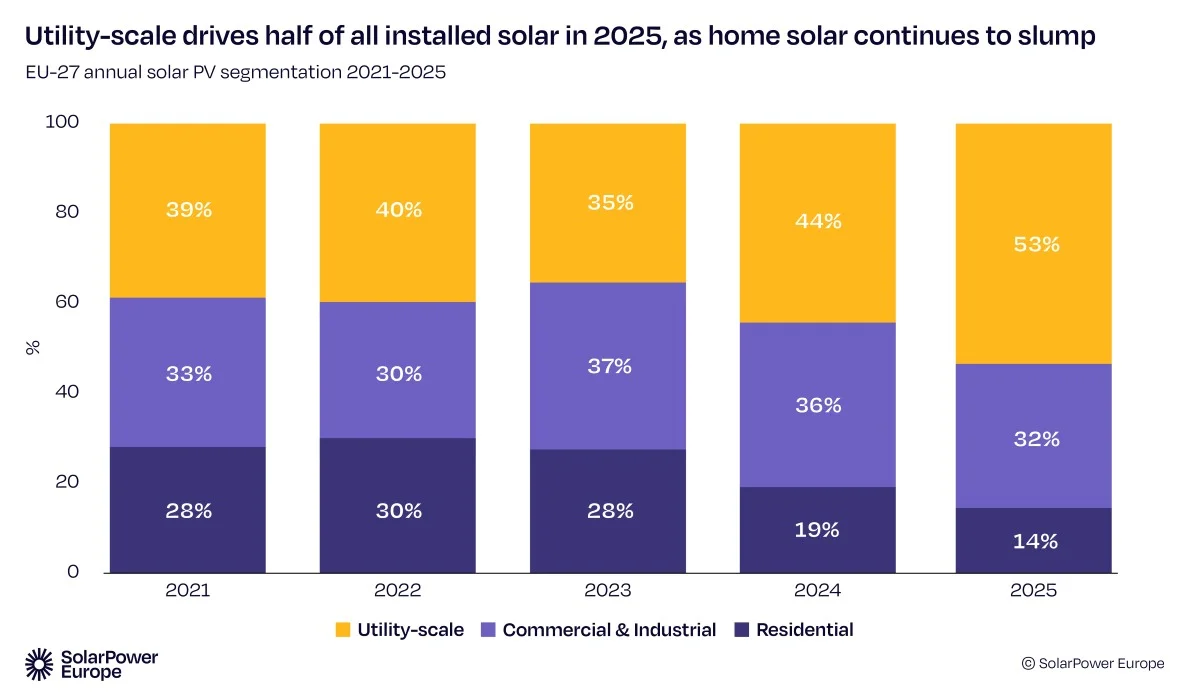
The slowdown in the European photovoltaic market is driven by a combination of factors, with the sharp contraction of the residential segment at the top of the list. According to the report, rooftop solar accounted for 28% of new installations in 2023, but its share fell to 14% in 2025.
This decline reflects reduced support schemes, the phase out of emergency measures introduced during the energy crisis, and a weaker perception of urgency around household energy prices. As a result, new rooftop installations have slowed significantly.
At the same time, utility scale solar surpassed 50% of new capacity for the first time. Yet this segment is also under pressure. SolarPower Europe highlights growing profitability challenges linked to an increase in hours with negative power prices, which erode revenues for producers and increase investment uncertainty.
Similar dynamics were already observed in Italy, according to ANIE’s Energy Storage Systems Observatory earlier this year.
Europe’s largest solar markets in 2025
The ranking of Europe’s leading solar markets remains broadly stable, but with notable shifts in growth dynamics.
| Position | Country |
|---|---|
| 1 | Germany |
| 2 | Spain |
| 3 | France |
| 4 | Italy |
| 5 | Poland |
| 6 | Greece |
| 7 | Romania |
| 8 | Netherlands |
| 9 | Bulgaria |
| 10 | Portugal |
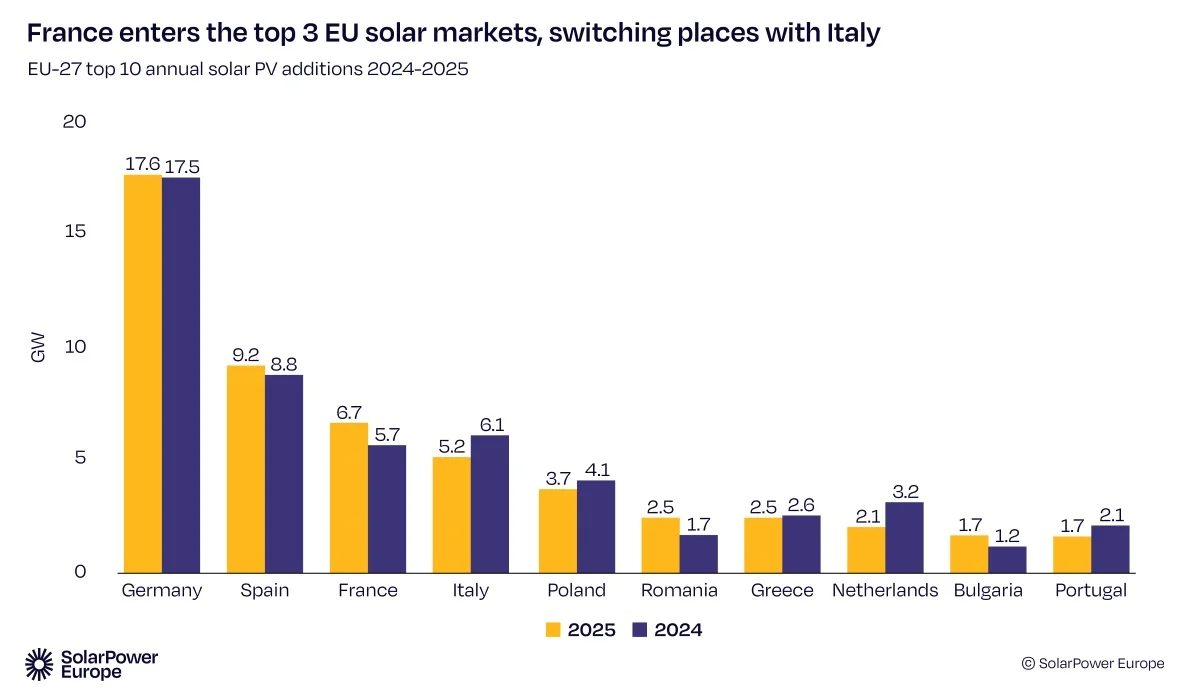
Germany and Spain retain their leadership, largely supported by large scale projects. France overtakes Italy, driven by strong expansion in commercial and utility scale solar. In Italy, rooftop installations fell sharply following the gradual withdrawal of support schemes.
The report also highlights the entry of Romania and Bulgaria into the top ten. Romania records the fastest growth rate among major markets, while Bulgaria’s expansion is linked to national recovery funding deadlines.
By contrast, the Netherlands drops to eighth place, reflecting the slowdown in residential installations. Among the top ten markets, five countries installed less solar than in 2024, including Italy, Poland, and the Netherlands.
Solar capacity per capita, where Europe is growing fastest
According to SolarPower Europe, ten EU member states surpassed the threshold of 1 kW of installed solar capacity per capita for the first time in 2025.
On average, the EU now exceeds 900 watts per capita, approaching the 1 kW benchmark that the report sees as achievable in 2026.
The Netherlands remains Europe’s leader with 1,582 W per capita, despite weaker rooftop growth, followed by Germany at 1,405 W per capita, up sharply from 2024. Estonia enters the top three for the first time, driven by one of the fastest per capita growth rates in the EU.
In southern Europe, Greece stands out, ranking fourth with 1,223 W per capita, supported by a strong increase in installations. Spain, Austria, and Denmark also remain above the 1 kW threshold, confirming the structural penetration of solar across markets with very different characteristics.
However, significant asymmetries persist. While more countries cross the 1 kW mark, competition is intensifying in the middle of the ranking. In 2025, entering the top ten required exceeding 1 kW per capita, compared with just 830 watts in 2024.
This signals both accelerating solar adoption and the need for targeted policies in lagging countries, including Italy, which does not rank in the top ten per capita in 2025, consistent with the slowdown in residential solar highlighted in the report.
| Position | Country | Watts per capita |
|---|---|---|
| 1 | Netherlands | 1,582 W/c |
| 2 | Germany | 1,405 W/c |
| 3 | Estonia | 1,335 W/c |
| 4 | Greece | 1,223 W/c |
| 5 | Austria | 1,177 W/c |
| 6 | Spain | 1,155 W/c |
| 7 | Denmark | 1,146 W/c |
| 8 | Hungary | 1,084 W/c |
| 9 | Luxembourg | 1,077 W/c |
| 10 | Belgium | 1,031 W/c |
What the European photovoltaic market needs to meet 2030 targets
According to SolarPower Europe, putting the European photovoltaic market back on a trajectory aligned with 2030 goals will require a clear political shift. The report’s recommendations focus on four priorities: redefining energy security around renewable electrification, developing a European strategy for system flexibility, accelerating permitting procedures, and reviving rooftop solar, particularly in the residential segment.
SolarPower Europe CEO Walburga Hemetsberger sums up the core message of the report: “We reached our solar target for 2025, but now, for the first time, our 2030 target is becoming out of reach.”


