
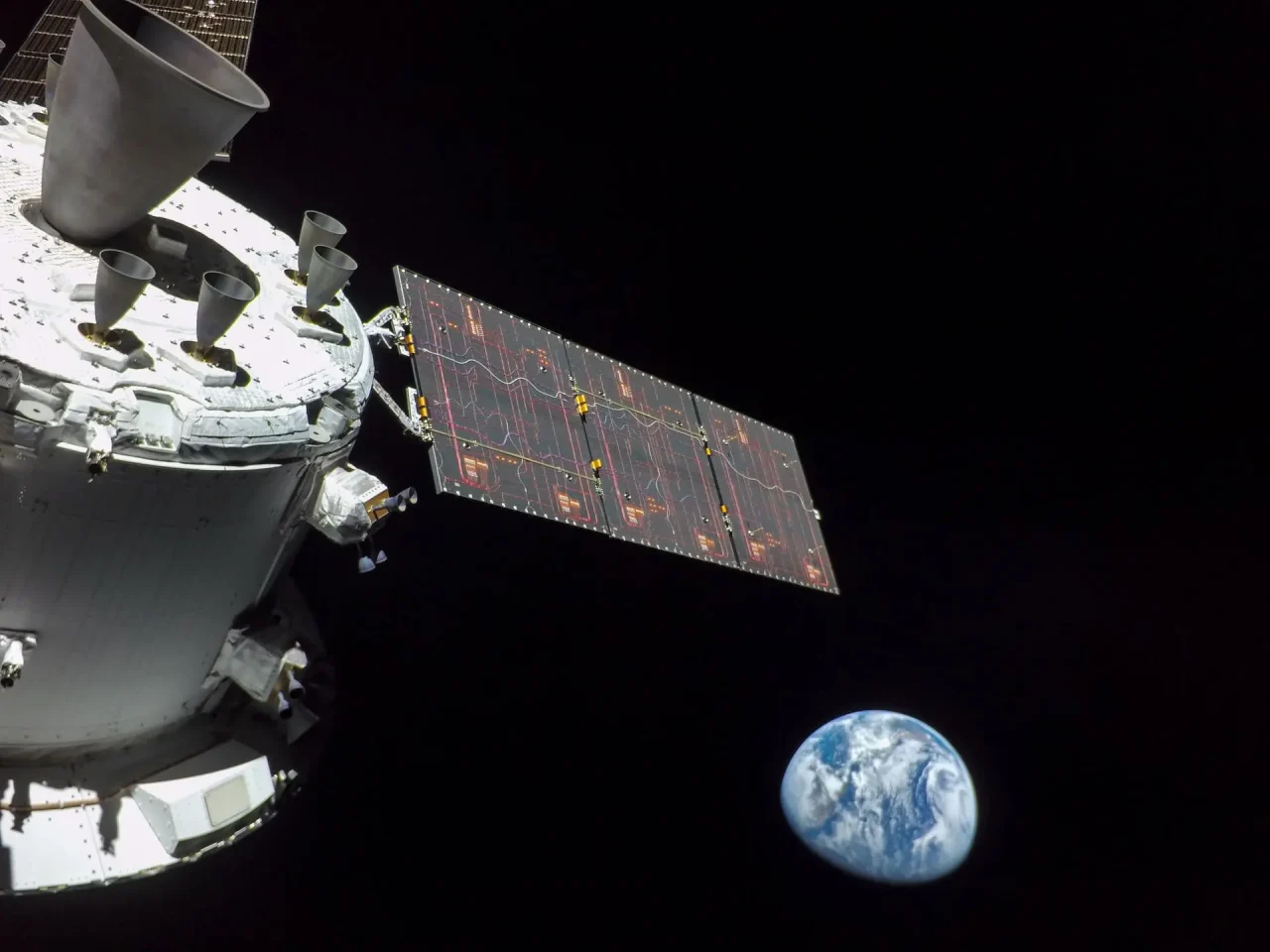

NASA’s Artemis II mission will send four astronauts around the Moon, with Orion’s solar arrays powering key systems during the flight.
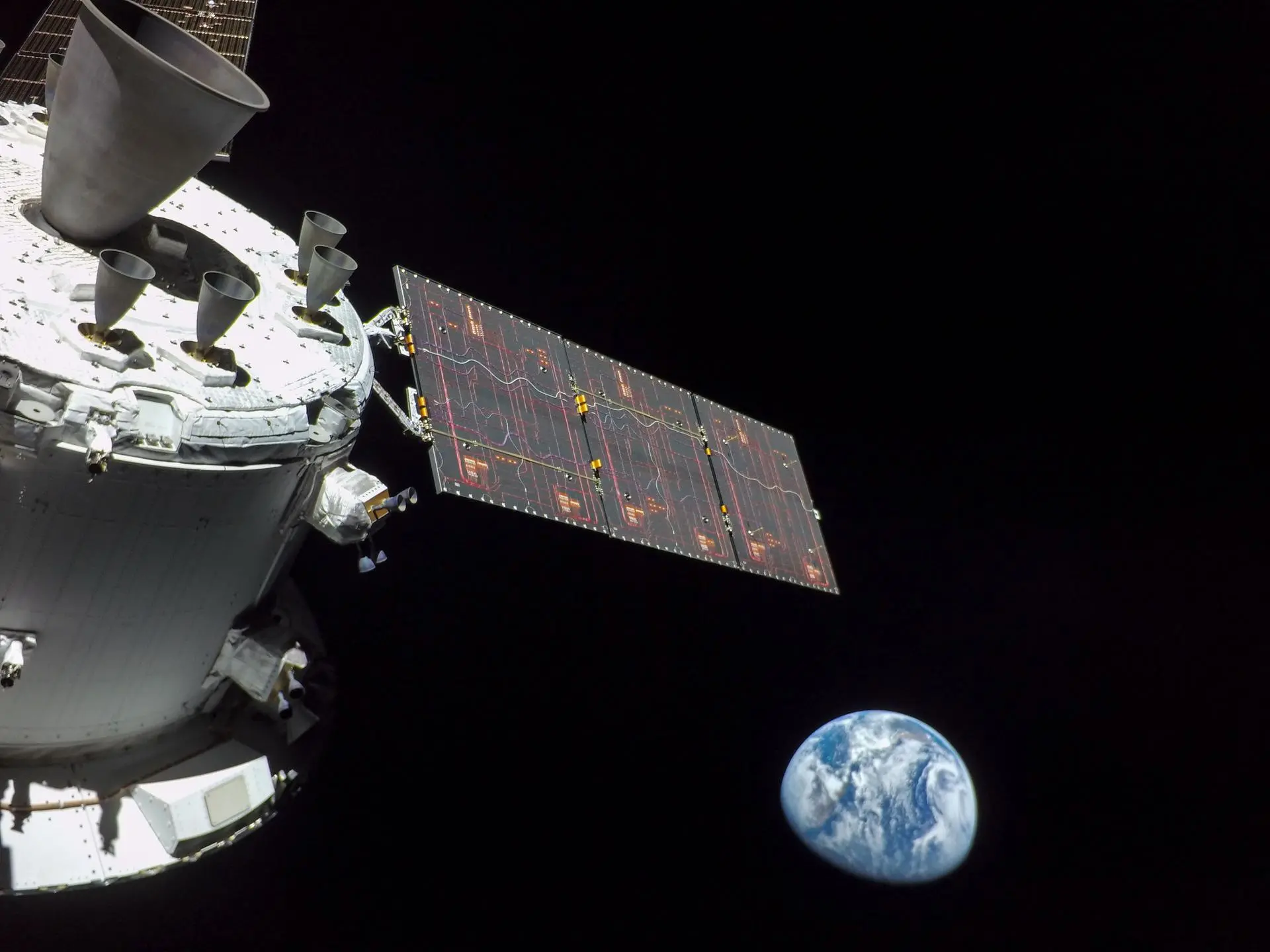
The Artemis II mission is scheduled to launch on Wednesday at 6:30 p.m. Eastern, marking NASA’s first crewed flight toward the Moon in more than 50 years. Four astronauts will fly aboard the Orion spacecraft on a mission expected to last about 10 days, with capabilities for up to 21 days.
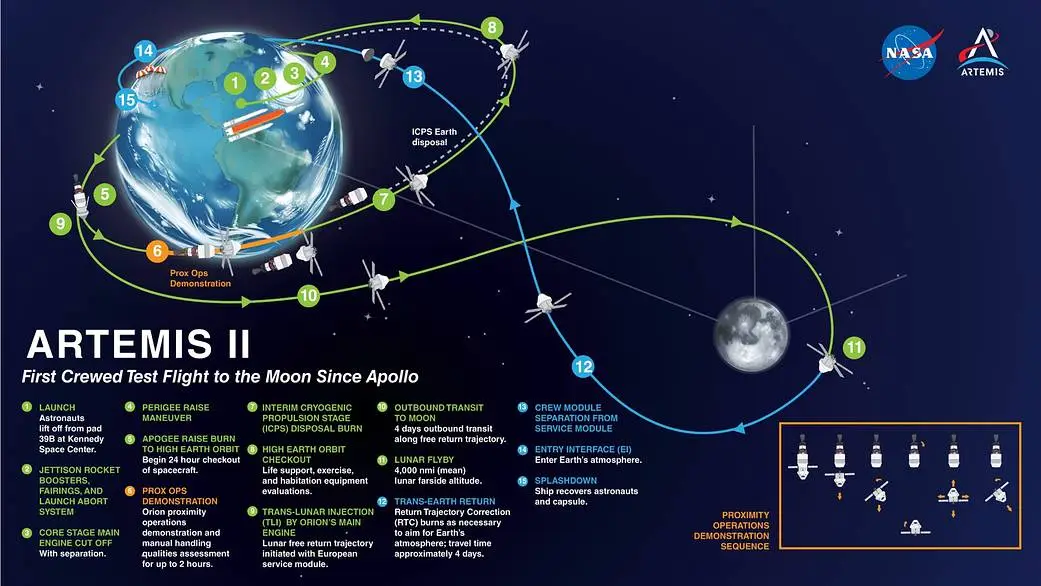
The crew will not land on the Moon. The flight follows a free-return path, looping around the far side before heading back to Earth. A crew has not used the profile since the Apollo program.
Reid Wiseman, Victor Glover, Christina Koch, and Jeremy Hansen will be on board. The mission follows the uncrewed Artemis I test and shifts the focus to how Orion performs with astronauts inside, including life support, navigation, and manual control.
Orion will launch on NASA’s Space Launch System from Kennedy Space Center in Florida. After reaching orbit, the spacecraft will complete a series of engine burns before committing to its lunar trajectory. The full stack stands about 67 feet tall and has a liftoff mass of about 78,000 pounds.
The vehicle is built in three sections. A launch abort system sits at the top and can pull the crew away from the rocket in an emergency. The crew module, where astronauts live and work, sits beneath it. The service module, attached below, handles propulsion, electrical power, and environmental systems.
Solar arrays power Orion’s deep space operations
All onboard electricity is generated through solar arrays mounted on the European Service Module.
The system uses four wings with a combined span of about 62 feet. Roughly 15,000 solar cells convert sunlight into electrical power. Output is about 11 kilowatts, enough to run avionics, communications, thermal control, and the systems that maintain air, water, and cabin pressure.
The arrays are mounted on rotating joints so they can stay oriented toward the Sun as the spacecraft changes position. Power production depends on that alignment. There is no alternate generation system onboard.
Electricity from the arrays is routed across the spacecraft to support both crew operations and flight systems. Life support draws from the same supply as guidance and navigation. Environmental controls, including carbon dioxide removal and temperature regulation, run continuously throughout the mission.
The service module, developed by the European Space Agency, integrates the power system with propulsion and consumable storage. It carries oxygen, nitrogen, and water, and houses 33 engines used for major burns and smaller adjustments during flight.
Crew module and onboard systems
The crew module serves as the primary habitat during the mission. It stands about 11 feet tall with a diameter of 16.5 feet and includes roughly 330 cubic feet of habitable volume. Four astronauts can operate inside for up to 21 days without docking to another spacecraft.
The structure is built from aluminum alloy components joined at NASA’s Michoud Assembly Facility in New Orleans. A heat shield measuring 16.5 feet in diameter protects the capsule during reentry, where speeds approach 25,000 miles per hour, and temperatures reach several thousand degrees Fahrenheit.
Inside, environmental systems regulate pressure, temperature, and air composition. Carbon dioxide is removed through a regenerable system. Water and food systems support daily operations, while exercise equipment and medical kits are included for longer-duration missions.
Control of the spacecraft is managed through digital displays and hand controllers. Most operations are automated, though the crew can take manual control when needed.
Flight profile and operations
After launch, Orion will enter an elliptical orbit around Earth and complete two revolutions while systems are checked. The spacecraft will then separate from the upper stage before a burn places it on a trajectory toward the Moon.
About three hours into the mission, astronauts will take part in a proximity operations demonstration, guiding Orion toward and away from the upper stage. The maneuver is designed to assess handling and control systems under real conditions.
“The spacecraft will fly autonomously most of the time,” Wiseman said in preflight materials released by NASA. “If something goes wrong, a crewmember can step in and take control.”
The translunar injection burn will send Orion toward the Moon on a four-day outbound trip. During the flight, the crew will test life support systems, communications, and emergency procedures.
The spacecraft will pass within several thousand miles of the lunar surface before traveling around the far side. At that point, communication with Earth will be briefly interrupted. The mission is expected to reach distances beyond 230,000 miles from Earth.
The return uses a free-return trajectory, relying on gravitational forces rather than continuous propulsion. Before reentry, the crew module will separate from the service module. A parachute system will slow the capsule for splashdown in the Pacific Ocean.
Role within the Artemis program
Artemis II is positioned as a systems test rather than a landing mission. Data gathered during the flight will inform later missions, including Artemis III, which is expected to attempt a return to the lunar surface.
The use of solar arrays as the sole power source reflects a shift in spacecraft design for longer missions. Continuous energy generation reduces reliance on stored consumables and supports extended operations beyond low Earth orbit.
Future missions are expected to build on the same approach, with power systems scaled for longer durations and greater distances.


