


Tesla's Model Y tops global electric car sales in September 2026, while Chinese automakers dominate the rankings and European brands struggle to keep pace.
 Add Rinnovabili to your Google favorites
Best-selling electric cars worldwide: the top models in 2026
Rankings have a way of capturing attention, and the global electric vehicle market is no exception. This analysis looks at the world’s best-selling electric cars, drawing on data published by CleanTechnica.
In September 2026, global sales of plug-in vehicles reached 2.16 million units, up 3% from the same month a year earlier. The figure covers all countries included in the analysis, making even this relatively modest increase significant for the global market.
A closer look at the numbers reveals a widening gap between battery electric vehicles (BEVs) and plug-in hybrids (PHEVs). Sales of fully electric cars climbed 8% year over year, reaching 1.54 million units in September 2026, while plug-in hybrid sales fell 9%.
Over the first nine months of the year, fully electric vehicles accounted for 18% of the global automotive market, compared with 7% for plug-in hybrids.
The world’s best-selling electric cars in September 2026
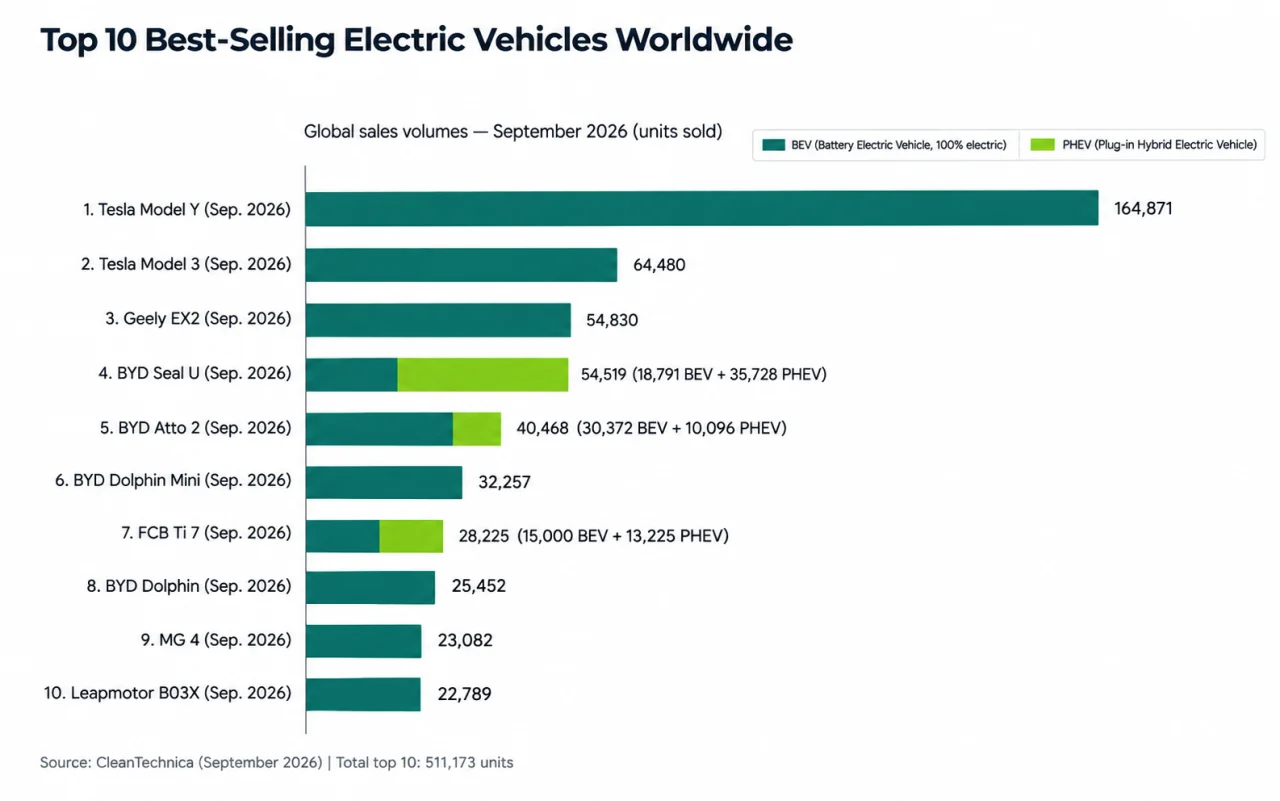
The September rankings reveal a familiar leader, although its performance may come as a surprise given the growing competition from Chinese manufacturers.
Tesla’s Model Y retained the top spot, recording 164,871 sales in September, a 17% increase year over year.
The American automaker also secured second place with the Tesla Model 3, although its 64,480 units sold were less than half the Model Y’s total.
Rounding out the podium was the Geely EX2, with 54,830 sales. The Chinese compact electric car has gained traction in international markets, including Brazil, Australia and Southeast Asia.
One of the most striking aspects of the ranking is the complete absence of European-made electric cars from the top 10. Not a single European model made the list, highlighting the difficulties European manufacturers face in competing at a global scale.
Part of the explanation may lie in their geographic priorities, with several European automakers maintaining a stronger focus on regional markets rather than pursuing the same international expansion strategies as their Chinese competitors.
Looking beyond fully electric vehicles to include plug-in hybrids, Chinese automotive giant BYD secured fourth place with the Seal U, finishing just behind the Geely EX2.
BYD’s presence was particularly notable: the manufacturer occupied fourth, fifth, sixth and eighth places in the combined ranking.
Other Chinese-owned brands also featured prominently, including MG, the former British automaker now under Chinese ownership, and Leapmotor.
The overall picture is clear: while Tesla continues to lead at the individual model level, Chinese manufacturers dominate much of the global electric vehicle landscape.
Best-selling electric cars from January to September 2026

Looking at cumulative sales for the first nine months of 2026, the Tesla Model Y remains the undisputed leader in global electric car sales, moving steadily toward the symbolic milestone of one million deliveries.
Between January and September, Tesla delivered 925,542 Model Y vehicles, giving the midsize electric SUV a substantial lead over its competitors.
Second place went to the BYD Seal U, with 380,080 units sold. Importantly, this figure includes both fully electric BEV versions and plug-in hybrid PHEV variants.
Close behind was the Geely EX2, with 376,284 registrations. Following a particularly strong September, when it overtook the BYD Seal U in monthly sales, Geely’s compact EV is now within striking distance of second place in the year-to-date rankings.
The Tesla Model 3 ranked fourth with 363,919 units sold.
Despite finishing second worldwide in September, the American electric sedan has experienced a more challenging year overall. Its cumulative sales were 7% lower than during the same period in 2025, pushing it off the year-to-date podium.
Although Tesla claimed two of the top four positions, the remaining rankings were dominated by Chinese models, mirroring the results for September alone.
Global EV market share: BYD and Geely lead automaker rankings
Moving beyond individual models to examine the world’s largest automotive manufacturers, the first nine months of 2026 confirm the strength of China’s position in the global plug-in vehicle market.
BYD remained the world’s largest plug-in vehicle manufacturer, holding a commanding 20.2% market share.
Its closest competitor was fellow Chinese automaker Geely, which secured 9.8% of the market.
Tesla climbed to third place with an 8.7% share, benefiting from a particularly strong end to the third quarter.
The middle of the rankings remained relatively stable. Volkswagen Group held fourth place with 7%, followed by MG in fifth with 6.2%.
Competition intensified further down the table.
Leapmotor strengthened its position in sixth place, increasing its market share to 4.4%. The company has continued to expand internationally, consolidating its position ahead of several established automotive manufacturers.
Hyundai-Kia ranked seventh with 3.9%, although its lead over eighth-place Chery narrowed considerably. Chery gained 0.1 percentage points in market share and trailed the South Korean group by just 3,000 registrations.
One of the most significant developments occurred near the bottom of the top 10.
Toyota reached a 3% market share and entered the global top 10, overtaking BMW, which slipped out of the rankings as its share declined to 2.9%.
What the electric car sales rankings reveal about the global market
The latest figures highlight a fundamental shift in the balance of power across the global automotive industry.
Together, the Chinese manufacturers represented in the top 10 account for more than 44% of the worldwide plug-in vehicle market.
Their collective strength reflects not only the size of China’s domestic market but also the increasingly international ambitions of its leading automakers.
Leapmotor’s performance is particularly noteworthy. With a 4.4% global market share, the company has established itself ahead of longstanding industry players such as Hyundai-Kia. Its growth has been supported by international expansion and commercial partnerships that have helped extend its market reach.
Toyota’s entry into the top 10 at BMW’s expense represents another important development among traditional automakers.
After years of taking a cautious approach to fully electric vehicles while prioritizing conventional hybrids, Toyota is beginning to benefit from an expanded plug-in lineup and growing BEV sales.
Its manufacturing scale and global distribution network could allow the Japanese automaker to challenge some of the companies currently ahead of it in the coming months.
For European manufacturers, however, the outlook remains more difficult.
With Volkswagen Group holding just 7% of the global plug-in market and BMW falling to 2.9%, European automakers continue to struggle to gain ground internationally.
One major challenge is the relatively slower pace of electric vehicle demand in their home markets compared with China’s rapid expansion.
The broader trend suggests that Chinese automakers are increasingly setting the pace of the global EV market, while Tesla continues to demonstrate the strength of its best-selling models.
For European manufacturers, the challenge is no longer simply to accelerate electrification. It is also to build the scale, competitiveness and international reach needed to compete in a market increasingly shaped by Chinese brands.


