


A new UN report argues that the world has entered an era of global water bankruptcy, where many water systems have crossed irreversible thresholds and cannot fully recover.

Global water bankruptcy marks a point of no return for water systems
The world has entered a new era, that of global water bankruptcy, according to a new report by United Nations scientists. This is not a distant threat but a tangible reality already visible across large parts of the planet, with consequences that extend far beyond regional boundaries. Many of the world’s water systems have moved beyond a post-crisis state and can no longer be fully restored. Long-term water use and pollution have exceeded natural inflows and safe depletion limits. For these reasons, concepts such as water stress and water crisis are no longer sufficient to describe the current condition of global water resources.
The report, Global water bankruptcy: living beyond our hydrological means in the post-crisis era, argues that widely used terms like water stress and water crisis fail to reflect the reality now facing many regions. The current post-crisis condition is defined by irreversible losses of natural water capital and by the inability to return to historical baseline levels.
The report was released ahead of a high-level meeting in Dakar, Senegal, scheduled for January 26 to 27, aimed at preparing the 2026 United Nations Water Conference. The conference will be co-hosted by the United Arab Emirates and Senegal from December 2 to 4 and will take place in the United Arab Emirates.
What global water bankruptcy really means
Water stress occurs when demand for water is high and available resources are limited, a condition that can still be addressed through targeted measures and relatively modest reforms. A water crisis represents a more acute situation, but one that remains reversible through emergency actions or short-term restrictions.
Global water bankruptcy, by contrast, describes a persistent post-crisis condition from which a full recovery is no longer possible. Restoration of water resources can only be partial and requires profound effort. It demands a fundamental rethink of water management, including demand reduction, resource reallocation, and a reassessment of adaptation strategies.
“This report tells an uncomfortable truth, many regions are living beyond their hydrological means, and many critical water systems are already bankrupt,” warned Kaveh Madani, the study’s lead author and director of the United Nations University’s Institute for Water, Environment and Health, often described as the UN’s water think tank.
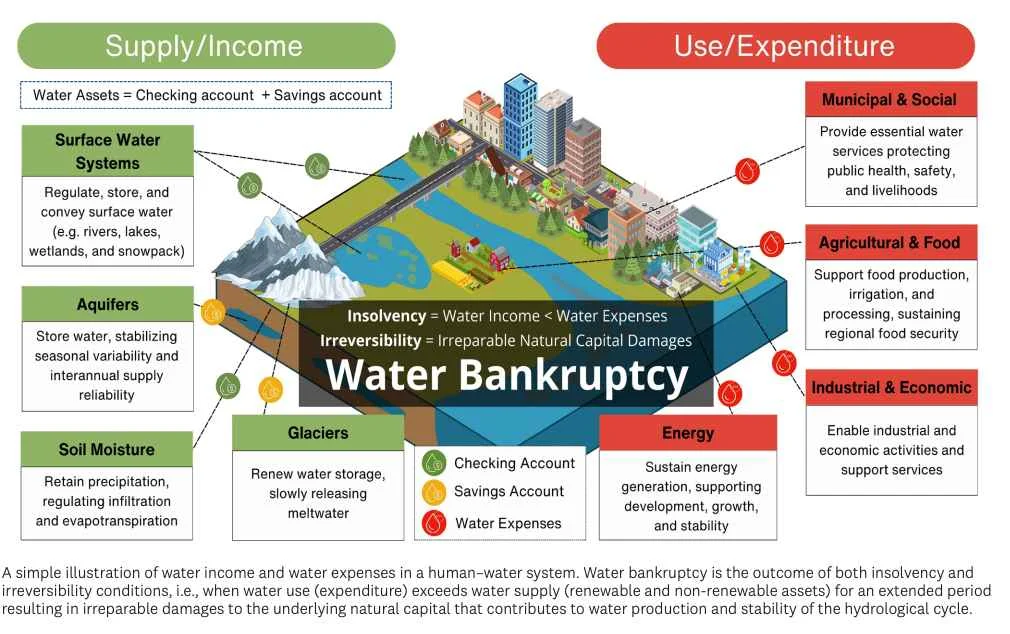
A planet in global water bankruptcy
Drawing on global datasets and recent scientific evidence, the report outlines the most severe global trends, the vast majority of which are driven by human activity.
Half of the world’s large lakes have lost water since the early 1990s, directly affecting 25 percent of the global population that depends on them. Half of all domestic water use worldwide now comes from groundwater. More than 40 percent of irrigation water is extracted from aquifers that are being persistently depleted, while 70 percent of major aquifers show long-term decline.
Over the past 50 years, 410 million hectares of natural wetlands have disappeared, an area nearly equivalent to the entire European Union. More than 30 percent of global glacier mass has been lost since 1970, and entire low- and mid-latitude mountain ranges are expected to lose all functional glaciers within a few decades. Dozens of major rivers now fail to reach the ocean during parts of the year. Many river basins and aquifers have been operating in deficit for over half a century, withdrawing more water than they receive. Around 100 million hectares of agricultural land have been damaged by salinization alone.
The consequences for humanity
Seventy-five percent of the world’s population lives in countries classified as water insecure or critically water insecure. Two billion people live on land that is subsiding, with some cities experiencing ground-level drops of up to 25 centimeters per year. Four billion people face severe water scarcity for at least one month each year.
An estimated 170 million hectares of agricultural land are subject to high or very high water stress, an area roughly equivalent to France, Spain, Germany, and Italy combined. The annual value of lost wetland ecosystem services is estimated at $5.1 trillion. Three billion people live in areas where total water storage is declining or unstable, regions that collectively produce more than half of the world’s food.
Between 2022 and 2023, 1.8 billion people experienced drought conditions. The current annual global cost of drought has reached $307 billion. At the same time, 2.2 billion people still lack access to safe drinking water, while 3.5 billion do not have access to safely managed sanitation services.
Anthropogenic droughts and human-driven scarcity
The report highlights that water scarcity is increasingly driven not by meteorological anomalies but by cumulative human impacts. Soil moisture depletion, deforestation, intensive irrigation, and the contraction of surface water bodies create chronic water deficits described as anthropogenic droughts.
In regions such as the Mediterranean, the Middle East, South Asia, the Horn of Africa, and western North America, these human-driven processes largely explain the intensification of drought observed in recent decades.
Anthropogenic droughts also interact with other climate risks. Prolonged drought and heat reduce soil and vegetation moisture, increasing the likelihood and severity of wildfires. Degraded soils are more prone to flash flooding when intense rainfall occurs. These compound extremes, megadroughts followed by fires and sudden floods, are becoming more frequent in drying regions and are difficult to manage with traditional crisis-response systems that assume hazards occur one at a time.
A new diagnosis for a new era
Madani explained that a region may experience flooding one year and still remain in a state of global water bankruptcy if long-term withdrawals exceed natural replenishment. In this sense, water bankruptcy is not about how wet or dry a place appears, but about balance and sustainability.
“As with climate change or pandemics, declaring global water bankruptcy does not imply uniform impacts everywhere,” Madani said. “It means that enough systems have crossed irreversible thresholds to create a planetary-scale condition.”
“Global water bankruptcy is global because its consequences travel,” he added. “Agriculture accounts for the vast majority of freshwater use, and food systems are tightly interconnected through trade. When water scarcity undermines agriculture in one region, the effects ripple through global markets, political stability, and food security elsewhere. This turns water bankruptcy from a series of isolated local crises into a shared global risk that requires a new type of response, bankruptcy management rather than crisis management.”
Declaring bankruptcy is not surrender, but a reset
The report stresses that global water bankruptcy is also a matter of justice, with deep social and political implications that demand the highest level of government attention and multilateral cooperation. Its burdens fall disproportionately on smallholder farmers, Indigenous communities, low-income populations, women, and young people.
While vanished glaciers cannot be rebuilt, further losses of remaining natural capital can still be prevented, and societies can learn to live within new hydrological limits. “Despite these warnings,” Madani concluded, “this report is a call for honesty, realism, and transformation. Declaring bankruptcy does not mean giving up, it means starting over. By acknowledging the reality of global water bankruptcy, we can finally make the hard choices needed to protect people, economies, and ecosystems. The longer we wait, the deeper the deficit grows.”


