


The global photovoltaic market closed 2024 with record growth and a deepening concentration among leading economies, reshaping the balance of solar power worldwide.

Global photovoltaic market in 2024, record growth and new balances
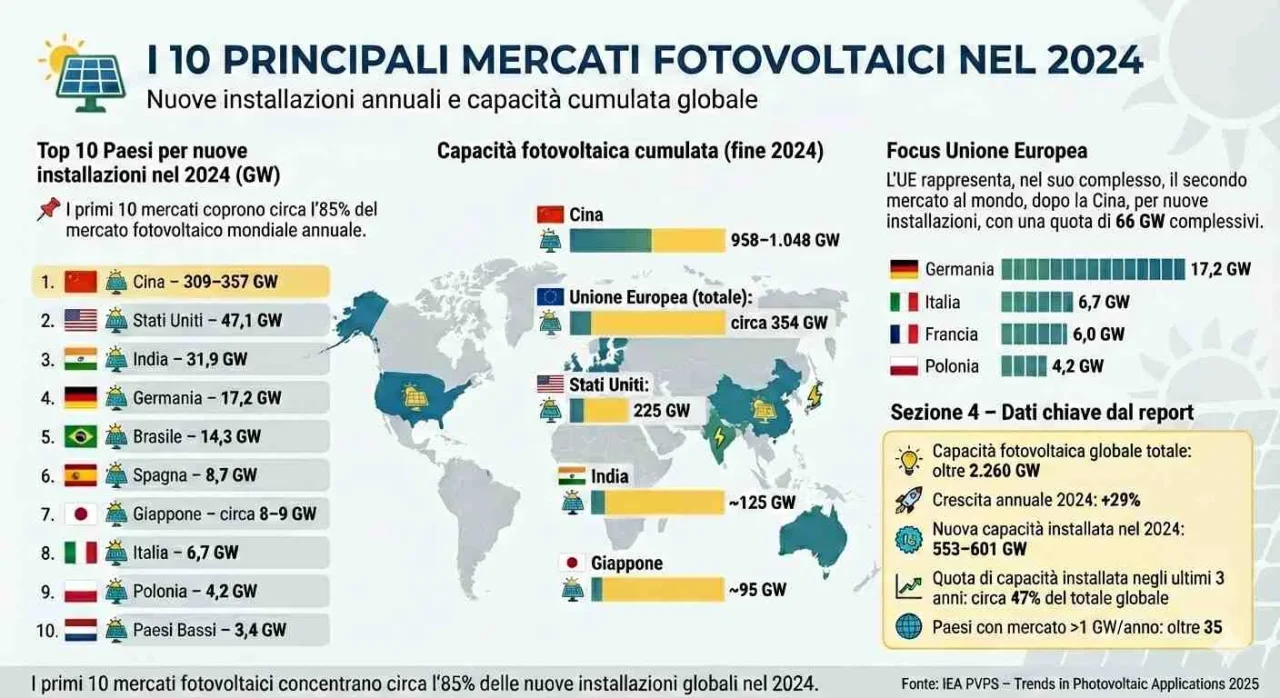
By the end of 2024, the global photovoltaic market surpassed 2,260 GW of cumulative installed capacity worldwide, marking a 29% year-on-year increase. New installations added between 553 GW and 601 GW in a single year, setting a new all-time record.
The figures confirm solar power as one of the central pillars of global electricity systems, supported by falling module costs, technological maturity, and its growing role as a hedge against energy price volatility.
According to the Trends in Photovoltaic Applications 2025 report by IEA PVPS, nearly half of all photovoltaic capacity currently operating worldwide has been installed in just the past three years, an acceleration with no historical precedent among energy technologies.
In 2024, more than 35 countries recorded annual markets exceeding 1 GW, while over 40 countries surpassed 4 GW of cumulative installed capacity. This signals an increasingly widespread adoption of solar power, albeit still heavily concentrated in major markets.
How the global photovoltaic market has evolved
The global photovoltaic market remains highly concentrated. The top 10 countries accounted for roughly 85% of new installations worldwide in 2024, underscoring how growth continues to be driven by a limited group of economies.
China remains firmly in the lead, installing between 309 GW and 357 GW in a single year, equivalent to about 59% of the global annual market. As a result, China’s cumulative capacity has climbed to between 958 GW and more than 1,048 GW.
As a bloc, the European Union follows with 66 GW of new capacity added in 2024, ahead of the United States with 47 GW, up 40% from 2023, and India with 31.9 GW.
The report highlights that after a temporary decline between 2019 and 2021, market concentration has increased again over the past four years, largely due to China’s exceptional expansion.
Solar power in Italy, 6.7 GW added in 2024
In Italy, the photovoltaic market closed 2024 with 6.7 GW of newly installed capacity, bringing cumulative installations to around 37 GW. The country remains firmly within the global top 10 and among Europe’s leading solar markets, after Germany and Spain. These figures position Italy as a structural contributor to the growth of solar power within the European Union.
The report notes that Italy is one of the European markets most strongly driven by distributed generation, alongside Germany, Poland, France, and Austria. In 2024, Italy installed 4.4 GW of distributed solar capacity, while cumulative installations in this segment reached 25.4 GW. This reflects a development model centered on residential, commercial, and industrial systems, supported by self-consumption and rooftop deployment.
In per capita terms, Italy sits in the middle tier within Europe, trailing countries such as the Netherlands or Germany, yet delivering a meaningful contribution to national electricity generation.
Overall, the Italian market remains one of the most dynamic in the EU, both in absolute volumes and in its ability to integrate photovoltaic systems into urban and industrial environments.
Technologies and segments driving global growth
From a technological standpoint, the 2024 photovoltaic market is shaped by several clear trends. N-type technologies now account for roughly 70% of global solar cell production, while bifacial modules represent more than 75% of total output. This reflects the industry’s ongoing push for higher efficiency and energy yields, particularly in large-scale installations.
In terms of market segments, utility-scale projects accounted for around 62% of new installations. Distributed solar continued to expand, supported by self-consumption and emerging business models.
The report also points to the growing relevance of dual-use applications such as agrivoltaics, floating solar, and infrastructure-integrated systems. These solutions help reduce land-use competition while improving the social acceptance of solar projects.


