The energy transition and the digitalization of industrial processes are profoundly reshaping the role of electric motors, which alone account for about 45% of global energy consumption. Improving their performance does not only mean boosting the efficiency of individual production lines, but also making a tangible contribution to decarbonization and business competitiveness.
Within this framework, low voltage motors play a critical role, as they form the backbone of countless applications across automation, transportation, manufacturing, and energy infrastructure. Innovation, digital integration, and alignment with European efficiency and emissions policies have become the key drivers of development.
To explore these issues, during a media trip organized by ABB Motion at the Vaasa plant in Finland, Rinnovabili spoke with David Hawley, Global Head of Sales for Low Voltage IEC Electric Motors. The conversation addressed a range of pressing topics: from technological challenges to new European regulations, from strategies to ensure resilient supply chains to long-term industry prospects.
The outcome is a clear vision: anticipating future standards while turning efficiency, digitalization, and circular economy principles into a global competitive advantage.
Interview with David Hawley, ABB Global Head of Sales Low Voltage IEC Electric Motors
What are today the most significant innovations in low voltage IEC motors?
The key innovations we see at ABB focus on extracting greater performance from traditional
technologies — induction motors, synchronous reluctance, and permanent magnet motors. The
drive for higher efficiency is essential. By combining different building blocks, we can develop
new models and solutions. At ABB, we are constantly pushing new ideas that bring value to
customers, always building on a very traditional physical concept.
What contribution can your motors make to helping industries achieve net-zero targets?
Electric motors account for 45% of global energy use. Many industrial plants still rely on old, inefficient motors — sometimes 30 years old. By replacing them with today’s technology, companies can achieve energy improvements of 30–40%. Raising awareness that energy-efficient products are accessible, easy to implement, and cost-effective is key. It’s a win-win for everyone.
EU directives are pushing towards increasingly efficient motors. What concrete steps is ABB taking to stay ahead of these standards?
We are already exceeding current mandatory standards. For example, in Europe we offer IE4 across 70 to 200 kilowatts, but we don’t want to stop where legislation dictates. With synchronous reluctance motors and permanent magnet technology, we are reaching IE5, a defined but not yet adopted standard. We are also exploring what IE6 might look like. It’s important to inform the market that this is possible and to encourage governments to accelerate adoption, since legislation remains the strongest driver.
The new EU Ecodesign Regulation will impose stricter efficiency standards. How are you preparing to turn this into a competitive advantage?
We are ready today. We anticipate future standards, design products that already exceed current ones, and develop technologies for those not yet in place. Our portfolio is designed and waiting — we simply adapt our market introduction to legislation timelines.
How will initiatives like the Net Zero Industry Act and the Clean Industrial Deal impact ABB’s business and decisions on plant location?
ABB is one of the few motor manufacturers that still maintains a strong European manufacturing footprint. We will continue to invest in our Finnish plant and in sustainability here in Europe. That said, Europe must ensure fair trade conditions, because tariffs or restrictions could make us less competitive compared to Asian manufacturers.
How are you driving adoption of high-efficiency motors?
There’s often a gap between corporate sustainability ambitions and procurement practices. At the C-suite level, companies commit to ambitious targets, but at the procurement level, price still dominates decisions. We work to close that gap — ensuring that energy efficiency is embedded in specifications for new projects, replacements, and equipment.
Supply chain resilience is a hot topic. How are you addressing challenges around copper and rare earths? Are you already developing circular economy models for recycling critical materials?
Robust supply chains are vital. Covid and the war in Ukraine disrupted supplies of electrical steel and copper. We’ve diversified sourcing and built strong strategic management, but demand from wind turbines and electric cars adds pressure. Expanding copper and steel production is critical. Integrity in supply chains is equally important — we always ensure compliance with global regulations. We also run circular economy campaigns through our service network, where replaced motors are taken back, processed in certified schemes, and customers receive certificates and credits toward new motors. This program is already active in several European countries and proving very popular.
Which markets are currently driving the strongest demand for low voltage IEC motors?
China remains the principal market, though highly competitive. India is also growing but with political and commercial challenges. In Europe, the market is relatively flat with some local opportunities, while Asia shows both growth and a shift of manufacturing from Europe to local sourcing.
How do Europe, the U.S., and Asia differ in their approach to industrial electrification?
The biggest driver right now is the boom in data centers. The U.S. is investing heavily in this area, creating new markets across ABB businesses. In Asia, urbanization continues to fuel electrification. Europe is more stable, with slower growth compared to the U.S. and Asia.
What strategic role does the Vaasa factory play in ABB’s global organization?
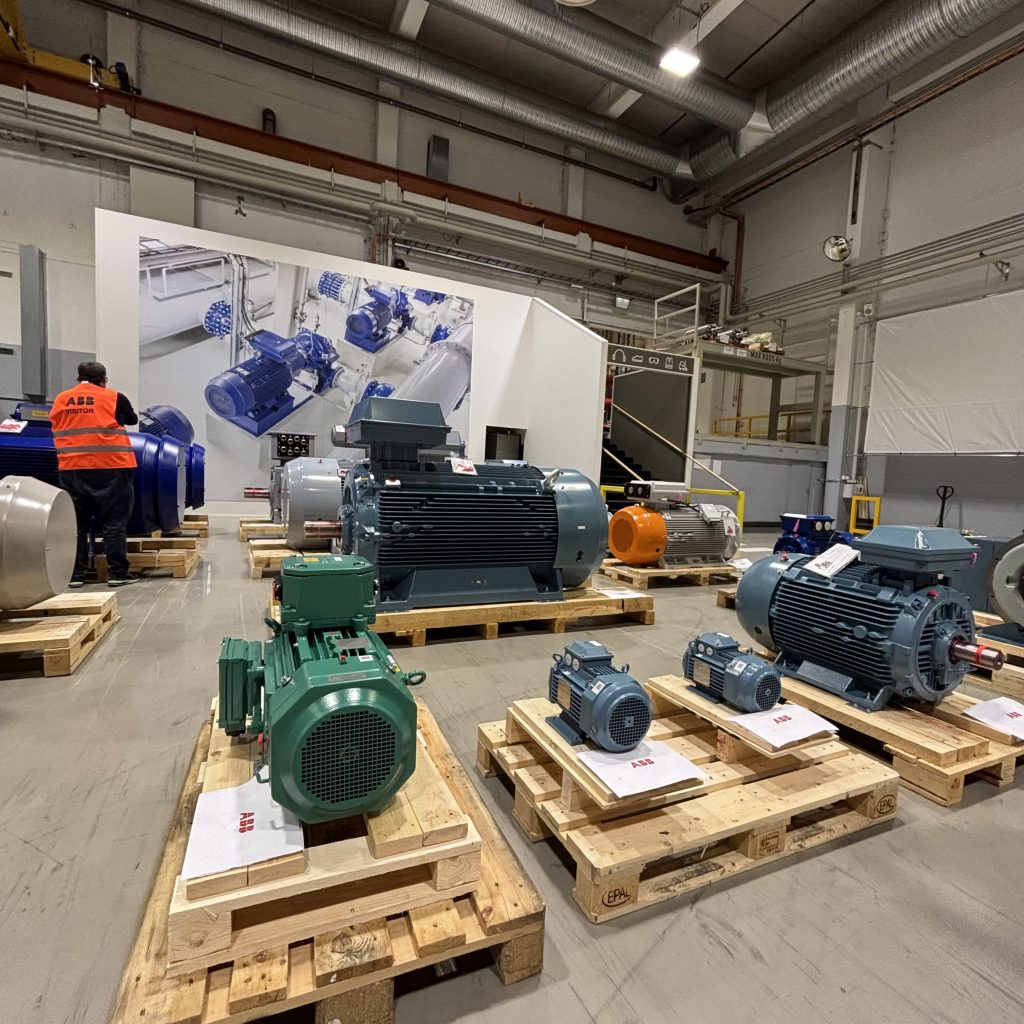
It’s absolutely key in its ability to produce low numbers of highly engineered products with high specifications carrying global certifications. It’s a respected product recognised by all the major users both in oil and gas, marine, transport, nuclear. We are able to deliver products with very, very high specifications. That requires a very high level of skill. It’s not something that you can automate. Where we can automate and where we will automate, we will do that. And we can go to places like China and India where we continually invest in High volume plants with high, high levels of automation. But to build a 450 frame explosion proof motor with a very high level of features suitable to be used on an open deck design, that is a very special motor that needs to be engineered and built accordingly. We would not be looking to invest in any other location to do that other than this VASA facility.
Vaasa is also a hub for the region’s energy transition. How do you engage with the local ecosystem?
We actively invest in the local area, supporting projects and engaging with the community. It’s an important part of how we operate.
How does the Vaasa factory ensure flexibility and efficiency in production?
Each motor has 150 components and we ship 300 motors per day. I’d never thought of that, you know, four and a half, 45,000 components per day or whatever it was that go through here. It’s a complex operation. We constantly invested in new tools, in new techniques, in lean manufacturing. This place has changed every time I come here. This place changes and becomes more flexible, leaner and more effective. So I think investment in modern technology, modern methodology and qualified people will always allow this plant to stay ahead of the game. It’s complex. We have to employ a lot of engineers and obviously, you know, these create overheads, but that’s the differentiation that ABB.
How are your motors evolving with sensors, IoT, and predictive maintenance?
ABB’s Smart Sensor technology is becoming smaller, better, and increasingly embedded in motors. It enables predictive maintenance and value-added services, allowing us to provide end-to-end data monitoring and lifecycle management in collaboration with our service division.
What is the role of digital twins and AI in motor development?
Finite element analysis and AI are already part of our R&D and consulting. While motors remain based on traditional principles, digitalization makes them more refined and effective across development, production, and service.
If you had to describe the motor of 2035 in three words, which would you choose?
Reliable, efficient, innovative.
And the factory of the future?
Fast, efficient, flexible.