Electricity consumption in the US varies by state, and the differences are getting more important as national demand grows. New data from Professor Mark Z. Jacobson at Stanford shows how uneven per-capita electricity use has become and how structural factors, not just climate, explain much of the variation. This comes at a time when the country is seeing increases in electricity demand from data centers, electric vehicles, and heat pumps.
Understanding how and why consumption differs is key to a reliable and low-emission grid. Research from MIT has recently shown that long-term energy modeling depends on accurate assumptions about both demand and efficiency. Stanford’s analysis provides a high-resolution view of how states use electricity today and points to long-standing differences in efficiency standards, building practices, and conservation programs that shape those patterns.
Per Capita Consumption by State
Stanford’s analysis compares per capita electricity demand for all 50 states from October 2024 to September 2025. The results show a big divide in how much electricity people use, with some states using more than twice as much per person as others. The states with the lowest per capita electricity demand are in regions that have stronger efficiency standards, stricter building codes, and more conservation programs. The states with the highest electricity use per person have fewer efficiency requirements and less insulation in residential and commercial buildings.
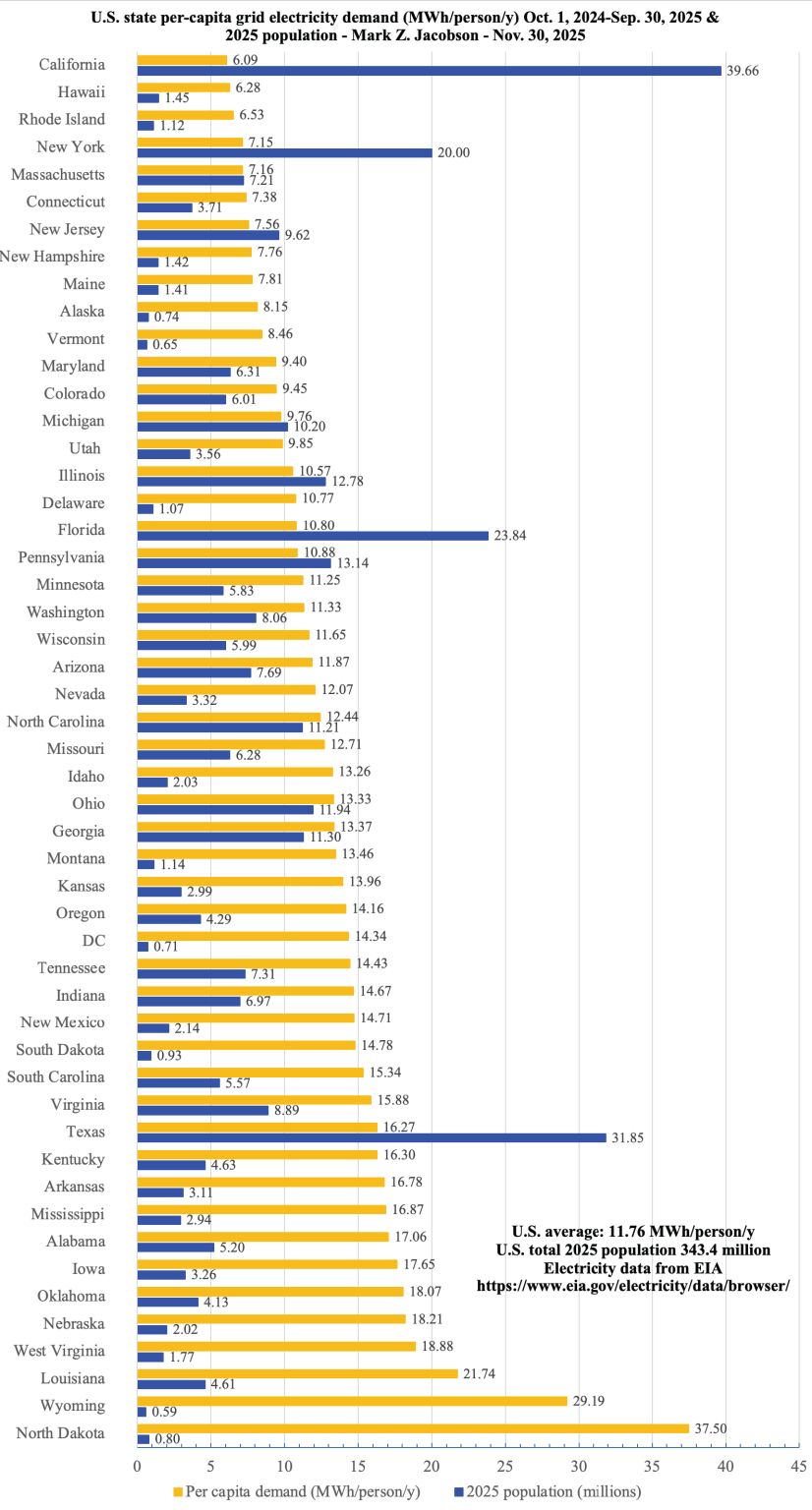
The differences are big. The group of highest-consuming states uses 2.6 times more electricity per capita than the group of lowest-consuming states. It’s not just the biggest states. Wyoming and North Dakota have some of the highest per capita electricity use in the country, several times more than states like California, New York, and Hawaii, which are at the low end of the range. The national average is 11.76 MWh per person per year, but many states are way above that. The comparison between Texas and California shows the size of the gap. Texas uses 2.67 times more electricity per person than California, despite similar population size and significant electrification in both markets. Several high-population states are below the national average. Density, building stock, and long-standing efficiency programs play a significant role in moderating electricity demand. Having been documented for decades, a 1987 study by Mills and Rosenfeld reached similar conclusions about the impact of efficiency standards and conservation policies.
Why Efficiency Matters
Jacobson notes the divide is not explained by heating choices alone. While some high-consuming states use more electric heat, many also burn way more fossil gas per capita than low-consuming states. This reinforces the idea that overall energy demand is shaped more by policy design, building performance, and efficiency requirements than by heating technology.
The analysis shows that insulation upgrades, updated appliance standards, conservation programs, and rooftop PV are some of the most effective tools to stabilize grid demand as new loads from EVs, heat pumps, and energy-intensive digital infrastructure grow.
Implications for Energy Planning and Policy
The differences in the Stanford analysis have big implications for energy planning and climate policy. States with higher per capita electricity consumption face more challenges as demand from electrification grows. Increased loads from electric vehicles, heat pumps, and data centers will put more stress on systems that already use more electricity. In states where efficiency standards are weak, these increases may require more rapid grid expansion and more investment in generation and transmission.
Lower-consuming states show the opposite trend. Stronger insulation requirements, appliance standards, and conservation programs have kept electricity demand stable as they electrify more of their heating and transportation. States like California, New York, and Massachusetts have some of the lowest electricity use per person despite big populations and continued electrification. This means efficiency is one of the best ways to moderate long-term grid demand. The data also shows how structural choices over several decades continue to shape today’s energy use. For national energy modeling, the state variation shows how important it is to use assumptions that reflect real-world consumption behavior and building performance. As federal and state governments consider new rules for reliability, interregional transmission, and clean energy deployment, accurate consumption data becomes key to long-term decision-making.
How the Findings Match MIT Research
The Stanford findings match recent research on how rising electricity demand will impact the US grid. A study from MIT modeled different approaches to expanding national transmission and found that demand assumptions have big impacts on cost, emissions, and reliability. One scenario focused on targeted expansion in regions with strong renewables, which reduced costs and emissions a bit. Another scenario looked at a more national buildout, which improved system reliability during extreme weather.
Both have trade-offs, and both rely on accurate forecasting of where demand will grow and how quickly efficiency measures can offset new loads.
The Stanford data shows demand is far from uniform across states, and these differences will grow as electrification accelerates. Together, the Stanford consumption data and MIT modeling show the importance of integrating efficiency, demand forecasting, and grid expansion into a coordinated strategy for managing future electricity needs.
The Stanford analysis provides a clear picture of how uneven electricity consumption has become across the United States and how long-standing efficiency policies continue to shape demand. These patterns matter as states prepare for growth in electricity use from transportation, heating, and digital infrastructure. Where efficiency standards are strong, grid demand is stable. Where standards are weak, consumption grows faster, and more pressure is on system expansion.
Research from institutions like MIT shows the country will have big decisions to make about new transmission and where to invest. Those decisions depend on knowing today’s and tomorrow’s demand. The combination of high-resolution consumption data and modeling studies shows that efficiency, planning, and policy design are key to the energy transition. Together, they mean managing demand is as important to grid reliability and emissions reduction as building new capacity.