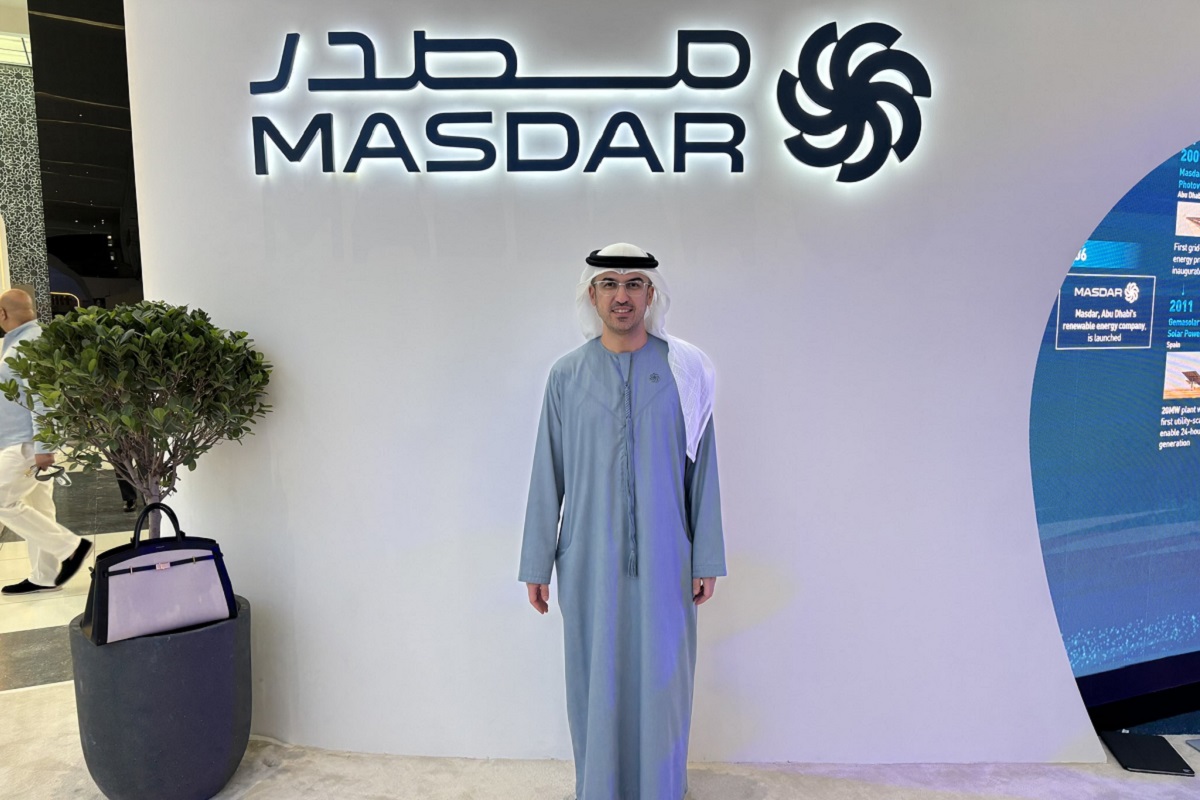
From oil producers to clean energy producers. The United Arab Emirates, which hold around 6% of the world’s proven oil reserves, aim to change their present and focus on an energy mix in which renewable energy—solar and wind in particular—becomes a central part of their future story. The World Future Energy Summit in Abu Dhabi, the most important industry trade fair in this part of the world, is clear evidence of this shift.
During the three-day event, where Rinnovabili was present with its own stand, the nearly €6 billion “Round the Clock” super project was unveiled—an initiative set to mark a turning point in renewable energy production in the Arab country. By combining a photovoltaic power plant with a battery energy storage system, the project will deliver 1 GW of stable renewable energy. We discussed this with Ibraheem Almansouri, Director of Engineering at Masdar.
What does Round the Clock represent for the energy transition of the United Arab Emirates and, more broadly, for the international community?
With this project, we are reshaping the renewable energy industry in the United Arab Emirates. We do not see it simply as a project, but as a model that can be replicated globally. As is well known, renewable energy has always been criticized for producing electricity only when natural resources are available: when there is sun, energy comes from photovoltaics; when the wind blows, it comes from wind power.
The key question has always been how to solve the problem of intermittency. With our Round the Clock (RTC) project, we have developed something truly unique: the largest gigascale renewable project capable of delivering continuous baseload power, 24 hours a day, 7 days a week, throughout the year, for 30 years.
Can you give us some figures to better understand the scale of the project?
We are combining 5.2 gigawatts of photovoltaic capacity with 19 gigawatt-hours of battery energy storage—the largest battery storage system ever deployed in a single project—to produce 1 gigawatt of baseload power. In this way, we solve the issue of intermittency and ensure a reliable power supply.
You mentioned that this project can be replicated outside the UAE. Are there already concrete plans?
We have already signed two memorandums of understanding: one with Uzbekistan to explore the deployment of 1 gigawatt, and another with Kazakhstan, signed in May 2025, for 500 megawatts. The “ingredients” of the RTC can vary from country to country depending on the most suitable energy mix. For example, in areas with higher wind availability, we can combine wind power, photovoltaics and battery storage.
It is important to emphasize that RTC is being developed at highly competitive tariffs, comparable to those of conventional baseload power generation, while delivering green electricity.
What are, in your view, the three main challenges of this project? And what are its key advantages?
We like challenges because we see them as opportunities. Before the era of artificial intelligence, many studies estimated that global energy demand would grow from 9 to 15 terawatts by 2035. With AI, these estimates double: we expect demand to reach up to 35 terawatts, placing enormous pressure on energy supply.
With our projects, we have demonstrated that we can make a significant contribution to the AI era by providing reliable, sustainable and cost-effective energy, while at the same time supporting economic growth in different countries.
Another major challenge we are addressing is the intermittency of renewables, which has long limited their credibility. Moreover, the project is fully aligned with the UAE’s strategy on clean energy, decarbonization, climate change mitigation and the energy transition.
It is also aligned with the country’s AI strategy. The UAE aims to become a key player in artificial intelligence, and our project will provide clean electricity to power the data centers required for AI. As our chairman said during the opening ceremony, there is no artificial intelligence without real energy—and we must carefully consider where that energy comes from. According to many studies, clean energy will cover up to 50% of the energy demand of data centers in the AI era.
Do you think that without AI this round-the-clock project would not have been possible?
We primarily look at our customers, who need energy. The solution is not designed exclusively for AI. It can unlock enormous potential in hard-to-abate industrial sectors that require reliable 24-hour power supply, regardless of the availability of natural resources.
RTC is therefore not only about artificial intelligence; it is a key tool for decarbonizing many sectors in an era of growing electrification. More electrification means higher electricity demand, and we must always consider the carbon footprint of the power sources we use.
With the extreme desert temperatures, how did you design the cooling system?
We operate in very unique climatic conditions and must take them into account. High temperatures affect electrical components in general. In the case of photovoltaics, for example, we have analyzed thermal losses due to heat, which are slightly higher than in other regions, but these are already factored into the design phase.
We conducted extensive studies, validated by third parties, including computational fluid dynamics (CFD) analyses, to assess the impact of the so-called “heat island effect,” which can occur when many containers are concentrated in one area. The project includes adequate spacing to ensure proper ventilation and the use of passive cooling systems to keep the batteries within their optimal operating range.
How will you manage the end of the batteries’ life cycle in 10 or 15 years?
This is not an issue unique to batteries; it concerns all electrical equipment. The European Union, for example, has introduced very strict regulations on electronic waste. The issue also applies to photovoltaics, which rely on semiconductors, and to wind power, such as the recycling of turbine blades.
Recycling is a very topical and widely discussed issue. We are working closely with OEMs—original equipment manufacturers—to assess the best solutions, from material recycling to reusing batteries in different applications, giving them a second life. There are studies showing that materials such as lithium can be recovered and reused.
How do Europe and China view this massive renewable infrastructure?
I attended the IRENA Assembly two days ago and had the opportunity to speak with many European and Chinese colleagues. The perception is very positive: there is a strong sense of pride in what we are doing and in the impact this project will have on the sector.
This initiative is changing the way renewable energy is perceived. More and more clients and large data centers are approaching Masdar to understand how this model can be replicated in other countries. Looking at the evolution of renewables, we can identify four phases: discovery and visibility, the era of subsidies, the gigascale project phase, and finally the RTC phase, in which renewables provide continuous baseload power.