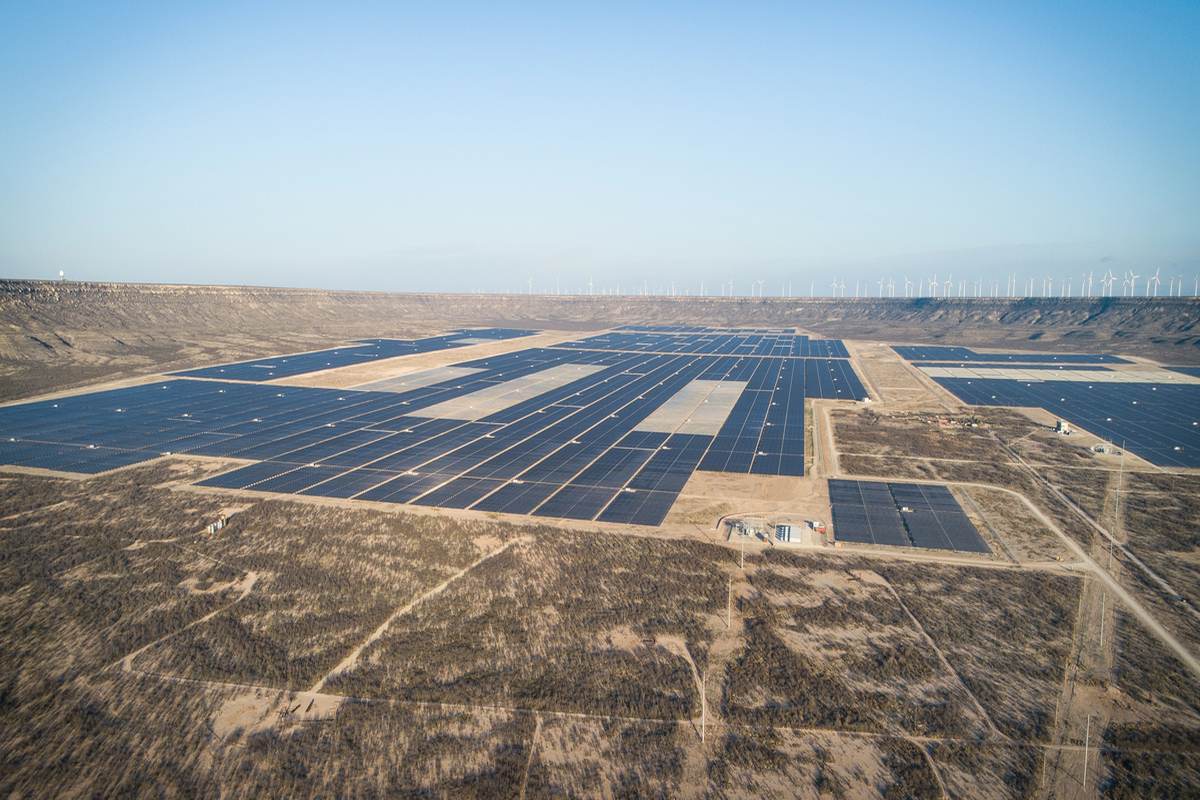
Texas leads the nation in wind and solar power
Texas has firmly established itself as the national leader in the United States for renewable energy. A major driving force behind the success of Texas wind and solar power is the remarkable speed at which new projects are planned, approved, and brought online across the state.
A new analysis examining 76 utility-scale projects developed between 2018 and 2025 shows that the median development time for Texas projects is roughly 3.5 years. The nonpartisan think tank Resources for the Future found that 12% of all the projects analyzed had publicly documented development timelines of less than two years. This rapid pace allows clean energy installations in Texas to move about 40% faster than renewable energy projects developed on federal lands. The analysis also finds quicker speeds in Texas than in many other states. Texas has fewer broad regulations at the state and local levels than many other states, allowing some projects to move quickly.
Nevertheless, project timelines still depend on local tax incentives, private land and power purchase agreements, federal safety reviews, grid coordination, and county road-use agreements. Timelines also vary by project type: the standard deviation of the full development timeline for wind projects is about 50% higher than that for solar projects. However, Texas’s rapid renewable energy development does not mean there is an absence of formal approval processes.
Solar achieves historic milestones over coal
This rapid deployment is driving a major shift in the state’s electricity generation mix. Solar energy is on track to surpass coal-fired generation on a full annual basis for the first time in 2026. This transition follows monthly milestones that began in 2025. Solar photovoltaics first surpassed coal on a monthly basis in March 2025, when solar production reached 4.33 billion kilowatt-hours (kWh) compared to 4.16 billion kWh generated by coal. Solar output remained higher than coal generation every month through August 2025. For 2026, estimates indicate that solar output crossed above coal generation again in March. Solar power in the ERCOT grid area is projected to maintain its monthly lead over coal through November, before coal generation temporarily returns to higher levels in December.
Looking ahead to 2027
The shift away from coal will accelerate further in 2027. Solar photovoltaics are projected to generate more electricity than coal in every month of the year except January and December. For the full year of 2027, annual photovoltaic generation in the ERCOT region is expected to reach 99 billion kWh, compared to 66 billion kWh produced by coal plants.
This growth will be supported by substantial additions to grid capacity. According to the Preliminary Monthly Electric Generator Inventory, 11.8 gigawatts (GW) of new solar capacity will enter into service in 2027, continuing the strong momentum of Texas wind and solar power.