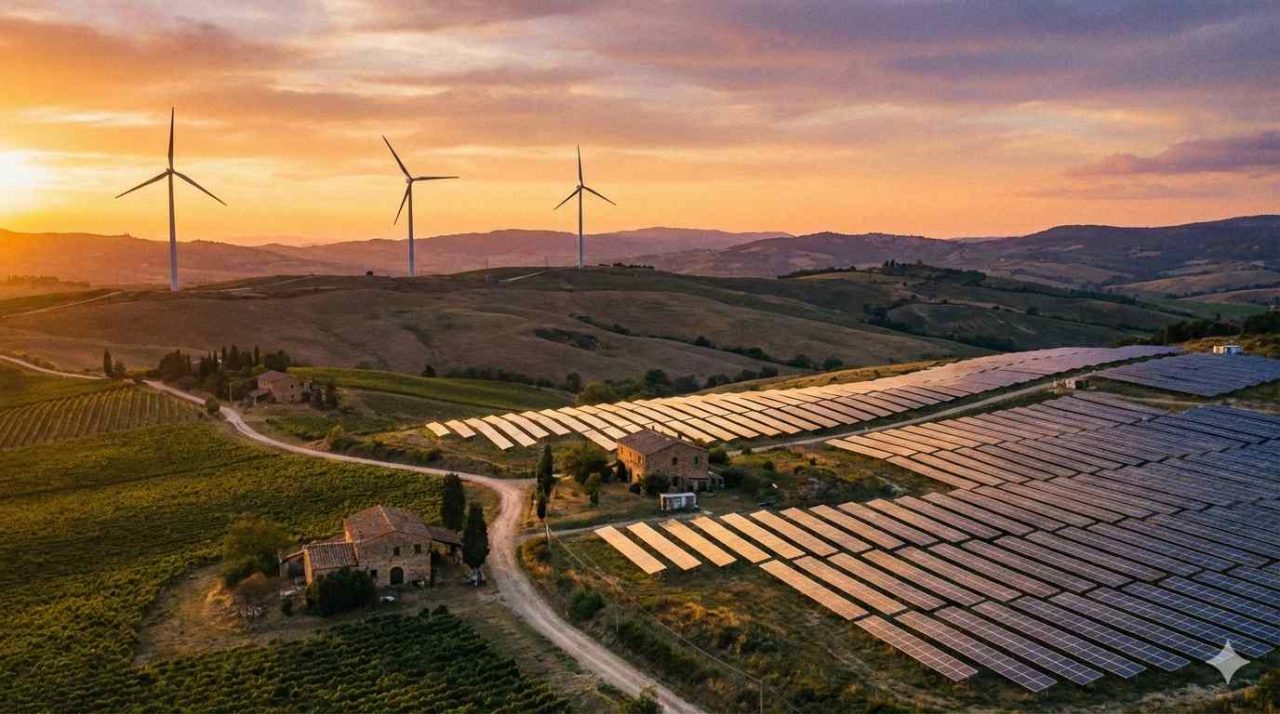
Scientific breakthrough 2025: renewables overtake coal worldwide
For the authoritative U.S. journal Science, renewable energy is the scientific breakthrough of 2025. In the first six months of the year, solar and wind covered 109% of global electricity demand growth, allowing renewables to overtake coal in the worldwide power mix.
The assessment comes from data published by the energy think tank Ember, which point to a structural shift in the global electricity system. It is the first time this has happened at a planetary scale.
Science is not rewarding a single technology, but a measurable process: the ability of renewables to grow faster than electricity demand, steadily displacing fossil fuels.
How much electricity did solar and wind produce in 2025?
According to Ember, between January and June 2025 global electricity demand rose by 2.6%, equal to +369 TWh. Over the same period:
- solar generation increased by 306 TWh, up 31%
- wind power grew by 97 TWh, up 7.7%
Solar alone covered 83% of new global demand. Combined, solar and wind fully exceeded the increase in electricity consumption.
This is central to Science’s rationale. The shift is no longer marginal growth, but real substitution.
Why renewables surpassed coal in the global power mix
In the first half of 2025, renewables generated 5,072 TWh, compared with 4,896 TWh from coal. The renewable share of global electricity rose to 34.3%, while coal fell to 33.1%.
That is why Science calls 2025 a scientific breakthrough. The crossover is not a short-term effect linked to weather or demand swings, but the result of years of capacity buildout, especially in solar power.
China’s decisive role in the global energy shift
China is the main driver of change. In the first half of 2025 it accounted for:
- 55% of global solar growth
- 82% of wind power growth
- 73% of nuclear growth
Chinese solar generation rose by 168 TWh, up 43%, while wind increased by 79 TWh, up 16%.
Thanks to this expansion, China met all of its electricity demand growth with clean sources, cutting coal and gas use and reducing power sector emissions by 46 MtCO₂.
What the renewables boom means for global emissions
Despite rising global electricity demand, power sector emissions remained broadly flat, with a slight decline of 12 MtCO₂ in the first half of 2025.
Ember estimates that without the growth of solar and wind, emissions would have increased by 236 MtCO₂. For Science, this confirms a deeper shift: renewable growth is not only technological, but climatic and systemic.
Why Science calls it a scientific breakthrough, not just an energy milestone
According to Science, the breakthrough is not a new invention. The technologies are mature. The real discontinuity is economic and industrial.
Renewables have become the cheapest source of electricity in many regions, driven by economies of scale, falling costs, and energy security concerns.
In 2004, installing 1 GW of solar capacity took a year. In 2025, 2 GW come online every day. The engine of change is no longer climate virtue, but economic self-interest.
A turning point, not the end of the road
Science stresses that overtaking coal is a starting point, not a finish line.
Challenges remain around grids, energy storage, hard-to-electrify sectors, and new coal plants still under construction. Even so, the signal is clear: renewables have proven they can sustain global growth.
For this reason, the structural expansion of renewable energy marks a historic passage. The energy transition is no longer a future objective, but a process already underway.