What LDES means for energy storage systems
The pace of Chinese innovation in energy storage technologies continues to accelerate. The latest milestone falls within the field of LDES, short for long duration energy storage. Battery manufacturer HiTHIUM has unveiled what it describes as the world’s first battery energy storage system capable of delivering power for eight consecutive hours.
This is a notable step forward for electrochemical storage, excluding flow batteries, which have traditionally dominated longer-duration applications.
LDES refers to energy storage systems designed to supply electricity over extended periods, typically eight to ten hours or more for daily load balancing, and potentially weeks or months when addressing seasonal cycles. These performance levels stand in sharp contrast to today’s conventional lithium-ion batteries, which usually provide two to four hours of discharge.
Because of this capability, LDES plays a critical role in grid stability. It allows excess electricity generated during periods of low demand to be stored and released when demand peaks, supporting a reliable and resilient power system.
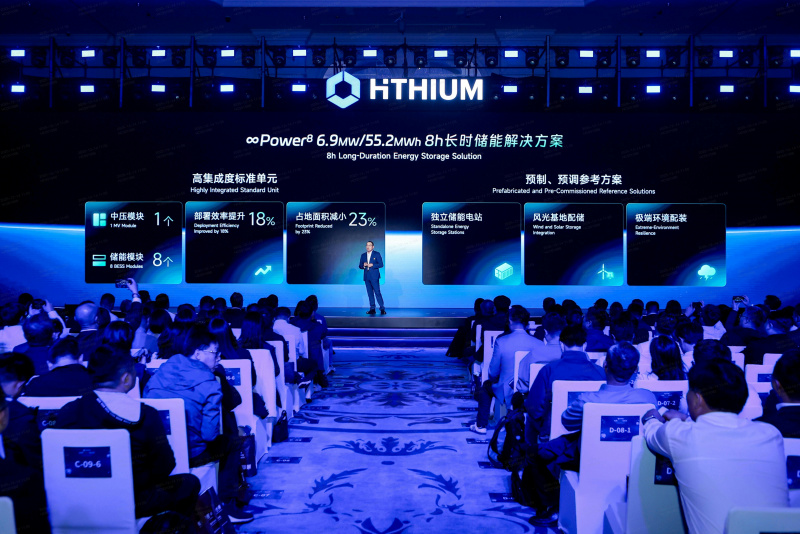
∞Power8, the 8-hour BESS unveiled by HiTHIUM
∞Power8, the name of HiTHIUM’s new system, was officially presented on December 12, 2025, during the company’s Eco-Day event. The solution delivers 6.9 MW of power with a total energy capacity of 55.2 MWh, positioning it as a native long-duration BESS designed for continuous, 24/7 operating scenarios.
The system is offered as a turnkey solution tailored to applications that require extended discharge times. Each unit integrates one medium-voltage module with eight storage modules. By optimizing cabling design and lifting systems, HiTHIUM reports a significant reduction in on-site construction workloads. Overall installation efficiency has increased by 18 percent, while land use has been reduced by 23 percent compared with the previous generation.
The design also targets operation in harsh environmental conditions, addressing real-world engineering and logistical constraints. Through the integration of intelligent control systems, simulation technologies, and an end-to-end active balancing strategy, auxiliary power consumption has been cut by more than 30 percent.
Thermal management precision has improved by 50 percent, with response times shortened by 20 percent. Balancing capability is reported to be 20 times higher than that of traditional passive solutions, while overall system efficiency exceeds 97 percent.