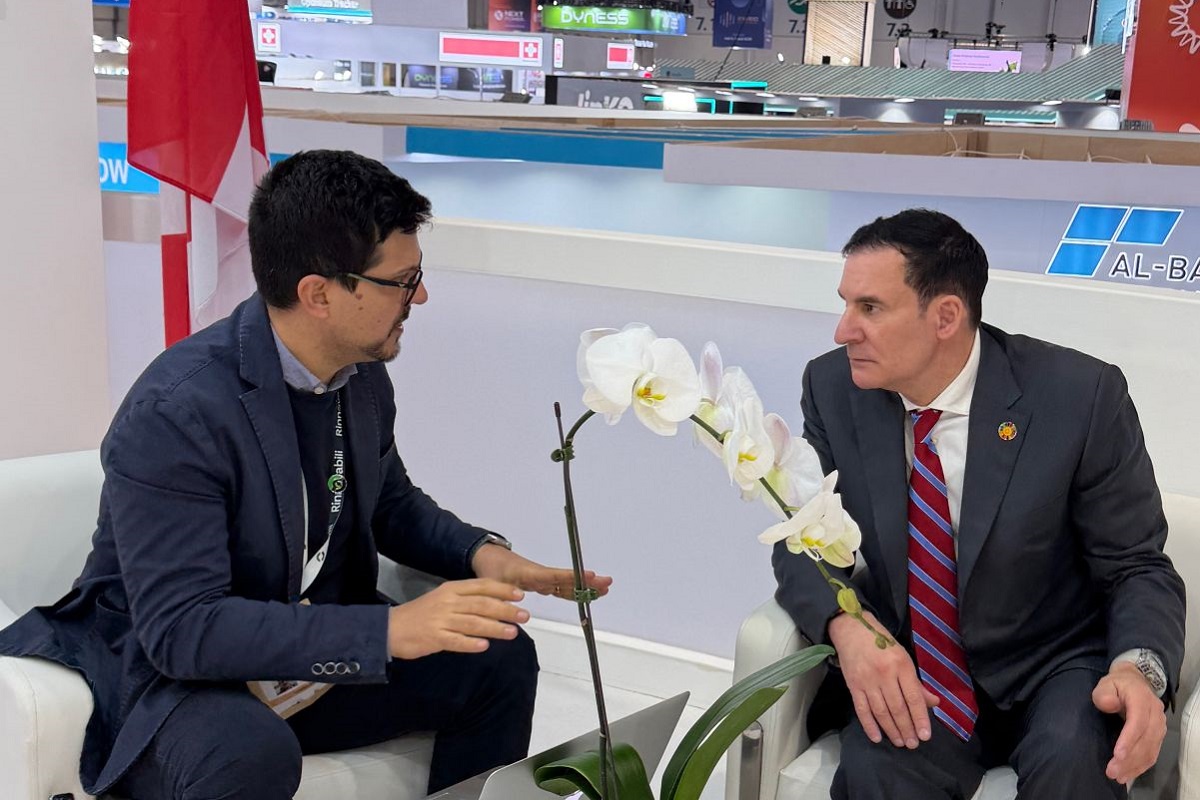
The price of solar energy could rise. And a lot, if a solution to the global silver shortage is not found. Saying this at the World Future Energy Summit in Abu Dhabi is Kerry Adler, founder and CEO of SkyPower Global, whom we interviewed at the company’s booth at one of the leading international events for the energy sector. With Adler we retraced the history of the group, analyzed the evolution of the renewables market, and discussed the major challenges facing photovoltaics globally: from rising raw material costs to the centrality of Africa as a new engine of growth, all the way to the role of power grids and storage in the energy transition.
Let’s start with the history of SkyPower Global: when did you enter the market?
SkyPower was founded in 2003 and, at the time, we started with small-scale projects: our first plant was 9 MW. Today we do not enter a country for less than one gigawatt. Paradoxically, the cost per megawatt has decreased, but the size of the required investments has grown enormously. Markets are evolving rapidly and the rate of solar adoption is now very high.
At the beginning everyone focused on the simplest markets, where solar served to replace existing capacity. In Ontario, in the United States for example, we obtained 51% of market allocations and helped design the Canadian feed-in tariff program. It was simple: you injected 10 MW into the grid and the system absorbed them without problems.
The renewables sector is entering a more complex phase: tighter margins and rising cost of capital. From your point of view, what has changed compared to five years ago in project development?
Today the situation is different. In countries such as China, India, and Europe, solar is no longer an experimental technology: it is fully proven. We have plants built in 2007–2008 that are still operating. But the real future is no longer in replacing existing generation: it is in new capacity, in first power. For this reason our focus today is Africa, followed by South America and Latin America. We believe the greatest global opportunity is right here. A few years ago we moved our headquarters to the United Arab Emirates, a strategic choice that allows us faster access to markets thanks to numerous investment and tax treaties. It is a country with a very clear vision: low-cost energy, quick to build, is essential for development.
A rapidly expanding market, but some critical issues remain. What do you see on the horizon for the sector?
Looking toward 2026, one of the main risk factors we have been monitoring for over 18 months is silver. Today the price of silver has the greatest impact on the cost of solar energy over the next 12–24 months.
Eighteen months ago a solar module contained silver worth 8–9 US cents; today we are close to 45 cents. Silver is increasingly scarce: it is used by electric vehicles, semiconductors, and industry, while jewelry accounts for only 4–5% of demand.
Those who produce modules and have not already secured silver supply today will not be competitive. Over the past 12 months the price has risen by 165%, and at present there are no mature technological alternatives: even developing them would require at least two or three years.
Do you have the solution in your pocket?
Today we see an oversupply of silicon and manufacturing capacity, but the real bottlenecks in solar and storage are silver and cobalt. For this reason we are diversifying: we remain focused on utility-scale, but from 2026 we will also enter modular, rapidly deployable systems. In Africa we work exclusively with governments, through public–private partnerships. We do not participate in auctions or tenders. All projects are covered by sovereign guarantees, the PPAs are denominated in US dollars, and this eliminates currency risk and payment default risk for investors.
So is it just a prejudice that many investors consider Africa a risky market?
It is a mistaken perception. We have been present in Africa since 2010. We invested cautiously, observed, and grew projects like a gardener grows plants. Today we can say that Africa is the greatest global energy opportunity. In reality, the risk of non-payment in Africa is lower than in many developed countries. Once energy is supplied, it cannot not be paid for: it is essential for the functioning of the state. Take the Democratic Republic of the Congo: we are expanding the national power grid. Today the country has just over 2 GW of installed capacity; a single one of our projects will represent about one third of total capacity. Without energy, industry does not develop, and without industry a country collapses.
The stability of the power system has also been decisive in contexts such as Egypt and South Africa. In Africa, energy does not replace: it enables development. Moreover, the continent is extremely rich in strategic resources: 60% of the world’s cobalt is in the DRC, essential for 80% of global batteries; copper in Zambia, Zimbabwe, and the DRC, indispensable for electrification and data centers.
What strategy is your company pursuing in Canada and the USA?
Our strategy in the North American market, therefore Canada and the United States, is very simple: stay away. Not because it is a bad market, but because this is where the main frictions are concentrated. The challenges are many. Beyond government tariffs, imports, and other issues, the real difficulty in the United States—according to colleagues who have been developing projects there for years—is first of all access to the grid and, second, the permitting process. Today in Africa we can obtain environmental permits in three or four months, typically within that timeframe. In the United States and Canada, as in most developed countries, instead, there are always numerous complications: supportive groups, opposing groups. Every government naturally has the right to set rules and regulations in line with its own agenda, and for this reason we do not criticize anyone.
After the blackouts in Spain and Portugal, some have attributed responsibility to photovoltaics. Is the issue of intermittency still central?
I believe that one of the greatest challenges developed countries must face today is the obsolescence of their power grids. Just look at the countries of the former Soviet Union—Kazakhstan, Uzbekistan, Turkmenistan, Tajikistan: they all use practically identical systems, replicated at the time and largely never replaced. Even in countries such as India, losses due to outdated electrical infrastructure are enormous. The problem is not solar, but the obsolescence of power grids. Many countries still operate with infrastructure that is decades old. Integrating renewables requires advanced grid-forming technologies. The real challenge of the coming years is the enormous increase in electricity demand. By 2030 global capacity will need to grow by at least five times. Where will we find this energy? Oil and gas are expensive and insufficient. Solar is the only scalable source, low-cost and with free input.
Today in many areas of the world the cost of solar generation is 1.5 US cents/kWh. With storage it reaches 6–8 cents: fully competitive. The problem, once again, is silver. Without an alternative solution, electricity prices will rise. The future of solar is bright. But the raw materials supply chain will be the real testing ground for the energy transition.