Impacts of photovoltaics in utility-scale solar systems
According to a new report by IRENA, the impacts of photovoltaics at utility scale have become a central issue in the global energy transition debate. Solar photovoltaics is now the fastest-growing renewable technology worldwide.
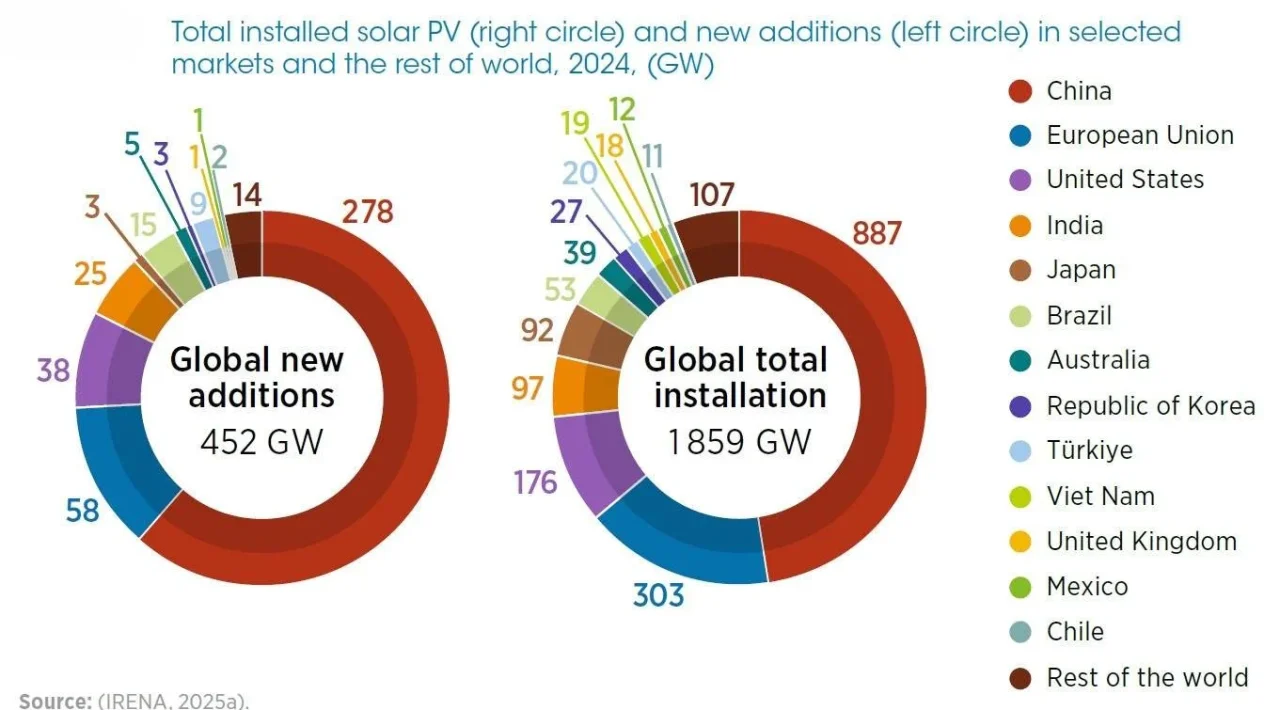
In 2024 alone, solar accounted for 77 percent of newly installed renewable capacity and 42 percent of total global green capacity. Since 2015, installed solar capacity has increased more than eightfold, fundamentally reshaping energy systems.
Under a pathway aligned with the goal of limiting global warming to 1.5°C, photovoltaics is expected to supply 37 percent of global renewable electricity by 2050 and account for roughly half of all new annual installations.
This rapid expansion is accelerating decarbonization, but it also makes a thorough assessment of local environmental effects unavoidable.
The impact of photovoltaics on global emissions
From a climate perspective, the impacts of photovoltaics are overwhelmingly positive, this is the first key finding of the IRENA report.
The International Renewable Energy Agency estimates that solar plants installed between 2019 and 2023 avoided around 1.1 gigatons of greenhouse gas emissions per year, equivalent to about 3 percent of total global emissions in 2024.
Over the longer term, the gradual replacement of coal and gas power plants with solar generation could cut carbon dioxide emissions by 3.2 gigatons per year by 2050.
Beyond CO₂, solar power also reduces emissions of air pollutants such as sulfur dioxide, nitrogen oxides and fine particulate matter, delivering direct benefits for public health and air quality in urban and industrial areas.
Land use challenges in utility-scale solar
Among the impacts of photovoltaics at large scale, land use remains one of the most debated issues in public and political discussions. The need for large surface areas can create conflicts with agricultural land use, especially in densely populated countries or regions with limited fertile land.
As IRENA points out, the land required depends on geographic conditions, technology and project design. Available data indicate average values ranging from 1 to 4 hectares per megawatt installed.
In China, even under a maximum expansion scenario, solar would occupy less than 1 percent of national territory by 2050.
In the United Kingdom, the required surface would remain below 0.7 percent of total land area and under 2 percent of agricultural land.
In the United States, estimated land occupation is below 0.5 percent of national territory.
According to IRENA, these figures show that solar photovoltaics does not pose a systemic threat to land use when supported by adequate spatial planning.
Impacts of photovoltaics on biodiversity and natural habitats
The issue becomes more critical when solar plants are located in ecologically sensitive areas. During the construction phase, projects can lead to habitat loss, soil compaction and erosion, altered water flows and disturbance to wildlife.
During operation, the presence of solar modules can affect soil temperature, moisture regimes, vegetation cover and the local microclimate.
The report also highlights direct risks to bird populations. In California, long-term monitoring shows an average mortality of 2.49 birds per megawatt per year at some solar facilities. Associated grid infrastructure, such as power lines and substations, further increases the risk of collisions and electrocution.
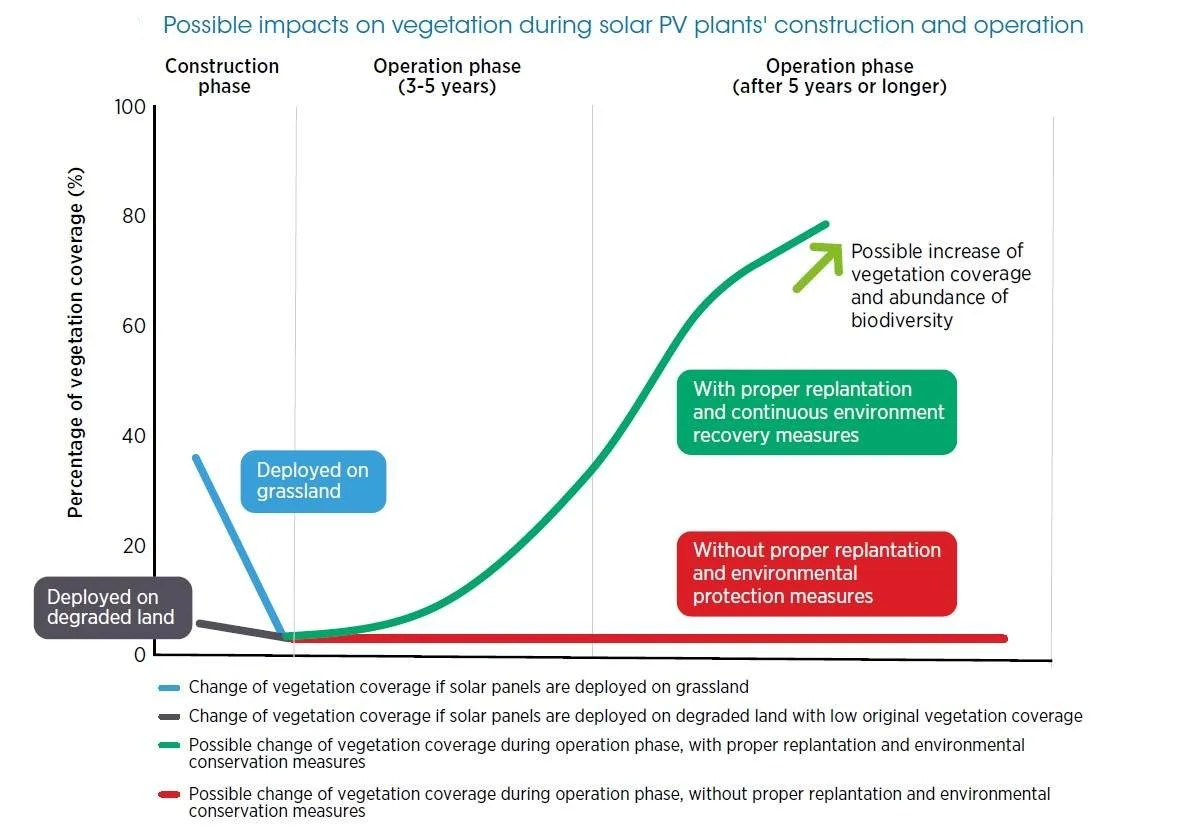
At the same time, in arid and semi-arid conditions, solar installations can support the restoration of abandoned mining sites or areas affected by desertification. In Gonghe, China, for example, vegetation cover increased from 2 percent to more than 55 percent over ten years thanks to the shading provided by solar panels.
Materials and resource use in photovoltaics
A central chapter of the report focuses on material extraction and use. IRENA estimates that by 2030 global solar module production will require 2.6 million tons of aluminum, 0.18 million tons of copper and around 4,000 tons of silver.
Primary extraction of these resources places significant pressure on terrestrial and marine ecosystems, involves substantial water consumption and generates emissions linked to mining activities. The report therefore stresses the need to develop more sustainable supply chains based on recycling, reuse and circular module design, reducing environmental risks across the entire life cycle.
When photovoltaics become a benefit for local communities
IRENA notes that the environmental impacts of photovoltaics can turn into tangible benefits when projects are well integrated into their surroundings.
As mentioned, solar plants can contribute to the restoration of degraded soils, reduce evaporation in arid regions and help mitigate sandstorms. In some contexts, vegetation management practices can support an increase in local biodiversity.
Synergies with agriculture and grazing are particularly relevant. In Canada, integrating sheep grazing within solar facilities has increased agricultural profitability from 10 percent to 40 percent, compared with an average of 7.3 percent in conventional farming.
In the United States, solar projects developed on remediated industrial sites have driven local property value increases ranging from 5 percent to 15 percent.
Public policies to reduce the impacts of photovoltaics
According to IRENA, managing the environmental impacts of photovoltaics at utility scale requires integrated and consistent public policies.
Comprehensive environmental impact assessments, cumulative analyses, forward-looking spatial planning and early engagement with local communities are essential tools to reduce conflicts and opposition.
The report underlines that today only a limited share of solar projects systematically incorporates advanced environmental measures. Strengthening these approaches is considered critical to ensure the long-term sustainable development of the sector.