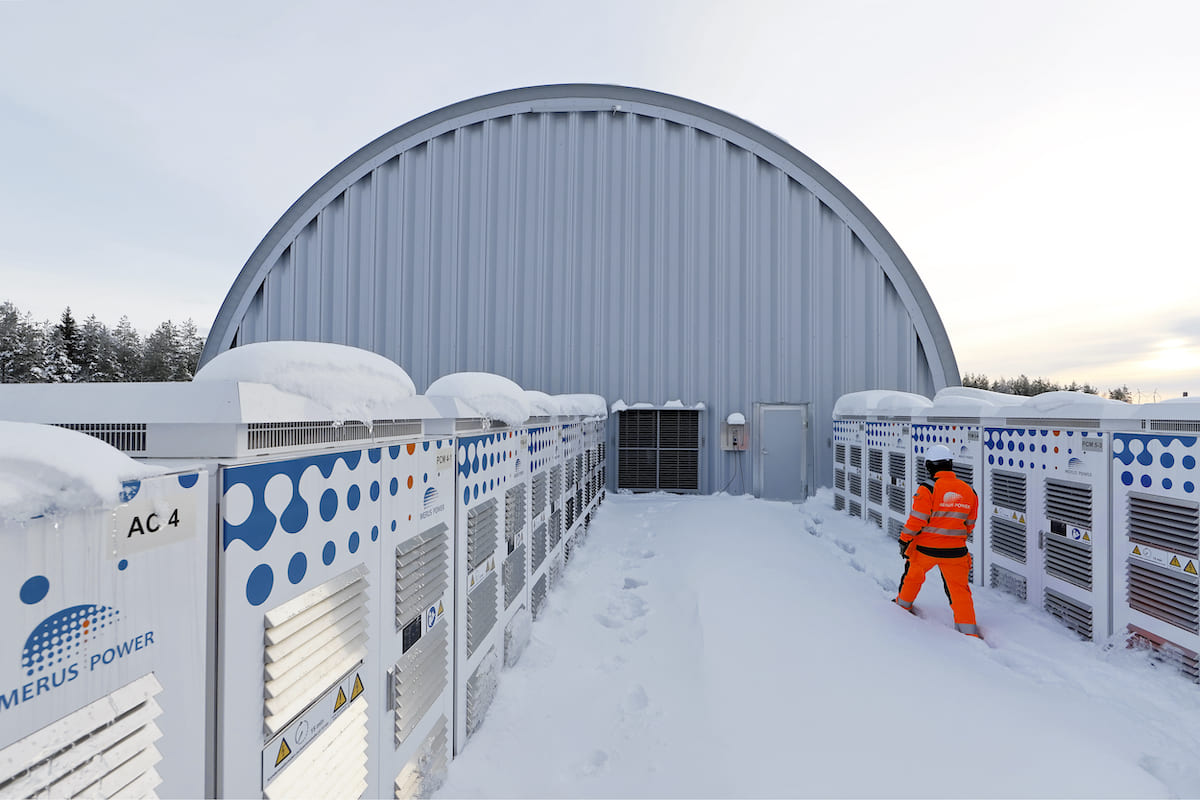
Grid-forming BESS strengthens Nordic power stability
A homegrown technology designed to operate reliably in extreme cold, resisting ice, snow and humidity while stabilizing the power grid, is now gaining ground in Finland. The new grid-forming BESS developed by Merus Power is the first of its kind approved for use in the Nordic transmission system.
Since 2023, when transmission system operator Fingrid published technical requirements for grid-forming functionality, Merus Power has moved quickly. Beyond introducing its Merus® ESS platform, the company has signed multiple supply and delivery agreements.
The first project was completed in October last year, with the commissioning of a 30 MW / 36 MWh installation in Valkeakoski for Alpiq. The most recent agreement, signed at the end of January, involves delivering a 30 MW / 80 MWh system to Neve.
Merus® ESS, engineered for extreme climates
All of these projects share a defining characteristic, they operate in a country where temperatures frequently fall below -40°C during winter cold waves, particularly in inland areas of Lapland. One of the core features of Merus® ESS is its ability to function reliably even when temperatures drop dramatically.
The system is modular, scalable and built for harsh climates and coastal environments. At its core are bidirectional inverters managed through a proprietary control platform and an integrated energy management system, EMS, designed to ensure uninterrupted operation.
The batteries use lithium iron phosphate, LFP, chemistry and deliver peak efficiency of 98.5%. The C-rate ranges between 1 and 0.25C, corresponding to discharge durations from one to four hours.
Available in 5 MW and 10 MW AC block configurations, Merus® ESS “offers the highest power on the market with a single MV transformer,” the company said.
The role of grid-forming technology
The defining strength of the system remains its grid-forming capability. Merus® ESS is the first grid-forming BESS approved by a transmission system operator in the Nordic countries.
Unlike traditional power electronics solutions, the system simulates inertia and actively generates voltage and frequency signals. This enhances grid stability and resilience, particularly as renewable generation increases and conventional rotating assets decline.
Merus Power also emphasizes cybersecurity as a critical component of its solutions, given that energy storage systems are part of critical infrastructure. “All power electronics and grid connection software are fully developed in-house,” the company noted.
Arctic energy storage as a reliability benchmark
Delivering performance under extreme weather conditions is central to the project’s positioning.
“Our solutions have been developed for demanding power grid environments, where performance, reliability and high availability are critical factors,” said Kari Tuomala, CEO of Merus Power.
“Arctic conditions place exceptional requirements on electrical systems,” added Kristian Gullsten, CEO of Neve Oy. “Merus Power’s solution addresses these challenges and supports our strategic goal of developing reliable and sustainable energy solutions for the demanding conditions of Lapland.”