
The Electricity 2026 report by the IEA
This is the age of electricity. Global electricity demand continues to rise relentlessly, and clean generation is keeping pace, with renewables set to account for the largest share of power generation by 2030. Yet never before has electricity attracted such intense focus on a range of urgent challenges, simultaneously generating optimism and concern.
Providing a snapshot of the sector is Electricity 2026, the latest report from the International Energy Agency, offering an in-depth analysis of recent trends and policy developments underpinning this new era.
Global electricity demand on track for 33,600 TWh
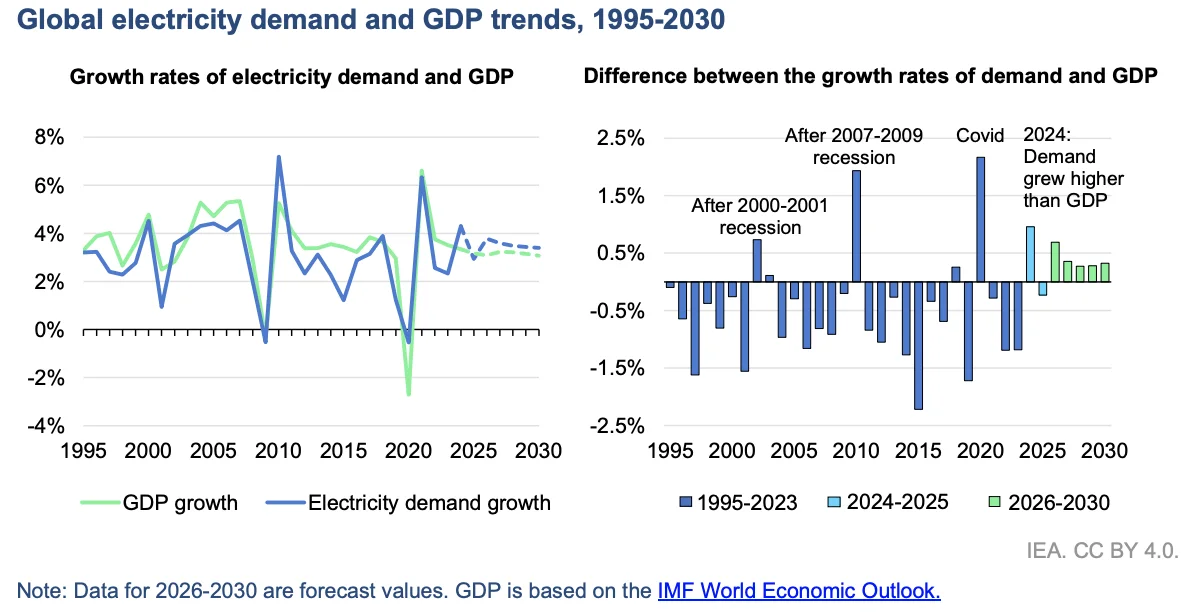
Overall trends point to a sharp acceleration in consumption over the near term. According to IEA analysts, global electricity demand will grow at an average annual rate of 3.6% over the 2026–2030 period. This pace is more than 50% higher than the average recorded over the past decade and will push global demand from 28,200 TWh in 2025 to 33,600 TWh by 2030.
As Keisuke Sadamori, director of energy markets and security at the IEA, put it, this is equivalent to “adding the electricity consumption of two additional European Unions.”
Two figures stand out. Electricity consumption is expected to grow at least 2.5 times faster than overall energy demand, and its expansion will outpace global GDP growth throughout the period to 2030.
Why global electricity demand is accelerating
The drivers behind this surge are largely familiar and concentrated in three sectors. Buildings account for 49% of demand growth to 2030, industry for 39%, and transport for 10%.
Nearly half of the increase in buildings comes from the expansion of data centers, themselves fueled by artificial intelligence, alongside the rollout of heat pumps and rising demand for cooling. In transport, the sector’s contribution to global demand growth is set to double, exceeding 10%, driven by the rapid uptake of electric vehicles.
Industrial electricity use is also accelerating compared with the past decade, led by light industry and advanced manufacturing linked to clean technologies such as semiconductors, batteries, and solar modules. A further 2% comes from other emerging uses of electricity.
Regional dynamics, however, vary widely. Emerging economies will remain the backbone of demand growth, with China alone accounting for nearly 50% of the global increase through the end of the decade, at an average annual growth rate of 4.9%. According to the Chinese government, the country is on track to reach electricity demand equivalent to the current consumption of the entire European Union.
India, the other major Asian powerhouse, will sustain robust growth at an average of 6.4% per year. The United States and the European Union, after years of stagnation, are also seeing demand rise again, with average annual growth rates of around 2% and 2.3%, respectively.
Renewable power generation keeps pace
Electricity demand is rising fast, but generation is keeping up and becoming steadily cleaner. Total renewable electricity generation is now surpassing coal-fired output, in line with previous IEA projections.
“With solar PV generating record amounts of electricity, renewable generation rose rapidly in 2025, reaching nearly the same level as coal-based generation based on the latest available data,” the report notes. “Renewable electricity generation is expected to increase by about 1,000 TWh per year through 2030, with solar PV alone accounting for more than 600 TWh.”
The IEA expects the transition toward low-emissions generation to continue through 2030, when renewables and nuclear together will supply 50% of global electricity, up from 42% today. At the same time, natural gas-fired power generation is also set to grow, supported by US demand and the phaseout of oil-fired power in the Middle East.

Grids, flexibility, and security emerge as critical bottlenecks
On paper, rising demand matched by rising generation might suggest balance. In practice, major obstacles remain in connecting the two. Infrastructure is the first constraint. More than 2,500 GW of projects, spanning renewables, storage, and large loads such as data centers, are currently stuck in grid connection queues worldwide.
To integrate the new generation mix and growing loads safely and efficiently, annual investment in power grids will need to rise sharply. The IEA estimates an increase of about 50% by 2030, from roughly $400 billion today to around $600 billion by the end of the decade.
System flexibility must also expand, particularly through demand response and energy storage. In the European Union alone, widespread deployment of demand response by 2030 could cut future system costs by €19–37 billion per year. Technical challenges are also intensifying. The decline of traditional synchronous generation from large fossil fuel plants requires new solutions, such as synchronous condensers and grid-forming inverters, to maintain voltage stability and system strength.
Strategic risks are growing as well. These range from physical threats, such as the sabotage of the EstLink-2 cable between Finland and Estonia, to digital ones, including a failed cyberattack on Poland’s power grid in December last year.
What lies ahead for electricity prices
In 2025, wholesale electricity prices followed divergent regional paths. Prices rose in the European Union and the United States due to higher natural gas costs, while falling in Australia and India.
Amid geopolitical tensions and rising uncertainty, forecasting remains difficult. The IEA expects regional divergence to persist, alongside increasing hourly volatility and continued pressure on end-user prices.
In the EU, average wholesale prices in 2025 stood at about $95/MWh, with futures markets pointing to relative stability in 2026 before easing to around $85/MWh in 2027. In the United States, prices climbed to about $50/MWh in 2025, are expected to average around $45/MWh in 2026, and return to roughly $50/MWh in 2027. In Australia, futures for 2026–2027 hover near $60/MWh, while prices in India are also expected to remain competitive in the short term.