ENTSO-E explains the causes of the blackout in Spain
At 12:33 p.m. on April 28, 2025, a massive blackout in Spain and Portugal left millions without electricity. Today, the European Network of Transmission System Operators for Electricity (ENTSO-E), which coordinates over 40 grid operators in 36 countries, has published its investigation. The findings are conclusive: renewables played no role in the event. Instead, a series of cascading system faults caused the collapse.
Two oscillations in frequency and voltage at 12:03 and 12:19 made the grid vulnerable to overvoltages. Minutes later, three major generation disconnections triggered a domino effect, worsened by the low availability of thermal plants to support voltage control. The Iberian grid lost synchronization with France and Morocco, making the collapse inevitable. Within 30 seconds, the system voltage dropped to zero. ENTSO-E notes that wind and solar generation levels were consistent with seasonal averages. As the independent think tank Ember stated, “the findings contradict claims that excessive reliance on solar power was to blame.”
Iberian operators acted swiftly to restore power
The ENTSO-E report also praises the rapid response of Spanish and Portuguese grid operators. The restoration was remarkable: the entire system was back online within 19 hours. Hydropower plants with black-start capability played a crucial role, as did international interconnections. Links with France and Morocco were reactivated within hours, helping to rebalance the system gradually.
The report highlights that several transformers connecting wind and solar facilities disconnected prematurely, exacerbating the overvoltage issues. Some thermal plants, on the other hand, failed to provide the required grid services. According to ENTSO-E, the vulnerability stemmed not from the share of renewables but from a lack of stabilizing resources and the specific grid configuration at the time. A final report, expected in early 2026, will provide further details and recommendations to prevent similar events.
Renewables drive electricity price cuts
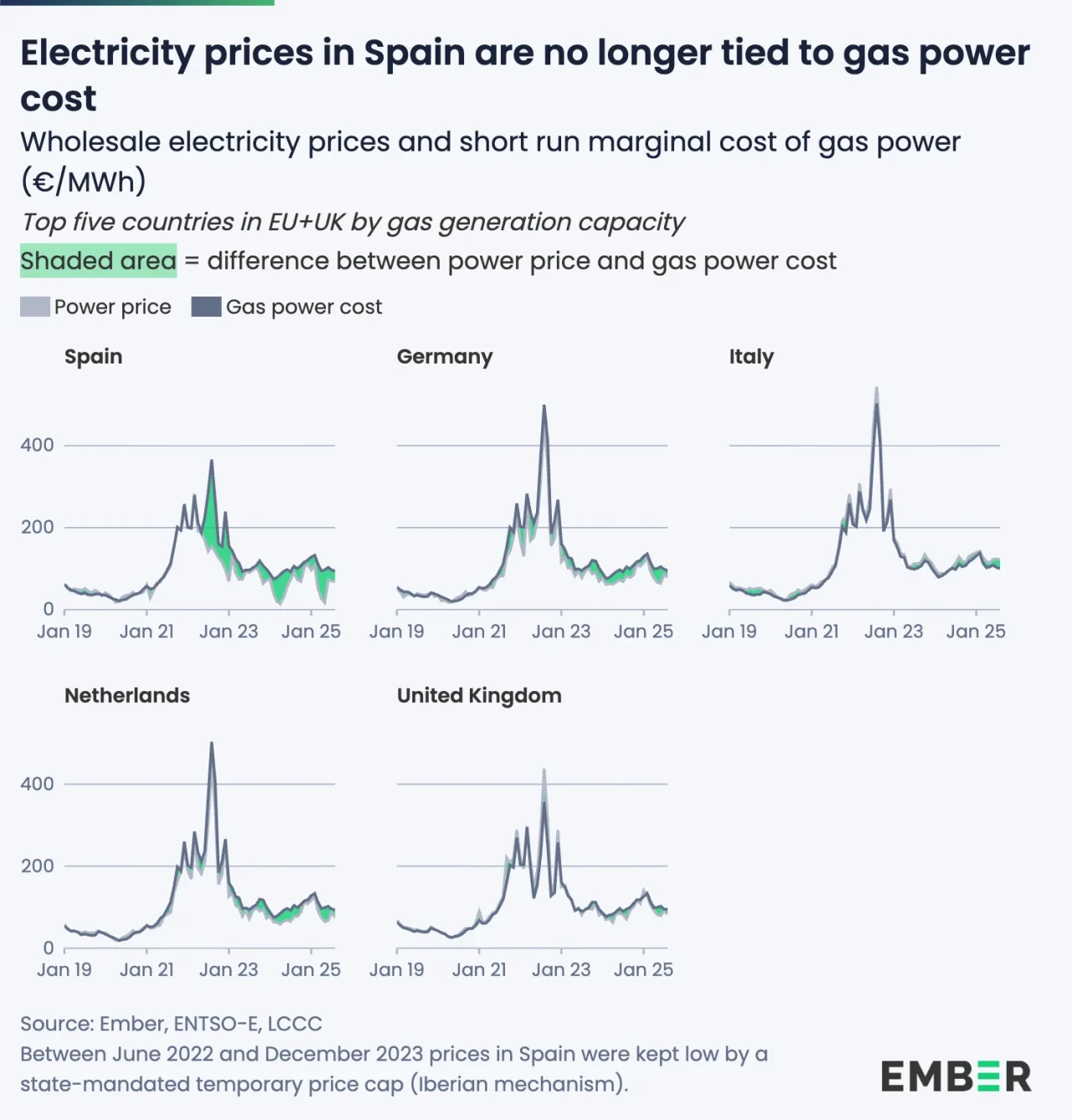
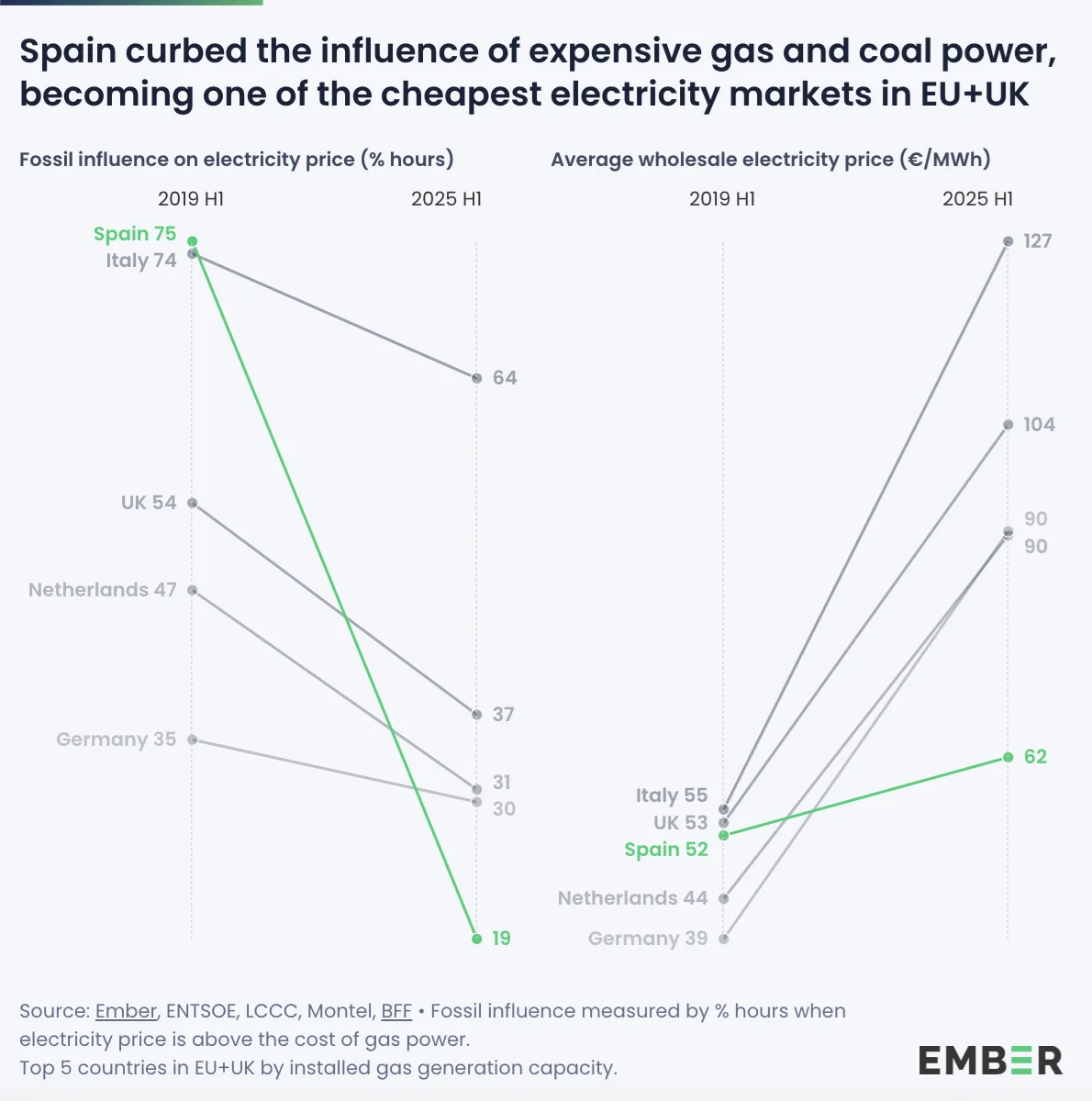
Alongside the blackout report, Ember released an analysis showing how renewables have transformed Spain’s electricity market. Since 2019, the rise of wind and solar has reduced the influence of gas and coal on prices by 75%. In the first half of 2025, fossil fuels set the price only 19% of the time, compared to 75% in 2019. As a result, wholesale prices in Spain were 32% below the EU average, among the lowest in Europe.
This shift was driven by a surge in installations, over 40 GW of new wind and solar capacity since 2019, boosting renewable coverage from 27% to 46% of demand. That contrasts sharply with slower progress in countries like Germany and Italy, where gas remains more dominant. Ember concludes, “Spain has broken the harmful link between electricity prices and fossil fuel volatility.”
Rising gas dependence after the blackout
Following the blackout, gas-fired plants played a larger role in stabilizing the grid. In May 2025, gas use for grid services doubled year-on-year, pushing up electricity costs. Gas accounted for 57% of final electricity prices, up from 14% the previous year. At the same time, renewable curtailment tripled, from 1.8% to 7.2% between May and July 2025.
These figures show how insufficient stabilizing tools can push the system back toward fossil fuel dependence. As Ember senior analyst Chris Rosslowe warned, “Spain risks sliding back into costly gas dependence. Strengthening grids and batteries is essential to permanently move away from fossil fuels.”
Upgrading Spain’s grid and flexibility solutions
Both ENTSO-E and Ember agree: Spain must invest in grid infrastructure and flexibility for clean energy. Although it is Europe’s fourth-largest electricity market, the country ranks only 13th in battery capacity, with just 120 MW installed.
Grid investment remains below the EU average: for every euro spent on new renewables, only 30 cents go to transmission infrastructure, compared to 70 cents elsewhere in Europe. Several projects are underway to bridge the gap. Eight synchronous compensators have been authorized to provide alternative stabilization services to gas. The announced battery pipeline exceeds 2.6 GW, with 340 MW already approved.
Reinforcing interconnections, especially the Bay of Biscay project backed by the European Investment Bank, will also be crucial. The technologies needed to ensure grid stability already exist and are not cost-prohibitive. The priority now is turning studies into real investment.
A lesson from Spain for Europe
The Spanish blackout offers lessons beyond the Iberian Peninsula. Grid security does not depend on the share of renewables but on the availability of stabilization resources and the quality of infrastructure. Other countries confirm this: Denmark manages 69% wind and solar without major issues, and the Netherlands 45%. Fossil-heavy grids have also faced blackouts, as seen in Texas and the UK.
The solutions are well known: storage, flexible demand, smart grids, and interconnections. Spain has already proven that renewables can cut power prices and boost competitiveness. Now, it must consolidate these gains with more resilient infrastructure. As Ember concludes, “strengthening the grid and energy storage is key to building the future energy system based on renewables.”