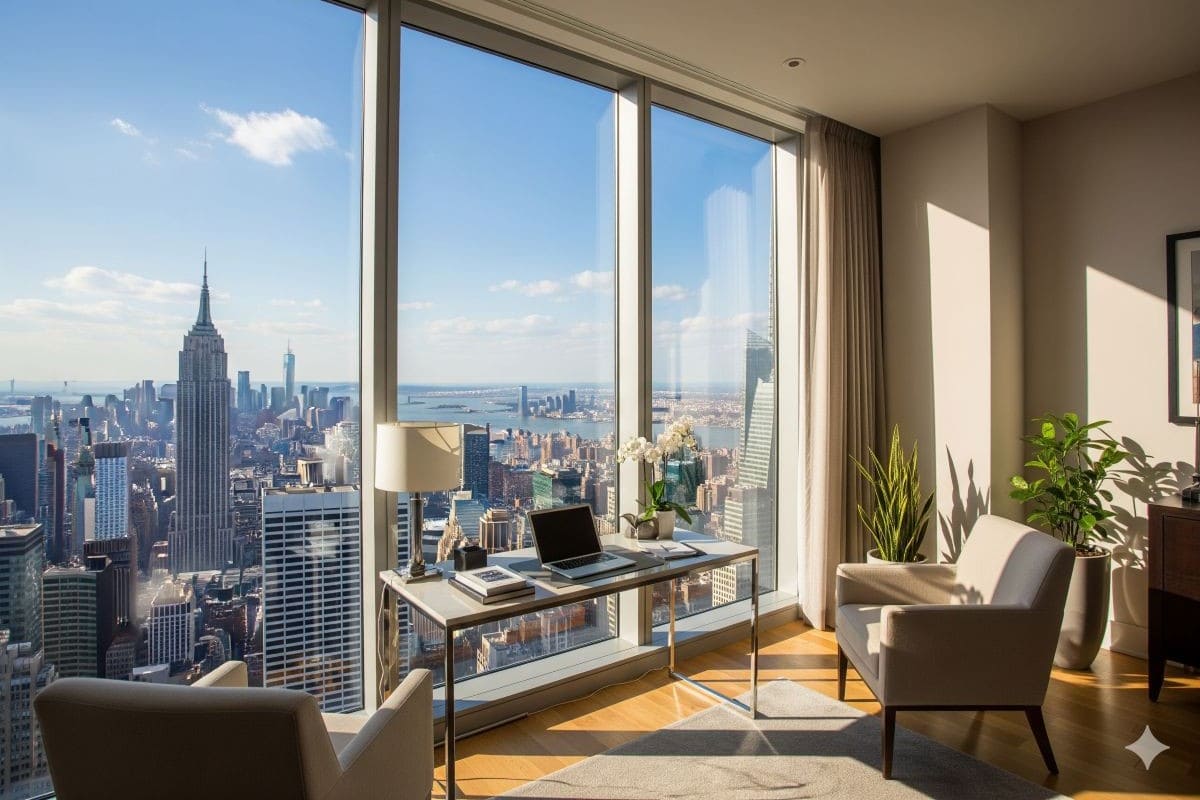
The quality of window views can shape wellbeing, workplace performance, and real estate value
Sustainable building design today is not only about energy efficiency and cutting consumption, it also concerns people’s wellbeing. A crucial factor is visual comfort, often overlooked in green building protocols.
In this context, researchers at Cornell University have developed ViewScore.io, an innovative software that measures and simulates the visual quality of windows, opening new opportunities for architects, energy managers, and developers.
Visual comfort as a key element of sustainable building design
The ViewScore.io software can simulate and assess window views, providing a score based on more than twenty parameters including privacy, external elements, and lighting. Its dual goal is to support architects and developers in sustainable building design and at the same time enhance occupant wellbeing.
Developed at the Environmental Systems Lab and Housing Innovation Lab within the College of Architecture, Art and Planning (AAP), the system uses machine learning, interviews, and surveys to predict user satisfaction with what they see from their windows. Tested in case studies in New York, the scores factor in window size and glazing, perceived privacy, and the presence of external elements such as sky, trees, buildings, people, and infrastructure.
“Architects often want to create panoramic views because people love to look outside, but from a sustainability perspective windows are a weakness,” explained Jaeha Kim, PhD candidate in systems engineering and lead developer of the software.
A scientific methodology for green building
The research behind the software, published in the journal Leukos, introduced an internationally shared experimental protocol, addressing the lack of uniform methods for evaluating views through glass surfaces. The study compared assessments conducted in physical spaces, virtual reality, and digital images, concluding that VR and images can effectively replace real-world experiments for most parameters, including user satisfaction.
Thanks to these tests, ViewScore.io has shown the potential to integrate visual quality into sustainable building standards and environmental comfort criteria.
Practical applications: from real estate to hospitality
Today, ViewScore.io is already available as a plug-in for architectural simulation software.
Looking ahead, its potential applications are wide-ranging:
- Architecture: real-time CAD plug-ins that optimize building orientation, window placement, and privacy levels.
- Real estate: integration with platforms such as Zillow or MLS to differentiate properties through objective metrics on view quality.
- Hospitality: support for revenue management in hotels, with optimized rates based on panoramic views, landmarks, or access to nature.
Visual comfort and real estate value
Studies in New York have shown that visual comfort improves on higher floors, along with greater access to natural light and privacy. This directly impacts market value, as apartments with better views also tend to be less affordable, creating social disparities.
The issue also emerged in a study of a residential complex in Queens, where researchers found that lower floors faced more privacy challenges due to proximity to surrounding buildings. According to the team, these findings challenge the validity of uniform design approaches across different floors, highlighting the need for more tailored solutions.
“We are not just developing an experimental protocol, we are turning it into a practical computational tool to improve living conditions,” concluded Kim.