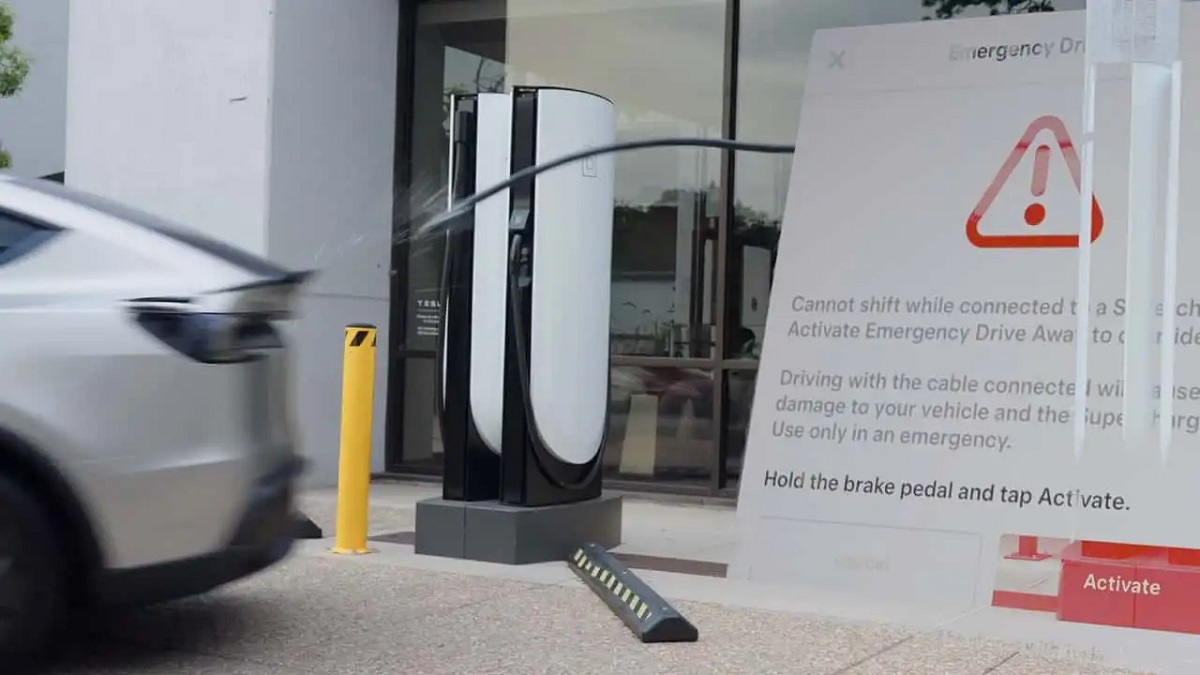
Tesla Emergency Drive Away lets drivers escape a charging station in seconds
An emergency feature that allows drivers to pull away from a charging station while the charging cable is still connected. Tesla has introduced a new safety function called Emergency Drive Away, recently released through an over-the-air software update.
But what is it actually designed to do?
Electric vehicle owners know that when a charging cable is plugged into the vehicle and electronically locked in place, it cannot be removed until the charging session has been terminated. Normally, drivers must stop charging through an app or charging card before disconnecting the cable.
This safety mechanism, standard on battery electric vehicles (BEVs), prevents drivers from accidentally damaging their vehicles or public charging infrastructure by attempting to drive away while still plugged in.
Tesla’s solution
Tesla engineers have developed a way for drivers to shift into Drive and leave a charging station without first disconnecting the cable. The feature is specifically intended for dangerous or emergency situations.
How does it work?
When a Tesla is connected to a Supercharger and the driver attempts to shift into Drive, the vehicle’s touchscreen displays a warning that charging is still underway. At the same time, it offers an option to override the normal safety restriction and drive away immediately.
The feature was introduced in a post on X by Max de Zegher, Tesla’s senior director of charging for North America, who described Emergency Drive Away in particularly stark terms:
“A feature we hope you never have to use.”
Why would drivers need to escape without unplugging?
There are several reasons why drivers might need this capability, and just as many reasons to avoid using it unless absolutely necessary.
The most obvious scenario involves an immediate threat to personal safety. A robbery in progress, a passenger experiencing a medical emergency or an urgent call for help could make leaving the charging station as quickly as possible essential.
But there is a significant downside.
Forcing the vehicle to disconnect while the cable remains attached can cause substantial mechanical damage, potentially breaking the vehicle’s charging port and the Supercharger connector.
That means two separate repair bills: one for the vehicle itself and another for the damaged charging equipment.
Damage and repair costs could reach $25,000
When Emergency Drive Away is activated, the vehicle automatically sends footage from its onboard cameras to Tesla. The automaker reserves the right to charge drivers for repairs and impose additional penalties if the feature is misused or activated without a legitimate emergency.
In other words, this is strictly a last-resort safety measure. The potential damage could reportedly cost as much as $25,000.
A closer look at the demonstration video in slow motion shows the motorized charging-port door giving way under the force of the attached cable, although it is difficult to determine whether other components are damaged.
The sudden departure also causes the Supercharger connector to separate from its cable, with a visible leak of coolant from the charging system.
Emergency Drive Away lets you shift into Drive while still plugged into a Supercharger https://t.co/40GSzyP4lG
— Tesla Charging (@TeslaCharging) October 1, 2026
The timing of the feature’s introduction is particularly notable. Emergency Drive Away was implemented two months after a shooting at a Tesla Supercharger in Twin Falls, Idaho.
During the incident, a gunman opened fire on several vehicles in the charging area. One driver was able to escape because their vehicle had not yet been connected to the Supercharger. Had the charging cable been locked in place, leaving the scene could have been considerably more difficult.
The new feature is therefore intended to give Tesla owners greater peace of mind, while potentially setting a precedent for other electric vehicle manufacturers.
For now, however, Emergency Drive Away works only at Tesla-operated Superchargers. It is not compatible with third-party charging networks and is currently available only in the United States.