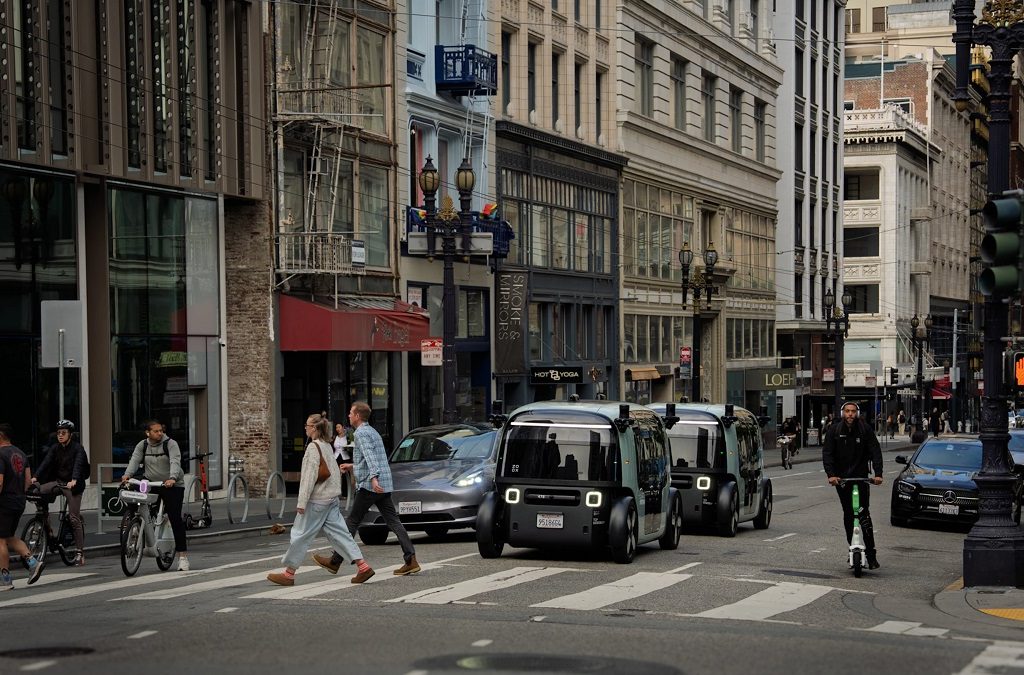
Would you ride in a steering wheel-free robotaxi with no brake pedal? In the United States, that future is rapidly becoming reality. The nation’s highway safety regulator has granted its first approval for robotaxis without steering wheels and is now considering an even more radical proposal that would also eliminate the brake pedal. Europe, meanwhile, is only beginning large-scale testing.
Safety, of course, remains the central issue. But today’s vehicle design rules were largely written nearly 50 years ago, when autonomous driving existed only in science fiction. “No one at the time could have imagined that cars would one day drive themselves, making components like steering wheels, windshield wipers, and rearview mirrors unnecessary,” explained Jonathan Morrison, head of the agency.
Amazon-backed Zoox is pushing for a new generation of autonomous vehicles
Driving the regulatory debate is Zoox, Amazon’s autonomous vehicle subsidiary acquired for $1.2 billion. The company has launched a free pilot service in San Francisco and Las Vegas using distinctive box-shaped vehicles with four inward-facing seats instead of a traditional driver’s position.
Before launching commercial service, Zoox still needs approval from state and local authorities. Amazon ultimately plans to manufacture 10,000 robotaxis annually at a facility near Silicon Valley. During its initial deployment, however, the company will be limited to 2,500 steering wheel-free vehicles over its first two years, during which it must demonstrate consistent real-world safety. Some Zoox components are also manufactured in Modena, Italy.
Safety concerns remain despite the promise of autonomous driving
Not everyone is convinced.
Beyond the curiosity of first-time passengers encountering vehicles without steering wheels, safety advocates remain skeptical. Advocates for Highway and Auto Safety argues there is still insufficient evidence that fully autonomous vehicles can safely operate on public roads.
“There are plenty of reassuring promises, but very little concrete evidence showing these vehicles are truly safe on public roads. That’s what concerns us most,” said the organization’s general counsel, Peter Kurdock.
Can autonomous driving reduce traffic crashes?
Safety is the defining challenge, extending far beyond vehicle design.
According to the National Highway Traffic Safety Administration (NHTSA), autonomous driving has the potential to eliminate two of the leading causes of serious crashes: driver distraction and drunk driving.
Robotaxis already operate extensively in parts of the United States and China, but the technology has also experienced well-publicized failures. Some autonomous vehicles have stopped unexpectedly in traffic, struggled to exit parking lots, or blocked emergency vehicles and school buses. U.S. regulators continue to investigate these incidents and have issued recalls where necessary.
The transparency problem
Another major issue is access to safety data.
The Insurance Institute for Highway Safety (IIHS) notes that it remains difficult to objectively measure the safety performance of robotaxis because most operators do not disclose their total miles driven. Without that information, calculating meaningful crash rates is nearly impossible.
At the same time, comparisons with human drivers are not straightforward. Robotaxi operators typically report even minor incidents, while human drivers generally report only crashes involving injuries or significant property damage.
Europe is taking a much slower path
Compared with the United States and China, Europe remains at an earlier stage of deployment.
The continent’s dense historic cities, narrow streets, pedestrian zones, and far more conservative regulatory framework have slowed adoption. A significant step forward came when 18 European countries, including Italy, signed a declaration of intent to support large-scale cross-border testing of autonomous vehicles. The initiative aims to create a common regulatory framework that could accelerate commercial deployment in public transportation, logistics, and freight.
The United Kingdom currently leads Europe after adopting the Automated Vehicles Act, one of the world’s most advanced legal frameworks for Level 4 autonomous driving. That regulatory environment prompted Waymo to choose London as its first European city for public road testing, followed by growing interest from companies including Baidu and Uber.
Within the European Union, progress remains more cautious, with strong emphasis on vehicle certification and cybersecurity. Germany hosts some of the continent’s most advanced pilot projects, where Volkswagen and Mobileye are testing autonomous shuttles in Munich and Berlin for future shared mobility services.
Meanwhile, Stellantis is partnering with Pony.ai to test autonomous electric vans and shuttles in countries including Luxembourg, while Uber plans to integrate AI technology from British autonomous driving company Wayve into its future European fleets.