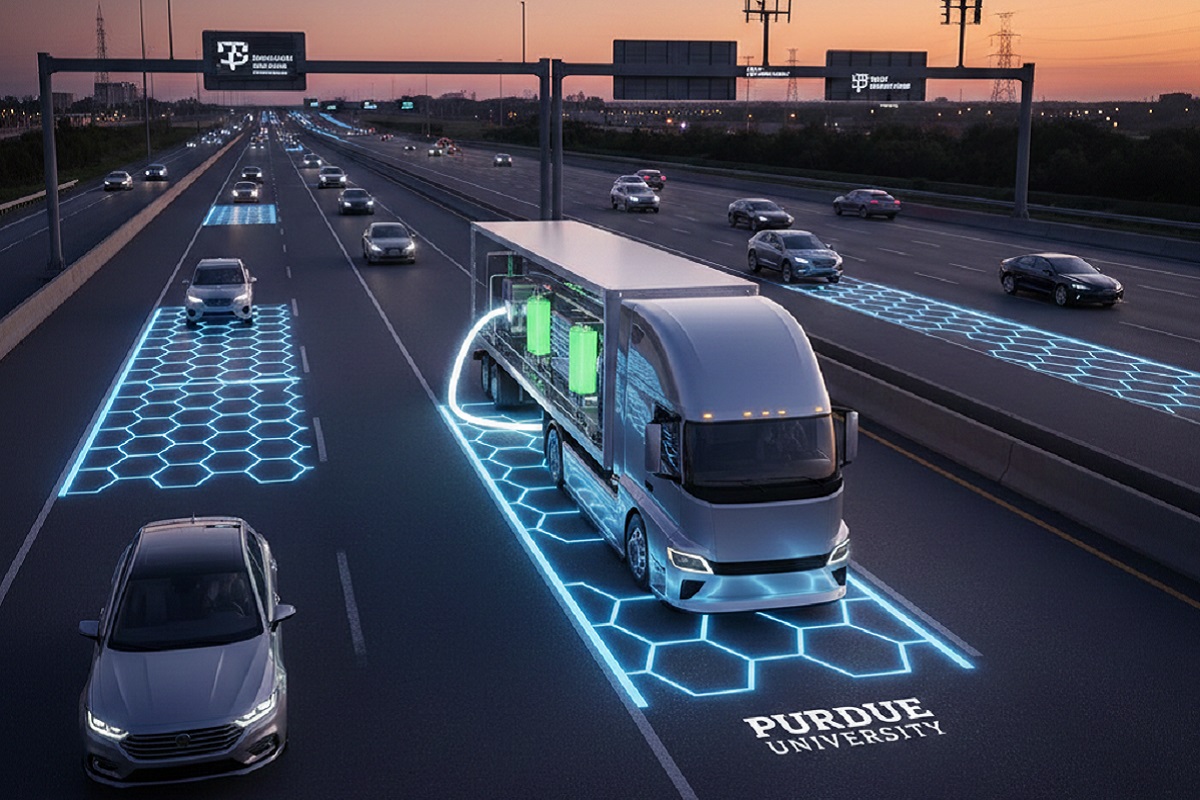
Electric truck technology tested on a live highway segment
Charging an electric truck wirelessly while driving on the highway is no longer theoretical. Purdue University engineers have demonstrated it on a 400 meter stretch of US Highway 52 near West Lafayette, developing what they describe as a practical and scalable solution for real world freight transport. For the first time, the research team successfully tested a wireless system on heavy duty vehicles, noted civil engineering professor Nadia Gkritza.
The project, launched in 2018, confirms that it is possible to transfer energy dynamically, meaning while the tractor trailer is in motion. Although wireless charging has been tested on lighter passenger vehicles, the Purdue experiment marks a breakthrough for trucks, which travel at higher speeds on highways and therefore require significantly more power.
Performance results and economic implications
In the West Lafayette pilot segment, Purdue’s wireless charging system delivered 190 kilowatts to a truck traveling at roughly 65 mph. “It is a system designed to work for the heaviest class of trucks as well as passenger transport vehicles,“ said Aaron Brovont, professor at Purdue University. Road freight is a core contributor to the US economy, which is why highways could see greater investment to support the adoption of electric trucks.
If electric trucks could recharge or maintain charge while using the highway network, their battery packs could become smaller. In turn, trucks could carry more cargo, reducing weight and cost pressures for fleets.
Wireless charging for trucks works like smartphones
“Two of the main barriers to EV adoption are range anxiety and cost,“ said Purdue professor John Haddock, noting that batteries are the single largest cost component of electric vehicles. The system enables roadway pavement to supply energy to electric trucks in a manner similar to how smartphones draw power through magnetic fields when charging wirelessly.
Concrete pavement transfers energy to moving vehicles
“Transferring energy through a magnetic field over relatively large distances is a challenge, and doing it for a heavy duty vehicle moving at power levels thousands of times higher than a smartphone makes it even more demanding,“ said Dionysios Aliprantis, professor of electrical and computer engineering at Purdue University.
To achieve this, the team embedded transmitting coils in designated lanes beneath the concrete pavement. These coils send energy to receiving coils mounted on the underside of the truck. The system has undergone additional testing to help establish industry standards for dynamic wireless power transfer. Researchers now aim to demonstrate the technology for multiple vehicle classes, including passenger cars and light duty trucks.