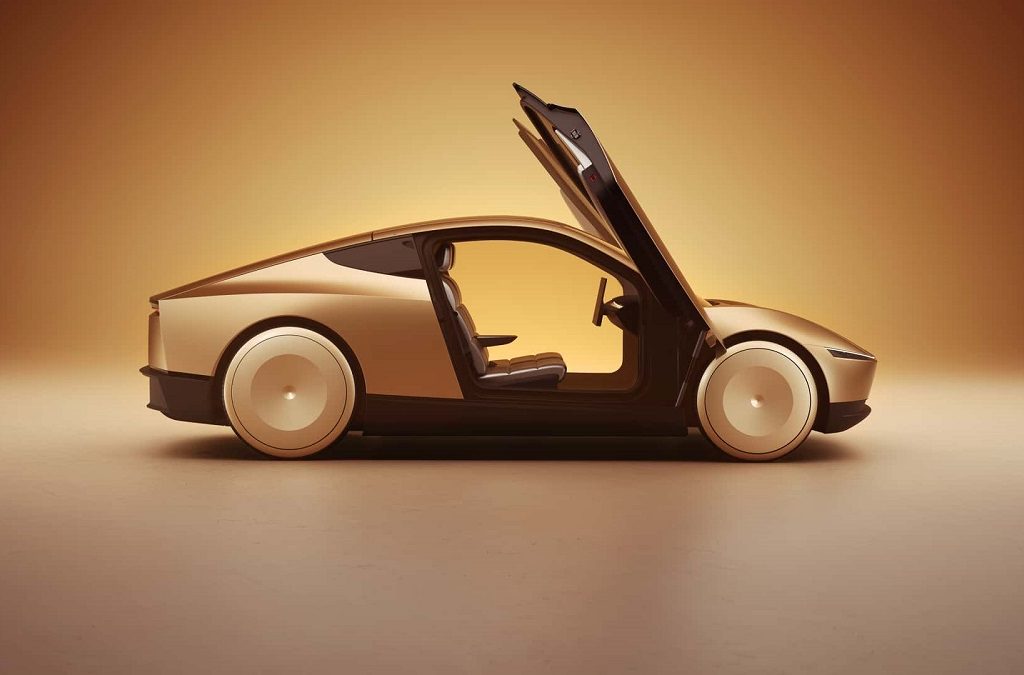
What Cybercab by Tesla will look like
No steering wheel, no pedals. It looks like a car, but it isn’t one in the traditional sense. Cybercab by Tesla is a next-generation robotaxi, an autonomous, electric two-seater designed purely for transportation, not driving. Elon Musk announced that production will begin in the second quarter of 2026, with the ambitious goal of reaching 3 million units per year within two years.
During the company’s quarterly earnings call, Musk described Cybercab as “a critical turning point toward 100% autonomous driving.” Tesla also plans to remove safety drivers from its existing robotaxi fleet in Austin by the end of the year, paving the way for full deployment of the new model.
Once human operators are out of the equation, Musk envisions the vehicle as “a living creature,” emphasizing the sophistication of its artificial intelligence. “I wonder how intelligent a car can get,” he mused. “It might even get bored.”
Inside Cybercab
Cybercab’s minimalist interior will include two passenger seats and a central display screen on the dashboard, showing travel information, communication tools for the robotaxi or remote operator, and payment options. The large touchscreen will also serve as an entertainment hub. Physical controls will be reduced to the essentials: window buttons, door handles, and an interior light switch.
The technology behind Cybercab
At the heart of Cybercab is Tesla’s Full Self-Driving system, powered by Tesla Vision, an AI-based camera suite. The car will feature the new A15 chip, developed with TSMC and Samsung, offering advanced computing performance and safety levels exceeding those of human drivers.
The 35 kWh battery will deliver a range of about 200 miles, optimized for city driving. Cybercab will also support wireless inductive charging, eliminating the need for cables and enabling fast recharging at Tesla’s Supercharger hubs equipped with integrated ground plates.
A fleet of Tesla robotaxis
The term “robot” frequently appears in Musk’s vision, from Cybercab to the humanoid robot Optimus, still facing supply chain hurdles. For Cybercab, Tesla plans two distinct business models:
- Robotaxi network: Cybercab will join a vast autonomous fleet accessible via app, offering rides at lower costs than traditional taxis.
- Shared ownership: Tesla aims to create a system where owners of Tesla vehicles, including Cybercab, Model 3, and Model Y, can rent out their cars to the fleet when not in use, turning vehicles into income-generating assets.
No new models on the horizon
Musk’s latest announcements reveal no new Tesla models in production. The rumored Model 2 compact EV remains on hold, as the company shifts its focus from manufacturing vehicles to developing digital mobility ecosystems and autonomous technology.
In a market now led by China’s BYD, Tesla’s strategy emphasizes the evolution from carmaker to mobility platform, one where vehicles like Cybercab redefine the very concept of driving.