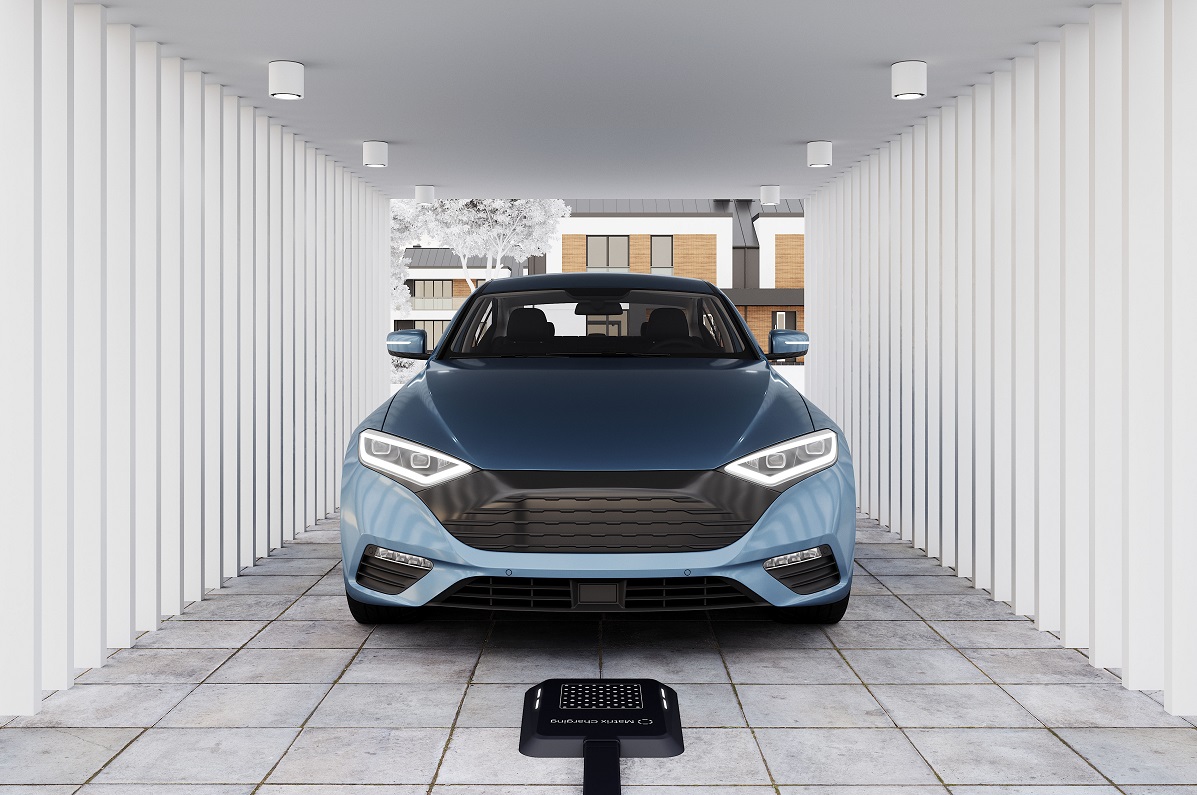
Conductive charging technology enters a new stage
The technology behind electric vehicle charging is beginning to evolve. In Austria, Easelink has developed Matrix Charging, an automated conductive charging system designed to streamline everyday use. The project has already gained support from several manufacturers, including Audi, Nissan and Vojah of the Chinese Dongfeng group, which created the MCIG consortium to simplify EV charging. At the latest IAA 2025 in Munich, we also saw a similar solution adopted by Porsche for the electric Cayenne. In that case, however, it relied on inductive, fully wireless transfer, while conductive charging requires direct contact even when the process is automated. Here is how it works.
Conductive charging system
Unlike cable-based systems or wireless induction solutions, Matrix Charging uses a physical connection between the vehicle and a plate installed on the ground. A lightweight, compact mechanical connector is mounted on the underside of the vehicle and can lower itself autonomously. When the vehicle parks over the plate, known as the pad, the system detects its position, aligns the components and brings the connector into direct contact with the charging surface. The attachment is fully automated, so the driver only needs to stop in the designated spot.
Unlike inductive charging, which transfers energy without contact but with reduced efficiency, Easelink’s solution maintains a physical conductive link. This allows for high efficiency levels, close to those of a cable, and power outputs comparable to a 22 kW AC charger or a DC fast charger delivering up to 50 kW.
The ground plate can be integrated into parking surfaces without creating obstacles and is built to withstand real-world conditions such as rain, snow, dust or road salt. The vehicle-mounted connector includes a cleaning mechanism that removes debris from the surface before making contact, ensuring consistent efficiency and electrical safety.
International adoption of the system
One of the most compelling aspects of this system is its complete automation. Since the vehicle connects to the grid every time it is parked, Matrix Charging is well suited to urban areas, taxi fleets, car-sharing operators and private parking spaces where frequent charging is required without user interaction. The Austrian company is also working on international standardization through the MCIG consortium, aiming to make the technology interoperable across different vehicle manufacturers and infrastructure providers.
Despite its potential, widespread adoption still depends on automakers integrating the connector into their models and on public and private parking operators installing the plates. The technology is already mature from an engineering standpoint, but it is still in an expansion and consolidation phase from an industrial and regulatory perspective.
“Our goal is to establish Matrix Charging as the global standard for automated charging. By making our essential patents available under FRAND conditions, we provide MCIG members with operational flexibility and long-term planning certainty for both the use and further development of the technology,” said founder and CEO Hermann Stockinger.

Differences between inductive and conductive systems
Easelink’s conductive system and inductive charging both offer cable-free automation, but rely on opposite principles. With Matrix Charging, the vehicle connects through physical contact with a ground plate, ensuring very high efficiency, strong power delivery for both AC and DC, and generous alignment tolerance. In practical terms, it acts like a cable that connects itself, with performance similar to a traditional charging station.
Inductive charging, on the other hand, transfers energy without contact through magnetic fields. It is theoretically more convenient, but has higher losses, typically lower power levels and requires very precise coil alignment. The infrastructure is more expensive and complex to install.