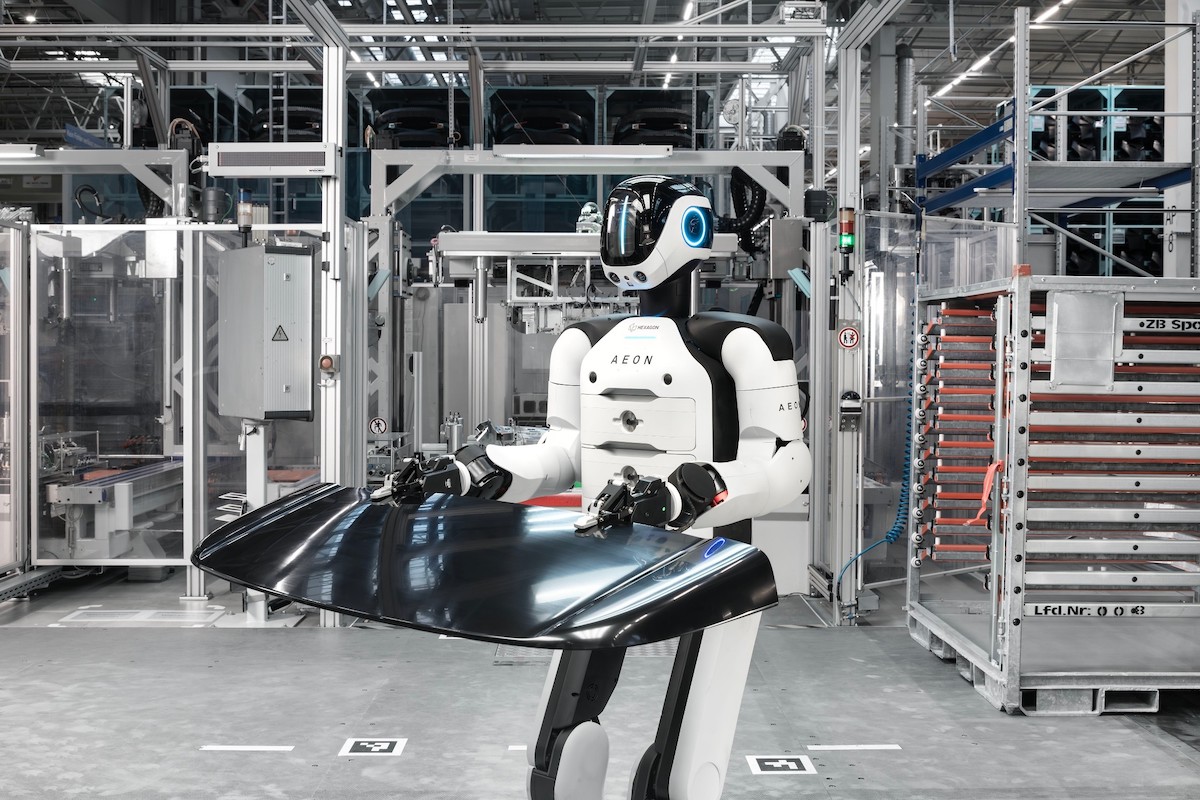
BMW humanoid robot pilot project advances Physical AI in production
BMW has launched a European test phase to integrate a humanoid robot into its series production of vehicles, batteries and components at its Leipzig plant. The robot, named AEON, is designed to work alongside human employees within the group’s manufacturing network.
The move reflects BMW’s broader push toward Physical AI, the application of artificial intelligence within real robotic bodies capable of operating in complex industrial environments.
Physical AI moves beyond software
Following successful trials in the United States, BMW is accelerating its strategy around Physical AI. Unlike traditional AI systems confined to digital interfaces, Physical AI allows machines to perceive, learn and act directly in real-world settings.
“The synergy between engineering expertise and artificial intelligence opens entirely new possibilities,” said Milan Nedeljković, Member of the Board of Management of BMW AG responsible for Production.
At the core of this approach is BMW iFACTORY, the company’s flexible and digital manufacturing model built on a unified data architecture. BMW has developed a platform where digital agents can instruct robots in real time, enabling adaptive and data-driven production processes.
Pilot project in Leipzig with AEON
The European pilot, launched last December, involves collaboration with Hexagon Robotics, which developed AEON as a multifunctional humanoid platform. The robot features an anthropomorphic upper body mounted on wheels and can be equipped with different grippers or scanning tools depending on the task.
After preliminary testing, a deeper integration phase will begin in April 2026, with the operational pilot scheduled for summer 2026. The BMW humanoid robot will be deployed in high-voltage battery assembly and component production, handling repetitive or ergonomically demanding tasks.
“Our goal is to be a technology leader and to integrate new technologies into production processes at an early stage,” said Michael Nikolaides, Senior Vice President Production Network and Supply Chain Management at BMW Group. “Pilot projects allow us to test and further develop the use of Physical AI under real industrial conditions.”
Lessons from the United States
BMW’s European expansion builds on experience gained in the United States. In 2025, at the Spartanburg plant in South Carolina, the Figure 02 robot became the first humanoid robot deployed in a BMW facility.
Over a ten-month period, the robot supported the production of 30,000 BMW X3 vehicles, handled more than 90,000 sheet metal components and logged approximately 1.2 million steps across 1,250 working hours. Results demonstrated millimeter-level precision in component placement and a rapid learning curve as the system transitioned from laboratory testing to real assembly lines.
A new paradigm with the Center of Competence
To manage this transformation, BMW has established a Center of Competence for Physical AI in Production. The hub evaluates technology partners and standardizes robot integration across the company’s ecosystem through 5G connectivity and standardized interfaces.
The strategy is not aimed at replacing workers but redefining their roles. By delegating low-value or physically strenuous operations to machines, BMW seeks to improve workplace safety and enhance global competitiveness.
“We are consolidating the expertise required to make artificial intelligence and robotics knowledge widely accessible within the company,” said Felix Haeckel, Team Lead of the Center of Competence Physical AI for Production. “In recent years, we have built an international team of experts dedicated not only to internal research and programming, but also to the progressive integration of AI into the existing production system.”