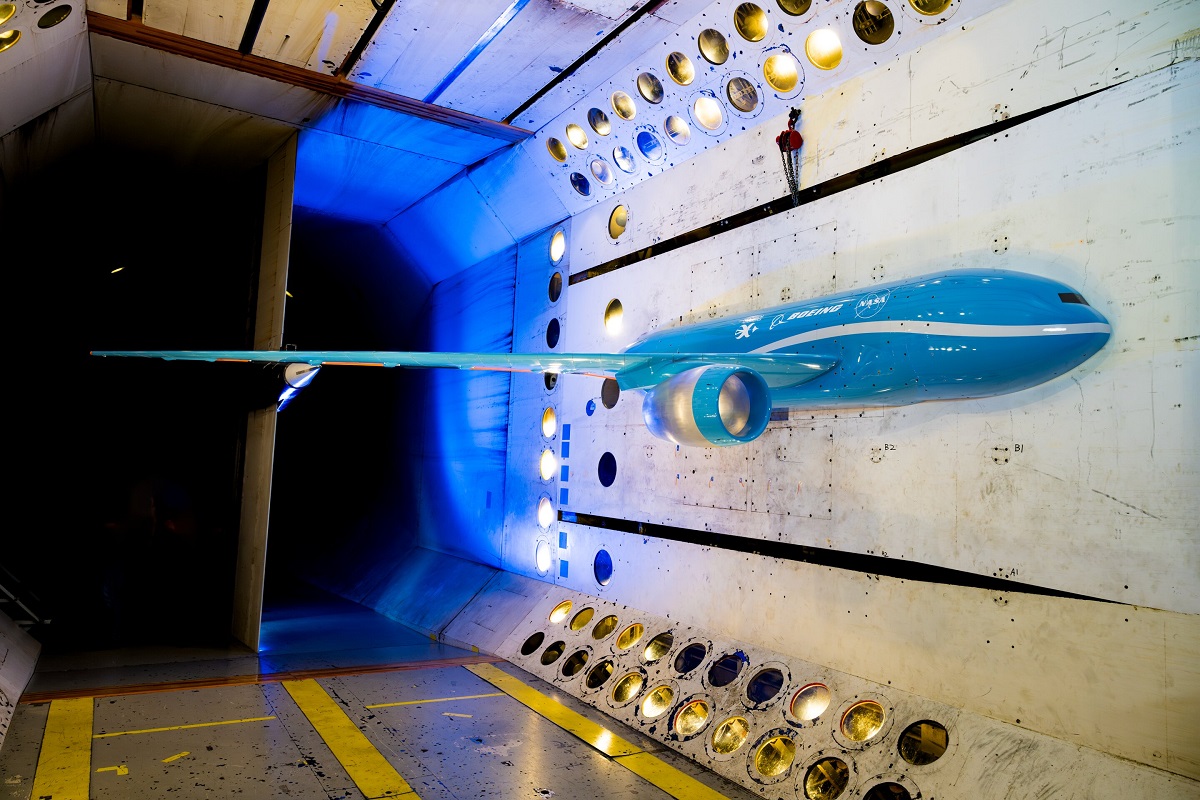
The airplane of the future and longer, thinner wings
For the airplane of the future, designed to consume less fuel and reduce its climate impact, NASA and Boeing have joined forces, combining research capabilities and funding. The focus is on wings that can flex and adapt to flight conditions, advanced aerodynamic technologies aimed at lowering emissions across the aviation sector and reshaping how the airplane of the future is designed.
Longer wings for more efficient aircraft
From an aerodynamic standpoint, longer and slimmer wings generate lift with less air resistance. This results in smoother flight and significant fuel savings, a key objective for the decarbonization of air transport.
The challenge is that increasing wingspan also increases flexibility. During flight, especially in gusty conditions or sharp maneuvers, this flexibility can create complex and potentially dangerous structural stresses.
The aeroelastic risk when wings start to vibrate
One of the most critical issues linked to thin wings is wing flutter, an aeroelastic instability that can trigger violent, self amplifying vibrations. When airflow interacts with the natural frequencies of the wing structure, oscillations can rapidly escalate, potentially leading to structural failure. Preventing this phenomenon is not only a safety requirement. Controlling aeroelastic effects also reduces structural loads, improves passenger comfort, and increases overall aircraft efficiency.
The airplane of the future tested in a wind tunnel
Studying wing flutter is not feasible using a full scale commercial aircraft. For this reason, NASA relied on the Transonic Dynamics Tunnel at the NASA Langley Research Center, a facility that has been operating for more than 60 years and has played a central role in the design of civil, military, and space aircraft.
Inside the tunnel, engineers installed a large scale model developed with NextGen Aeronautics. The setup resembles a half aircraft, with a wing about four meters long mounted on a wall and equipped with advanced instrumentation to measure forces, vibrations, and structural responses.
Wings that adapt to flight conditions
At the core of the project, known as Integrated Adaptive Wing Technology Maturation, is the use of active control surfaces along the trailing edge of the wing. Ten movable panels adjust airflow in real time, damping the gust induced effects that cause wing vibrations and reducing aeroelastic loads.
Compared with earlier programs, this model represents a significant technological leap. The higher number of control surfaces enables far more sophisticated stabilization strategies, improving both wing stability and aerodynamic performance.

Test results and future outlook
“When you have a very flexible wing, you enter a regime of higher acceleration,” said Jennifer Pinkerton, an aerospace engineer at NASA Langley. “Factors such as gust loads and maneuver loads can cause even greater excitation than with a lower aspect ratio wing. Higher aspect ratio wings also tend to be more fuel efficient, so we are trying to take advantage of that while simultaneously controlling the aeroelastic response.”
Test campaigns showed a significant reduction in wing vibrations during simulated wind gusts. Based on the data collected, engineers have launched computational analyses and simulations, with early results described as highly promising. The knowledge gained will be shared with the aerospace industry and could directly influence the design of the next generation of commercial aircraft, making them more efficient, quieter, and less damaging to the climate.
“Initial data analyses showed that the controllers developed by NASA and Boeing and used during the test delivered notable performance improvements,” said Heaney. “We are excited to continue analyzing the data and to share the results in the coming months.”