Triple-junction photovoltaic in perovskite, the latest advances
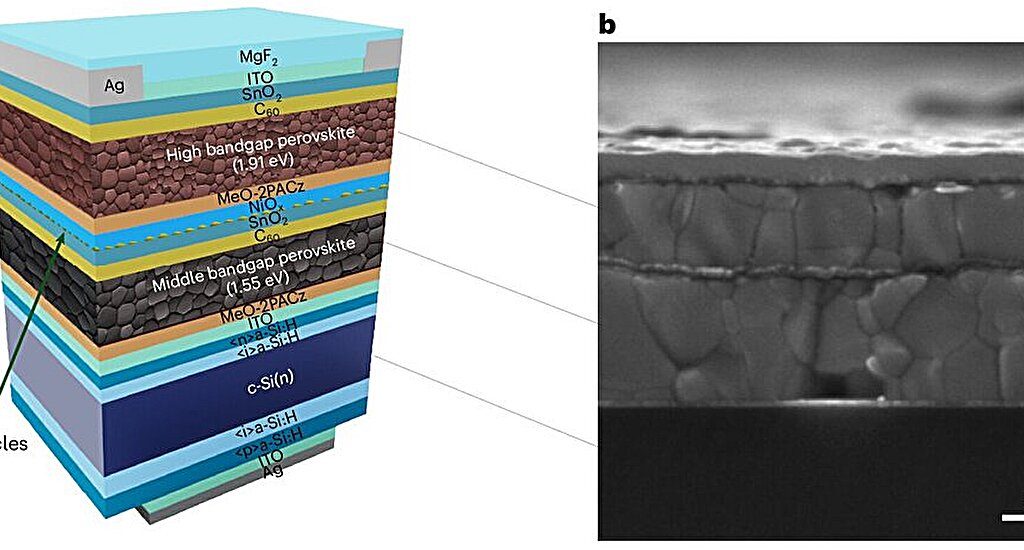
A new world record has been set in solar energy efficiency. An international team of scientists from Australia, China, Slovenia, and Germany has developed a triple-junction photovoltaic device that pushes the boundaries of conversion performance. The 1 cm² prototype can transform 27.06% of sunlight into electricity, an achievement worthy of the Guinness World Records.
The device, a perovskite–perovskite–silicon tandem cell, demonstrated both excellent thermal stability and scalability. When the active area was increased to 16 cm², the conversion efficiency remained above 23%, the highest ever achieved for this technology at that size.
“This is the largest perovskite-based triple-junction device ever demonstrated and has been rigorously tested and certified by independent laboratories,” said Professor Anita Ho-Baillie from the University of Sydney, who led the research team. “This gives us further confidence that the technology can be adapted for real-world use.”
The potential of multijunction photovoltaics
Multijunction photovoltaic technology represents the most promising approach to surpass the traditional Shockley–Queisser limit. That limit, it should be recalled, sets at 33.7% the maximum portion of sunlight that an “ideal” single-junction solar cell can convert into electricity.
By stacking semiconductor materials with different bandgaps, tandem cells can capture multiple portions of the solar spectrum, pushing theoretical efficiency up to about 45% for dual-junction and around 51% for triple-junction designs.
Metal halide perovskites have long been integrated into these multilayer structures due to their easy fabrication, compatibility with monolithic integration, and tunable bandgap properties.
The first perovskite–perovskite–silicon tandem cell appeared in 2018 with 14% efficiency, followed in 2019 by the first all-perovskite triple-junction cell at 6.7%. Over the years, both conversion efficiency and stability have improved dramatically, extending operational durability from minutes to hundreds of hours.
However, scalability and resistance to environmental stress remain key challenges—precisely the focus of the new work by Ho-Baillie’s team.
Redesigning perovskite solar cells
The researchers focused on surface defects in the upper perovskite junction, redesigning both the material chemistry and overall cell architecture. They replaced methylammonium, commonly used in high-efficiency but unstable perovskite cells, with rubidium, creating a wide-bandgap perovskite lattice less prone to degradation.
To address surface defects in the top layer, they applied a treatment with piperazine-1,4-diium chloride, replacing lithium fluoride. To interface the upper and middle perovskite layers, the team used gold nanoparticles deposited on tin oxide.
The result? The triple-junction photovoltaic device achieved an efficiency of 27.06% on a 1 cm² active area, becoming the first in the world to pass the International Electrotechnical Commission (IEC) thermal cycling test, which subjects prototypes to 200 extreme temperature cycles ranging from -40 to 85 degrees Celsius. The unit retained 95% of its efficiency after 407 hours of continuous operation under illumination.
When scaled to a 16 cm² area, the prototype achieved an independently certified efficiency of 23.3%.
“We improved both performance and resilience,” said Ho-Baillie. “This not only shows that large and stable perovskite devices are possible but also highlights their enormous potential for further efficiency gains.”
The study “Tailoring nanoscale interfaces for perovskite–perovskite–silicon triple-junction solar cells” was published in Nature Nanotechnology (2025).