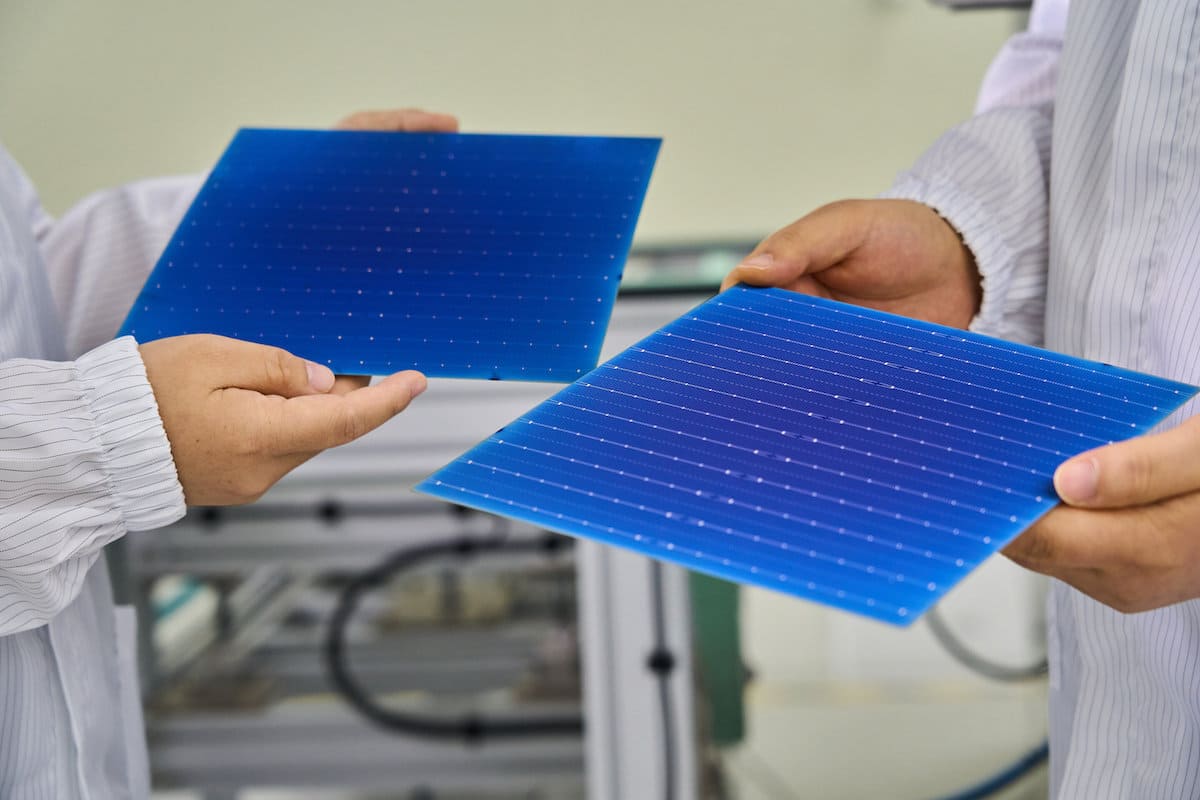
Why SHJ solar cells lose efficiency
SHJ solar cells continue to expand their presence in the global solar market. Despite notable efficiency gains, optimizing their electronic and optoelectronic properties remains challenging. The main issue is that these cells contain multiple, complex defects that traditional analysis techniques struggle to detect.
Until now, such defects could only be inferred indirectly, making it nearly impossible to understand their true nature. A new study from the Korea Institute of Energy Research, conducted with Chungbuk National University, has changed this. Led by Dr. Hee-Eun Song, the research team refined the conventional diagnostic approach and introduced a new technique capable of identifying, for the first time, the specific defects responsible for SHJ efficiency losses.
The efficiency landscape for SHJ solar cells
The findings are significant. Today SHJ solar cells are among the leading n-type technologies replacing PERC. In terms of performance, SHJ modules sit between other major technologies such as TOPCon and IBC, with average module efficiencies of 23.6 percent compared with 23.2 percent for TOPCon and 23.8 percent for IBC.
Long-term projections suggest that SHJ solar cells could reach 26 percent efficiency within the next decade.
Wafer thickness and tandem potential: key competitive strengths
Industry attention is also driven by the technology’s extremely thin wafer. At just 122 µm in 2024, it is the thinnest in the sector and ideal for tandem or multijunction architectures. Forecasts indicate further reductions to 95 µm by 2035.
The main drawback is the high silver consumption required for metallization on both sides of the cell, though alternatives are already under evaluation.
As the segment prepares for rapid growth, precisely identifying and managing material defects becomes essential.
“The defects,” the Korean researchers note, “transform dynamically, altering material behavior, influencing charge transport, recombination dynamics, and long-term stability.”
A new technique to analyze defects in SHJ solar cells
Reducing performance degradation requires effective passivation strategies, such as advanced surface coatings. But addressing the issue first requires an in depth understanding of the defects themselves. Conventional Deep Level Transient Spectroscopy (DLTS) works well for simple structures but is not suitable for complex devices like SHJ solar cells.
To solve this limitation, the research team developed a new interpretation method capable of analyzing the full transient response of the solar cell. The study revealed that the key efficiency limiting defect is actually a combination of two distinct components: a slow component associated with a deep defect and a fast component linked to a surface defect.
By analyzing them separately, the researchers extracted characteristics such as defect energy levels, spatial location within the device, and atomic bond configurations.
“The results,” they explain, “show that passivation quality depends not only on defect concentration but also on the bonding configurations of those defects. These configurations evolve into deeper or shallower defects depending on deposition conditions, layer stacking sequences, and thermal annealing, ultimately shaping the material’s overall properties.”
What the findings mean for the future of SHJ solar cells
The study also found that the two defect types can undergo bond configuration changes depending on the manufacturing process and operating conditions.
Dr. Hee-Eun Song of the KIER Photovoltaic Research Department stated, “We expect this study to accelerate the development of high efficiency SHJ solar cells and support the realization of world class tandem devices using KIER technologies.”
Read the research article Unraveling Mixed-Defect Transformations and Passivation Dynamics in Silicon Heterojunction Solar Cells, published in Advanced Functional Materials.