On-demand hydrogen production without sunlight
Producing on-demand hydrogen using solar energy, even in complete darkness, is no longer a theoretical concept. A new study published in the scientific journal Advanced Materials by a team of Chinese researchers demonstrates that solar energy can be stored and later released as hydrogen without the presence of light.
The system combines graphitic carbon nitride, g-C₃N₄, with ammonium metatungstate, known as W12, in a liquid suspension. This approach addresses two long-standing structural challenges of hydrogen, storage safety and the intermittency of solar energy.
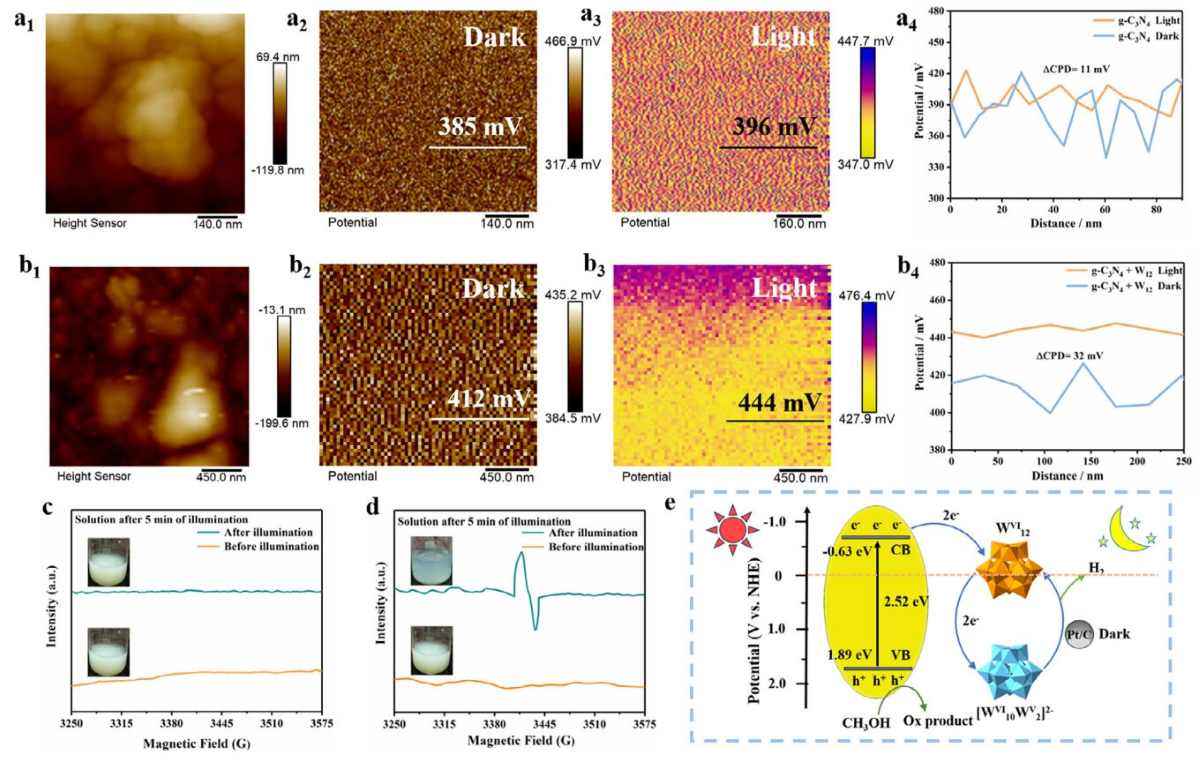
During the initial phase, the system is exposed to sunlight. The g-C₃N₄ acts as a photon absorber, generating electrons that are transferred and stored within the W12 polyoxometalate. As the charge accumulates, the solution undergoes a visible color change from pale yellow to blue, signaling successful energy storage. The stored energy remains stable until it is released later, without the need for additional irradiation.
Performance metrics of the on-demand hydrogen system
Experimental results show strong quantitative performance. Under dark conditions, the system achieves a hydrogen evolution rate of 3,220 µmol g⁻¹ h⁻¹. When operated outdoors under natural sunlight, hydrogen production reaches 954 µmol g⁻¹ h⁻¹. Both figures outperform most dark-mode photocatalytic systems reported in the scientific literature.
Hydrogen release is triggered by introducing a Pt/C catalyst, which initiates the controlled discharge of electrons stored in the W12 compound. The process does not require external electrical input or complex infrastructure, relying solely on the energy captured during the illumination phase.
This architecture makes it possible to decouple solar energy harvesting from hydrogen production in time, allowing the system to operate efficiently even in the absence of light.
The g-C₃N₄–W12 coupling mechanism
The efficiency of the system is driven by the favorable energetic alignment between the two materials. W12, a tungsten-based compound that functions as a chemical battery, has a reduction potential that matches the band structure of g-C₃N₄, a semiconductor capable of absorbing light and generating electrons.
In addition, the two components carry opposite surface charges, leading to spontaneous electrostatic self-assembly within the suspension. This direct contact creates an internal electric field that accelerates electron transfer from the semiconductor to the polyoxometalate, improving both charge storage and release.
Surface analyses, potential measurements, and electron paramagnetic resonance spectra reported in the study confirm the presence of stabilized electrons within W12 after illumination. The result is an optimized pathway for storing and releasing electrons, a critical factor for reliable on-demand hydrogen production.
Addressing key challenges in the hydrogen value chain
The study positions this system as a response to two structural weaknesses in the hydrogen value chain. The first is the risk associated with hydrogen storage and transport, which typically requires high-pressure tanks. The second is the discontinuous nature of solar energy, which limits the operational reliability of conventional photocatalytic systems.
In this configuration, hydrogen is not stored but generated only when needed, reducing the risks linked to compression and transport. At the same time, solar energy can be harvested under optimal conditions and used later, even in environments without direct sunlight.
According to the researchers, the system demonstrates robust performance under real-world conditions and opens the door to scalable solutions for hydrogen production in sunny regions, with deferred use in energy-constrained settings.
A paradigm shift inspired by nature
The concept mirrors natural photosynthesis, where light-driven reactions are separated from dark reactions. Here, solar energy is converted into a chemical reserve of electrons that can be released on demand to produce hydrogen.
The g-C₃N₄/W12 system shows that hydrogen production can be decoupled from immediate solar availability, enabling new plant designs and logistical models. The combination of chemical simplicity, the absence of external electrical inputs, and high performance places this approach among the most advanced solutions currently being explored for on-demand hydrogen generation.