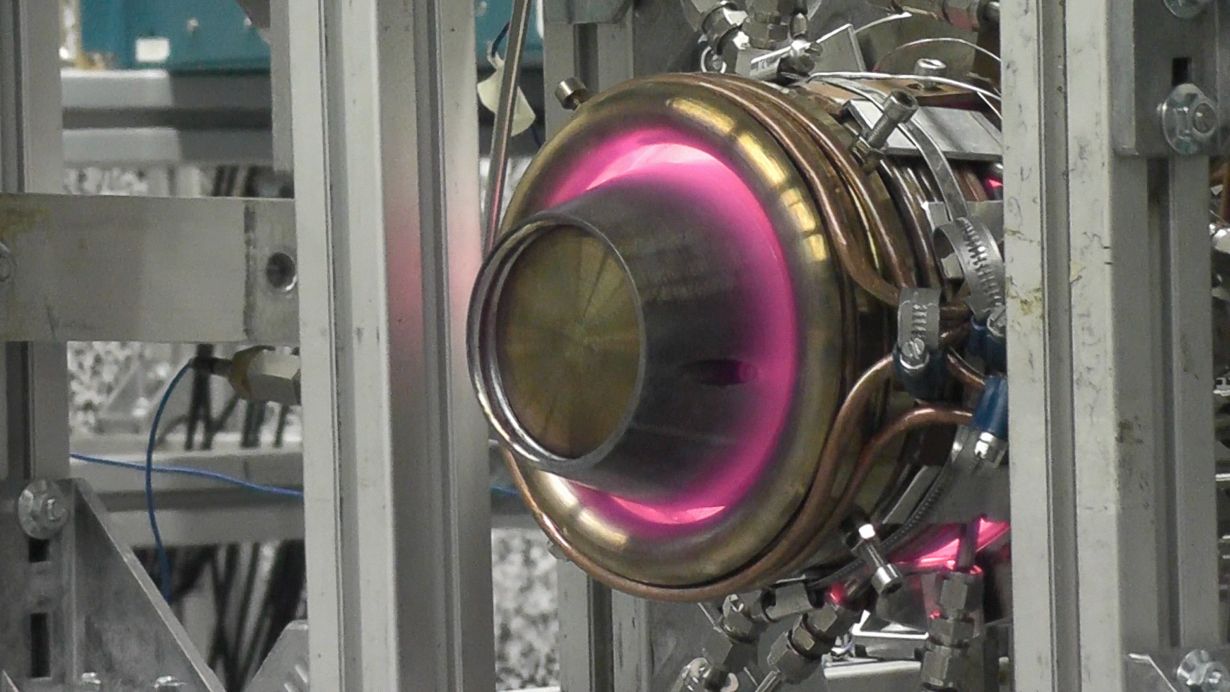
Hydrogen turbine breakthrough at KIT
Researchers at the Karlsruhe Institute of Technology, KIT, have unveiled a hydrogen turbine design that removes one of the most energy-intensive components of conventional gas turbines, the axial compressor. After extensive optimization, the team succeeded in operating the system for more than five minutes, surpassing a previous benchmark of 250 seconds achieved by NASA with a similar concept. The prototype also generated electricity during testing.
The development is part of broader efforts to decarbonize thermal power plants and heavy transport. In sectors where full electrification remains impractical, hydrogen, particularly when produced through zero-emission technologies, is increasingly viewed as a strategic energy carrier.
Major industrial players such as Ansaldo Energia, Siemens Energy and Mitsubishi Power have already explored hydrogen-based combustion systems. The KIT project, however, introduces a fundamentally different architecture.
Pressure-gain combustion eliminates the compressor
In conventional gas turbines, compressors are essential. Air is continuously drawn in, compressed, mixed with fuel and burned. Nearly half of the energy produced is typically consumed just to power the compressor itself. These systems are also complex and heavy.
The KIT researchers sought a design capable of increasing efficiency while reducing moving parts. Their approach relies on pressure-gain combustion, a technology that generates high pressure through detonation waves inside the combustion chamber.
“These waves arise from fluid-mechanical instabilities, patterns of waves and vortices in the flow, completely without mechanical compressors,” the institute explained in a statement.
Unlike the traditional Brayton cycle used in standard gas turbines, Pressure-Gain Combustion occurs extremely rapidly through shock or detonation waves in a confined space. Because the gas does not have time to expand during combustion, pressure rises sharply.
The method improves efficiency but also presents formidable engineering challenges. During detonation, temperatures at the wave front can exceed 2,500°C almost instantaneously, well above the melting point of even advanced metal alloys.
Extending operation beyond seconds
The KIT project builds on years of research. Previous experiments lasted only fractions of a second to avoid melting the combustion chamber. The latest prototype, however, maintained operation for more than five minutes, a significant step forward for the hydrogen turbine concept.
Although the technology is not limited to hydrogen, the team selected H2 for its rapid reaction properties and ability to sustain stable pressure increases.
The researchers also achieved a second milestone by generating electricity during operation.
“This is an extremely difficult step because the very rapid and intense combustion processes in the chamber make it challenging to transfer energy stably to the turbine,” said Professor Daniel Banuti, director of the institute. “We are the first to successfully operate a turbine of this type and generate electricity in the process.”
Implications for power generation and aviation
The breakthrough opens the possibility of lighter, more cost-effective and highly efficient turbines for power generation and potentially for future aviation applications.
The team will present its compressor-free hydrogen turbine at the Hannover Messe from April 20 to 24, 2026, at the KIT stand.