Hydrogen storage in solid carriers
Hydrogen storage, one of the main unresolved challenges in building a hydrogen-based energy value chain, could find a new solution in a semiconductor material capable of releasing hydrogen simply through exposure to visible light.
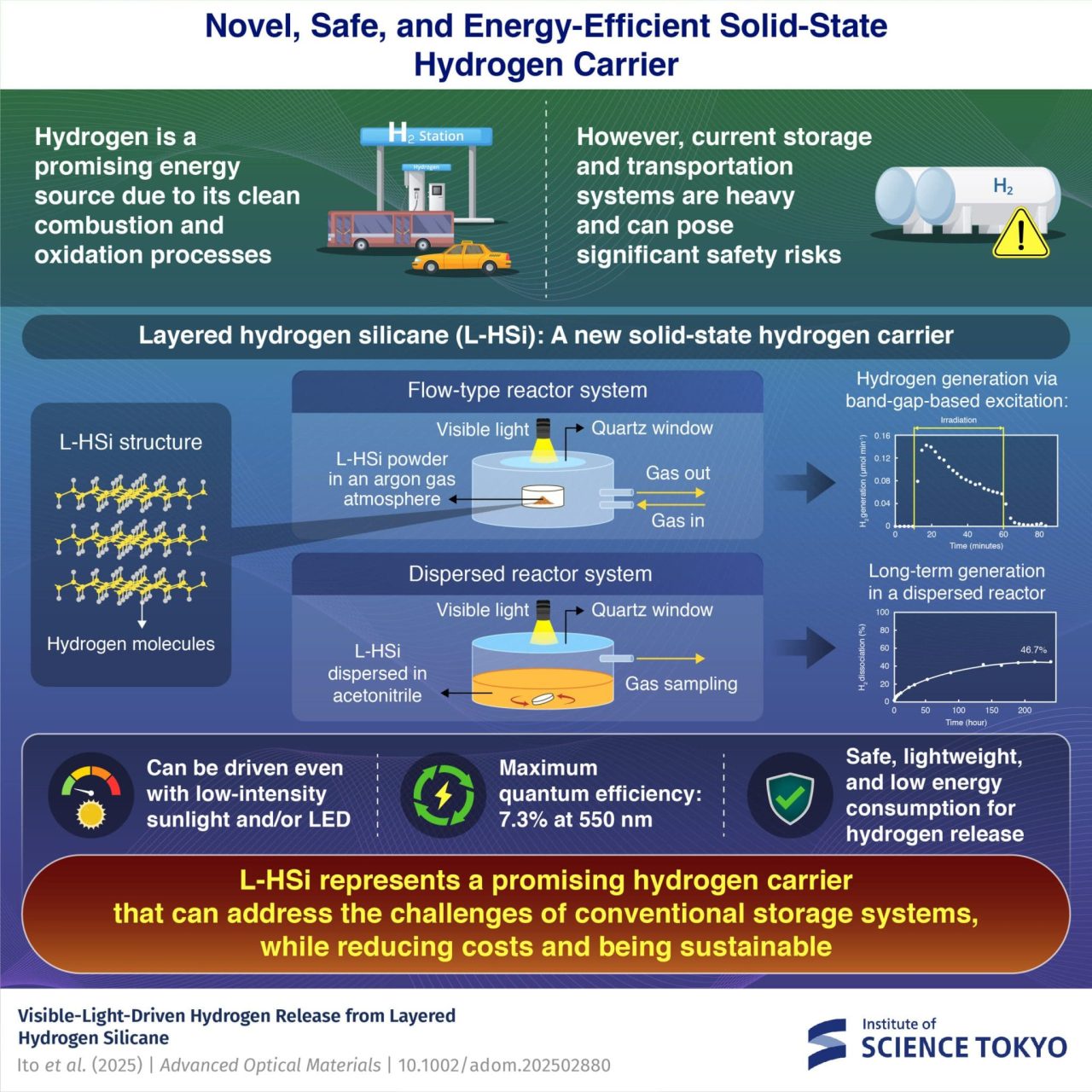
A study published in the scientific journal Advanced Optical Materials shows that layered hydrogen silicane, a solid composed of silicon and hydrogen, can store hydrogen in a stable form and release it at ambient temperature and pressure when exposed to sunlight or LED light.
The material reaches a gravimetric capacity of 3.44% by weight and a maximum quantum efficiency of 7.3% at 550 nm. These results show how hydrogen storage can be integrated with low-energy release mechanisms, without relying on compression, liquefaction, or high-temperature heating.
What is layered hydrogen silicane?
The material investigated is called layered hydrogen silicane, or L-HSi, and consists of silicon and hydrogen in a 1:1 ratio. According to the scientific paper “Visible-Light-Driven Hydrogen Release from Layered Hydrogen Silicane,” authored by Japanese researchers and academics, it represents a new candidate for hydrogen storage thanks to its combination of solid-state stability, relatively high hydrogen density, and the ability to release hydrogen under ambient conditions.
The authors place their work within the broader context of the limitations of existing hydrogen storage systems. Compressed hydrogen tanks offer low volumetric density and raise safety concerns, while liquid hydrogen requires cryogenic temperatures and significant energy input.
Liquid carriers such as ammonia or methylcyclohexane also require high-temperature dehydrogenation processes and pose challenges related to toxicity or corrosiveness. Solid materials, so far, have been constrained by the use of heavy metals and limited gravimetric capacity.
Structural properties of the L-HSi carrier
Layered hydrogen silicane is synthesized through a decalcification process of CaSi₂ in hydrochloric acid at −20 °C, which preserves the layered structure of the original material. The result is a solid composed of two-dimensional sheets of corrugated silicon, in which each silicon atom is bonded to a hydrogen atom oriented perpendicular to the plane of the layer.
Structural and chemical analyses reported in the study show that this configuration allows the material to achieve a hydrogen gravimetric capacity of 3.44% by weight, a high value for a lightweight solid material free of heavy metals.
Thermal desorption measurements also indicate an H/Si ratio of 1.02, suggesting that nearly all silicon atoms participate in hydrogen storage. These characteristics place L-HSi among the most promising solid hydrogen storage materials studied so far, particularly when compared with conventional metal hydrides.
Light-activated hydrogen storage
One of the core elements of the study concerns the hydrogen release mechanism. Layered hydrogen silicane is a semiconductor with an optical bandgap of 2.13 eV, corresponding to a wavelength of about 600 nm, within the visible light range. Experiments show that hydrogen is released only when the material is irradiated with wavelengths shorter than this threshold.
Tests conducted in the absence of light show that thermal hydrogen release begins only above 270 °C, while during irradiation the surface temperature of the material does not exceed 80 °C. This evidence rules out a photothermal mechanism.
Instead, the overlap between the material’s absorption spectrum and the action spectrum of hydrogen release confirms that the process is driven by electronic excitation across the bandgap, a key insight for understanding light-activated hydrogen storage.
Efficient even at low light intensity
Tests carried out under inert atmosphere show that hydrogen release under visible light remains effective even at low light intensities. The internal quantum efficiency reaches a maximum of 7.3% at 550 nm, a result significantly higher than that observed in previous solid materials sensitive only to ultraviolet radiation.
A particularly relevant finding concerns the dependence on light intensity. The authors report that hydrogen release occurs even when the light source intensity is just 3% of that of a xenon lamp, a level comparable to natural sunlight or a commercial LED. The efficiency remains nearly constant as light intensity varies.
This indicates that the process does not require concentrated light sources and can be powered by diffuse illumination, a crucial factor for practical applications in solid hydrogen storage.
How much hydrogen can be released over time?
To assess the maximum amount of hydrogen that can be released, the research team used a dispersed system in which the material was suspended in acetonitrile and irradiated for more than 200 hours. Under these conditions, light can reach the L-HSi particles more uniformly.
The results show that up to 46.7% of the total hydrogen stored in the material can be released. The process then slows down because the decreasing number of available protons makes their recombination into H₂ molecules progressively more difficult. In addition, surface oxidation following hydrogen release contributes to limiting further dehydrogenation cycles.
The experiments clearly show that hydrogen release stops in the absence of light, confirming that the process is directly driven by illumination.