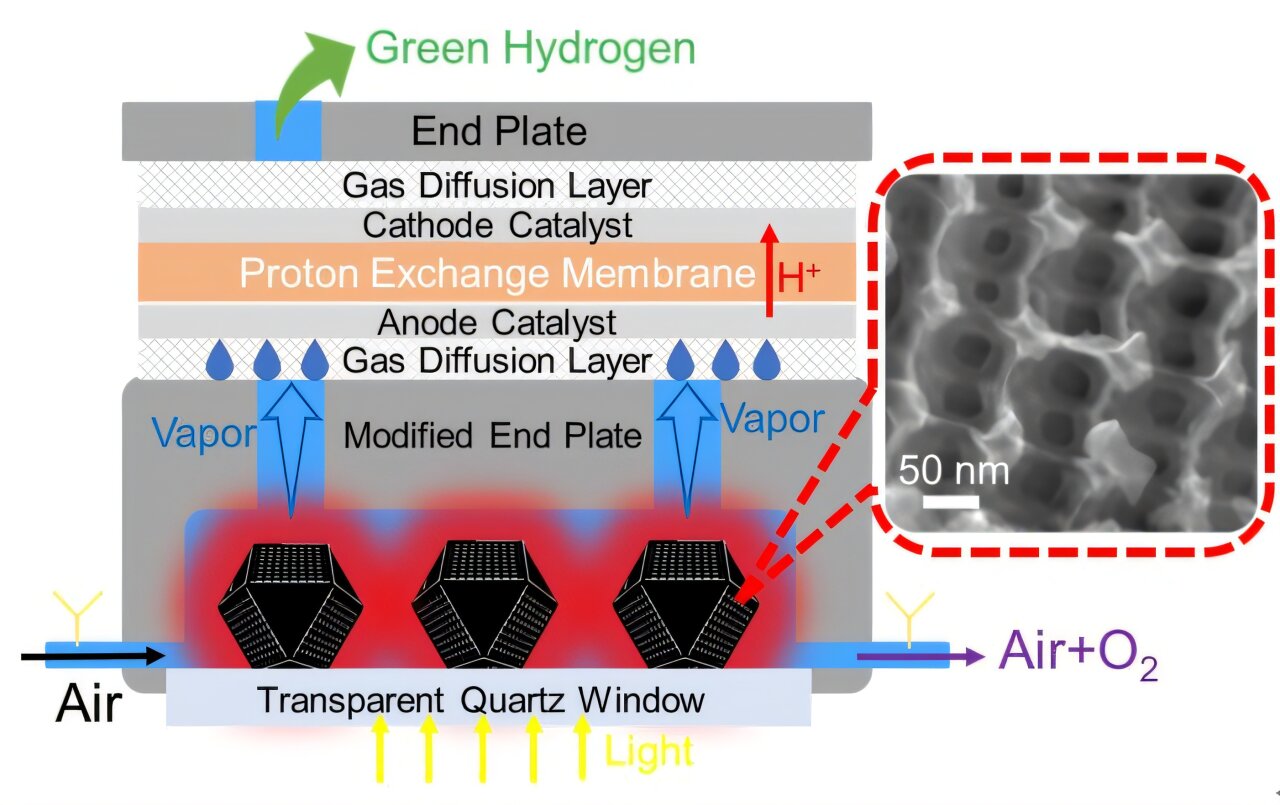
Producing green hydrogen from atmospheric moisture
Generating green hydrogen from air and sun without any external energy input is now a reality. It may not yet be highly efficient, but it is reliable and sustainable. A team of researchers from the Chinese Academy of Sciences, working with colleagues in Ireland and Australia, has developed a new electrolysis system designed for water-scarce regions.
The study combines two well-established technologies: a porous carbon–based atmospheric water harvester and a proton exchange membrane electrolyzer. To understand the breakthrough, it is useful to take a step back.
Proton exchange membrane electrolysis: how it works
Proton Exchange Membrane Water Electrolysis (PEMWE) is an efficient and eco-friendly method for producing green hydrogen. Like all electrolyzers, it requires energy. When a voltage is applied to both electrodes, water at the anode side releases oxygen, free electrons, and hydrogen ions. These ions migrate through the membrane to the cathode, where they recombine with electrons to form hydrogen gas.
PEMWE offers several advantages. It can operate at high current densities, reducing operating costs, and it integrates well with intermittent renewable sources such as wind and solar, capturing energy that would otherwise go unused. Another strength lies in its low gas crossover rate, ensuring that the hydrogen and oxygen produced are of very high purity, an essential feature for fuel cell applications.
The challenge of pure water
The drawback is that PEM electrolysis requires pure water as feedstock, which poses a significant challenge in regions where freshwater is scarce. One alternative is to use seawater after desalination and purification, but that process consumes energy and produces brine waste that is difficult to manage.
To overcome this issue, the team led by Professor Yin Huajie of the Chinese Academy of Sciences integrated PEMWE with a self-sufficient solar-powered atmospheric water harvesting system. The prototype captures humidity using a hierarchically porous carbon-based photothermal adsorbent. The principle is simple: the material binds water molecules from the air, then releases them when exposed to light.
Test results show promise
The researchers powered the electrolyzer with a solar panel measuring 175 × 116 mm. In trials, the system achieved a record water collection capacity of 0.49 liters per hour per kilogram of adsorbent at 40% relative humidity. During outdoor testing, it generated up to 204 milliliters of green hydrogen per hour at noon, using only atmospheric moisture as input. Remarkably, the system remained operational even at extremely low humidity levels of 20%, proving its effectiveness in arid conditions.
The findings are published in Advanced Materials.