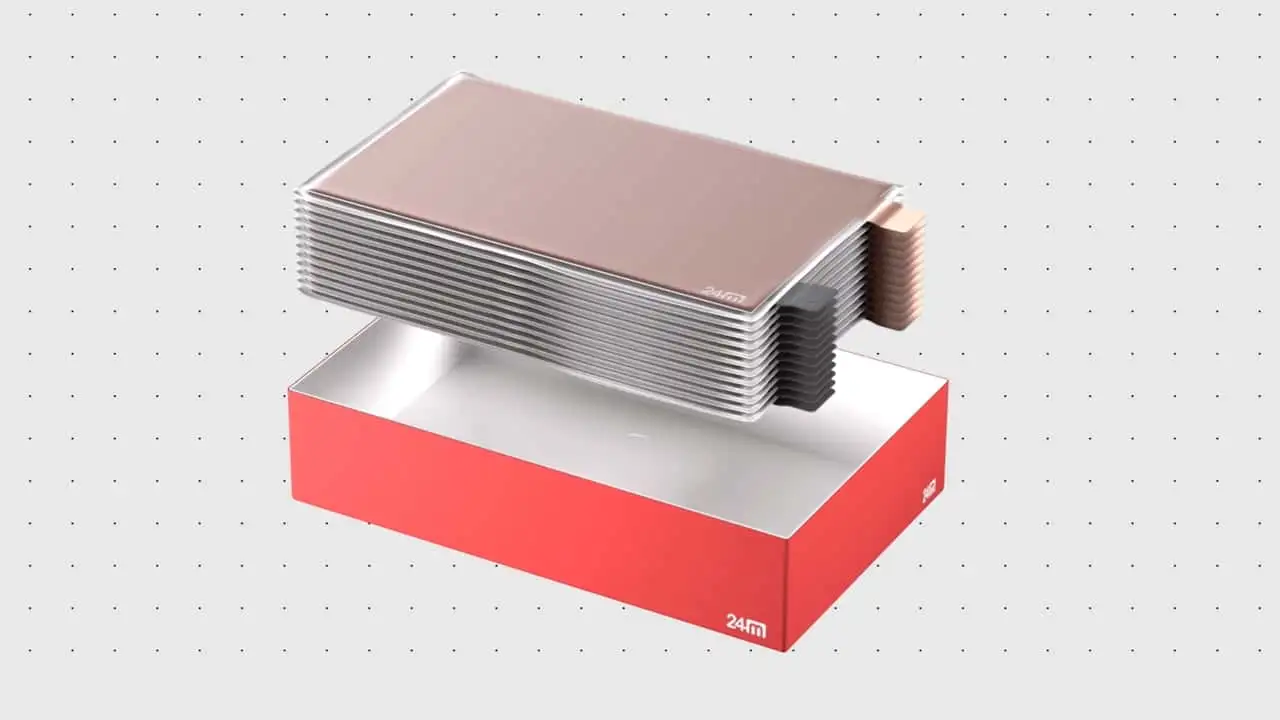
A new frontier for electric car batteries
An electric car capable of traveling 1,000 miles on a single charge may soon become reality. A new system for producing and assembling batteries promises to increase the range of electric vehicles by up to 50%. Considering the current record for battery range, the potential of 24M Technologies’ innovation, called ETOP, short for Electrode-to-Pack, is astonishing. The key lies in a radical shift from the traditional cell–module–pack structure to a direct electrode–pack configuration.
A new structural paradigm
Today, most battery manufacturers and automakers build battery packs by assembling individual cells into modules, which are then integrated into the full pack. While this approach is well established, it involves a high proportion of inactive materials, such as metal supports and plastic casings, that do not contribute to energy storage. The result is lower energy density, higher costs, and increased weight.
24M’s ETOP design eliminates both cells and modules entirely. The electrodes are sealed in thin polymer films and integrated directly into the pack. This creates an ultra-compact structure in which up to 80% of the total volume is active material, compared to just 30–60% in conventional batteries.
More energy, lower costs
According to the company, the impact on energy performance is significant. A 75-kWh NMC (nickel-manganese-cobalt) pack, the typical capacity for a mid-segment EV, can reach 100 kWh while keeping the same physical size, increasing range by roughly 33%. Alternatively, manufacturers could achieve the same range using the more affordable and safer LFP (lithium-iron-phosphate) chemistry, drastically cutting production costs.
ETOP is also compatible with nearly all existing chemistries, NMC, LFP, NCA, sodium-ion, LTO, and LiS, giving manufacturers flexibility to maximize pack-level energy density regardless of active material. Naoki Ota, president and CEO of 24M Technologies, described the system as “the closest version to an ideal battery: essentially active material enclosed in a sophisticated shell.”
Flexibility and manufacturing simplicity
The new architecture offers remarkable design flexibility. Battery packs can be produced in unconventional shapes, oval, hexagonal, or fully customized, and at voltages ranging from 48 V up to 800 V, thanks to the ability to connect sealed anode-cathode pairs directly in series or parallel.
On the manufacturing side, the technology reduces complexity and capital costs. Individual electrode sealing simplifies safety tolerances and improves yield, eliminating the need for high-precision equipment.