How carbon capture energy is evolving with new electrochemical systems
What if capturing emissions could also generate electricity? That question is at the core of a new breakthrough in carbon capture energy, an electrochemical system capable of combining clean power generation with the removal of greenhouse gases from the atmosphere.
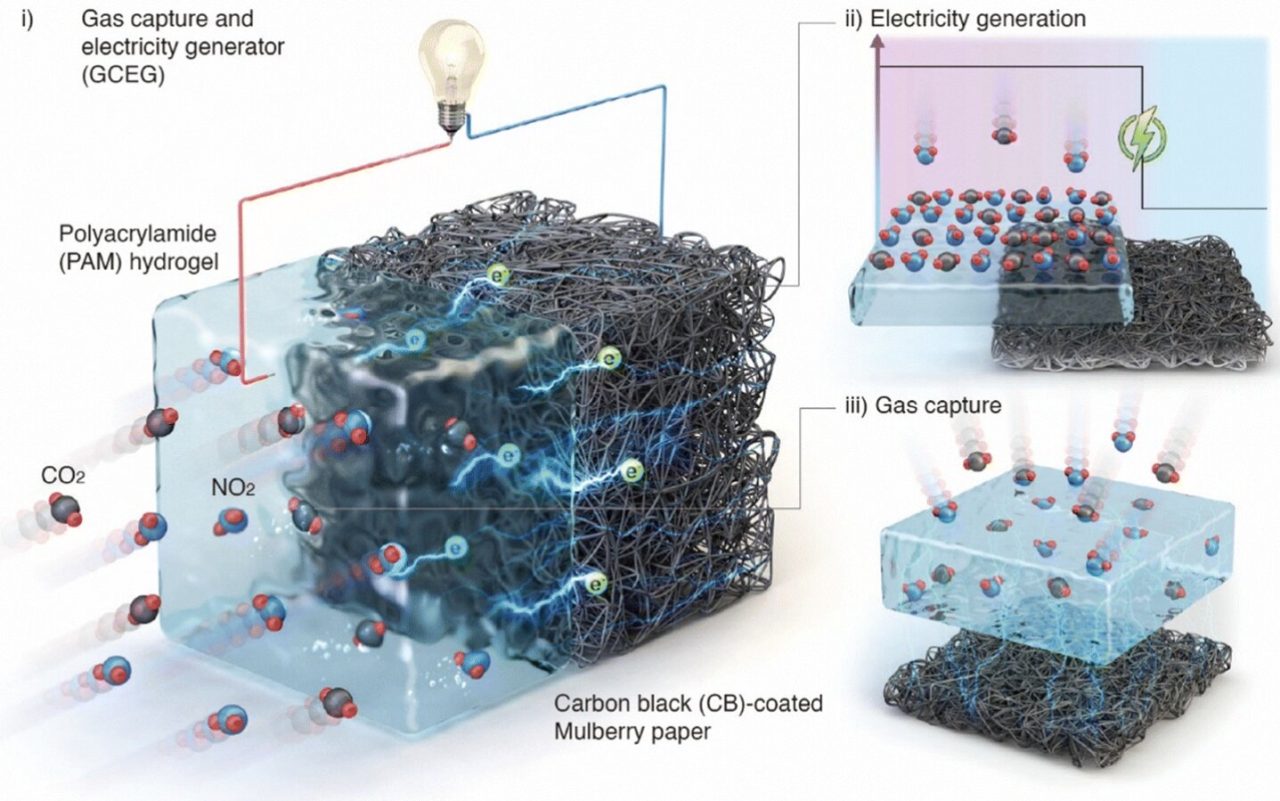
Developed through a collaboration between several universities and research institutes in South Korea, the system, known as the Gas Capture and Electricity Generator, is not technically a battery. Instead, it belongs to a still emerging class of technologies that produce electricity through gas-driven ionic gradients.
This sets it apart from other solutions, such as those developed by Energy Dome, which rely on different thermodynamic processes.
Carbon capture energy and the challenge of efficiency
The starting point of the research was to improve carbon capture energy systems, particularly technologies linked to carbon capture, utilization, and storage (CCUS). Despite their potential, these systems remain limited by high operating costs.
The main bottleneck is the so-called energy penalty. Capturing and processing gases requires large amounts of energy, often reducing the efficiency of power plants by up to 50% when integrated with carbon capture processes.
To overcome this limitation, the South Korean team introduced a fundamentally new mechanism that directly converts the physicochemical energy generated during gas adsorption on electrode surfaces into electricity.
How the gas capture and electricity generator works
One of the key strengths of this carbon capture energy solution is its structural simplicity and use of low-cost, sustainable materials:
- A mulberry paper electrode that provides a natural porous structure
- A carbon black coating that makes the electrode conductive
- A polyacrylamide (PAM) hydrogel applied asymmetrically, enabling selective adsorption of NOx and CO2
This asymmetry is crucial. It creates a chemical and physical gradient that allows current to flow in a defined direction. When greenhouse gases are adsorbed, charge redistribution and ion migration occur inside the device, generating a potential difference and an electrical current.
In practical terms, as explained by researchers at Sungkyunkwan University, pollutant molecules effectively act as a form of “fuel,” allowing the system to purify the air while producing energy at the same time.
Performance of the carbon capture energy device
The results remain modest but promising. Under exposure to 50 ppm of NO2, the device shows:
- An open-circuit voltage of about 0.8 V
- A short-circuit current of approximately 80 µA
- Stable voltage output for up to 24 hours under continuous gas flow
These performances are supported by the reversible adsorption and desorption of gas molecules, demonstrating good reproducibility.
According to Professor Ji-Soo Jang of Ajou University, this research suggests a shift in perspective: greenhouse gases should not be seen only as pollutants, but also as a potential energy resource.
“Our goal is to further develop this technology into an environmental platform that not only achieves carbon neutrality but also generates energy,” Jang said.
Toward a new model of carbon capture energy
This emerging approach to carbon capture energy challenges a key assumption in current systems, that emissions are solely a cost to be managed. Instead, it reframes them as a potential input for energy generation.
That said, the limitations remain significant. The current performance levels are far from commercial scalability, and the technology will need to overcome the same economic and infrastructure barriers that have slowed broader CCUS adoption.
Still, the concept opens a new direction: integrating emissions management directly into energy production processes, reducing the need for separate and energy-intensive capture systems.
Read the study Electrical power generation from asymmetric greenhouse gas capture, published in Energy & Environmental Science.