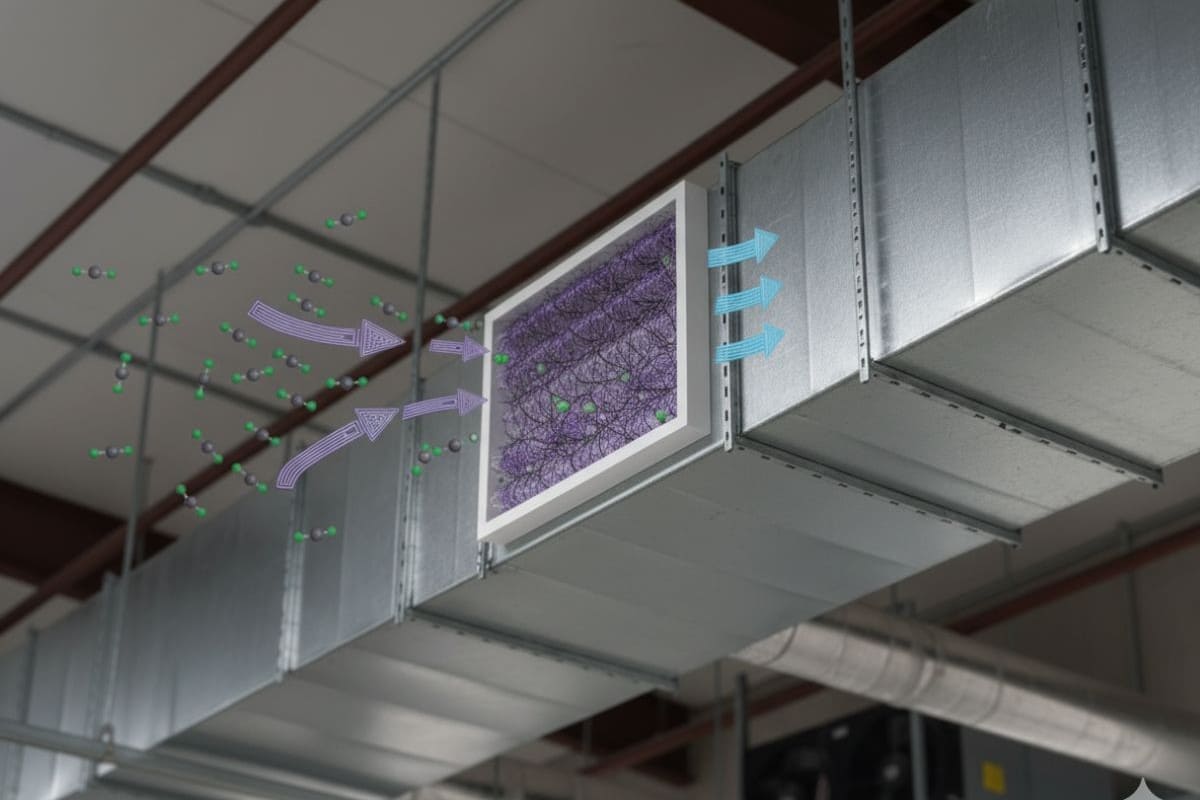
CO2 capture filters in HVAC systems: a new model for direct air capture
A new CO2 capture filter technology is redefining how we remove carbon dioxide from the atmosphere, transforming standard ventilation systems into tools for urban decarbonization. Developed by an international research team, the filter can be installed in existing HVAC (Heating, Ventilation, and Air Conditioning) systems to capture CO2 even at low concentrations.
By integrating CO2 capture filters directly into HVAC systems, the technology enables a distributed approach to direct air capture (DAC). This method lowers costs and overcomes the limitations of centralized DAC plants, which are often large, expensive, and energy-intensive. The filter itself is made of conductive carbon nanofibers coated with polyethyleneimine, a compound that selectively absorbs CO2 while allowing other air components to pass freely.
Low energy use and easy regeneration
One of the main advantages of this innovation is its ease of regeneration. Unlike conventional DAC technologies, the filter can be reactivated with low amounts of energy, using either solar heat or low-voltage electricity. This feature allows continuous operation over time while maintaining a net CO2 removal efficiency of 92.1%.
Operational costs range between $209 and $668 per ton of CO2 captured, making the system competitive with large-scale carbon removal solutions.

Global potential and future applications
Researchers estimate that if CO2 capture filters were integrated into existing ventilation systems worldwide, they could remove about 596 million tons of CO2 annually, roughly 2% of global emissions.
This distributed approach leverages existing infrastructure, avoiding the need for costly new facilities. The next step is to scale production and incorporate the filters into sustainable building projects.
The study, “Distributed direct air capture by carbon nanofiber air filters,” was published in Science Advances.