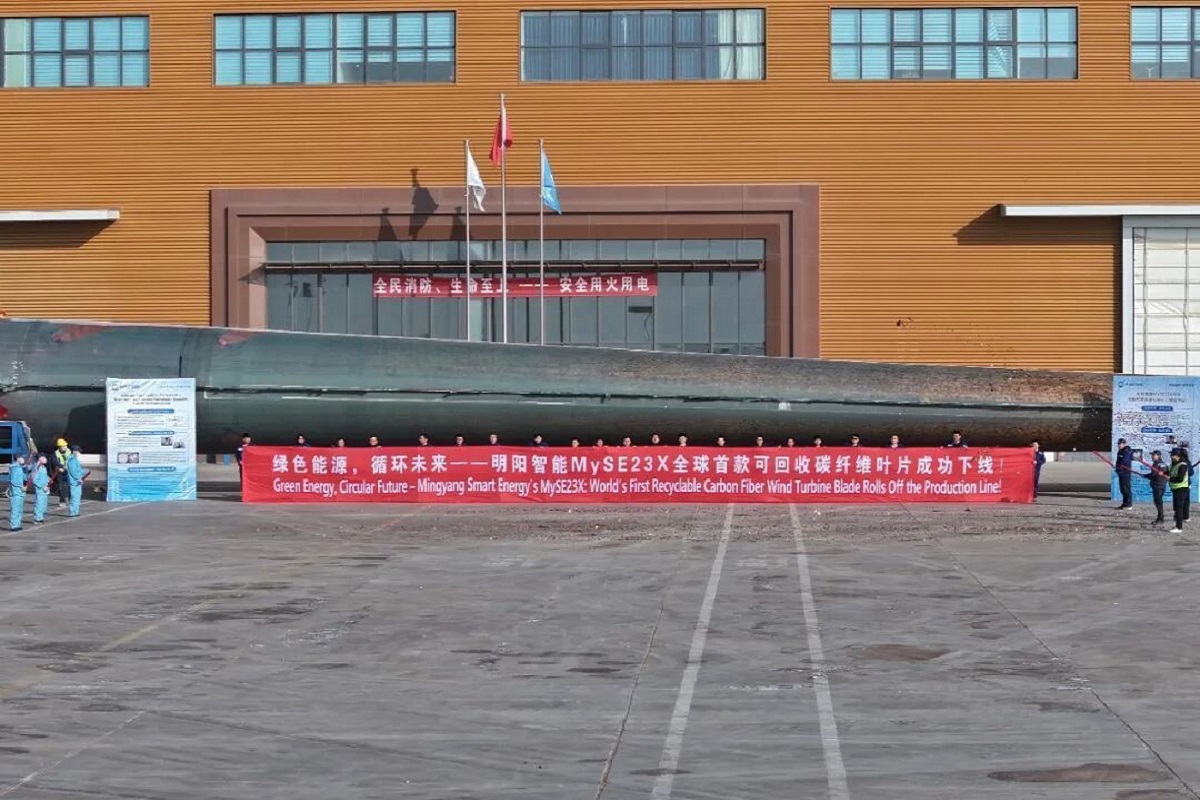
Recyclable wind turbine blade, China’s first full-scale carbon fiber solution
The world’s first recyclable wind turbine blade made entirely of carbon fiber and designed for full reuse is being presented by the Chinese company Ming Yang Smart Energy. In a post published on LinkedIn, the manufacturer unveiled the MySE23X blade, which exceeds 110 meters in length and is engineered not only to optimize performance over time but also to avoid end-of-life disposal issues. According to the company, once the blade reaches the end of its operating life, it can be fully recycled without material loss.
The announcement comes as mounting evidence highlights the scale of the problem. A recent study by the University of Cambridge estimates that by 2050, around 43 million tons of waste from decommissioned wind turbine blades could accumulate globally if no effective recycling solutions are deployed.
How the recyclable carbon fiber blade works
The statement published on the professional social network reads: “By leveraging a single degradation technology operating at ambient temperature and pressure, the recyclable carbon fiber MySE23X blade enables the efficient chemical separation of composite materials using a dedicated degradation solution. The recyclable carbon fiber panel provides high-strength, lightweight structural support for the blade while ensuring the complete recycling of the carbon fiber.” If the innovation delivers on these claims, it would also address one of wind power’s most significant environmental challenges: the disposal of turbine blades.
Why wind turbine blade recycling remains a challenge
To withstand years of continuous aerodynamic stress, wind turbine blades are made from composite materials in which glass or carbon fibers are embedded in a matrix of thermoset epoxy resins. Unlike conventional plastics, these resins undergo irreversible chemical cross-linking during manufacturing, once cured, they can no longer be melted down. This turns each blade into a single solid structure that, at the end of its service life, cannot be broken down into its original components.
Compared with earlier recycling attempts that relied on intense heat or high pressure, often damaging the very fibers meant to be recovered, this new chemical process operates at ambient temperature and pressure. It chemically dissolves the bonding agent that holds the blade together. Until now, the fate of decommissioned turbines has been mechanical shredding, an energy-intensive process that produces low-value material for construction, or, worse, disposal in landfills.
Recyclable wind turbine blade technology and controlled degradation
The MySE23X blade would introduce a controlled degradation chemistry. The use of specific reagents allows the resin bonds to be dissolved without damaging the high-value carbon fibers. This step marks a shift from a linear extract-and-dispose model to a genuinely circular one, turning waste from decommissioned blades into high-performance materials for new turbines and automotive components.
At present, Ming Yang Smart Energy is the only turbine manufacturer worldwide to have announced the development of blades that are 100 percent recyclable. Another company, Siemens, with its Gamesa RecycleBlade, has reached a 95 percent recycling rate, but has announced that it can achieve full recyclability by 2040.