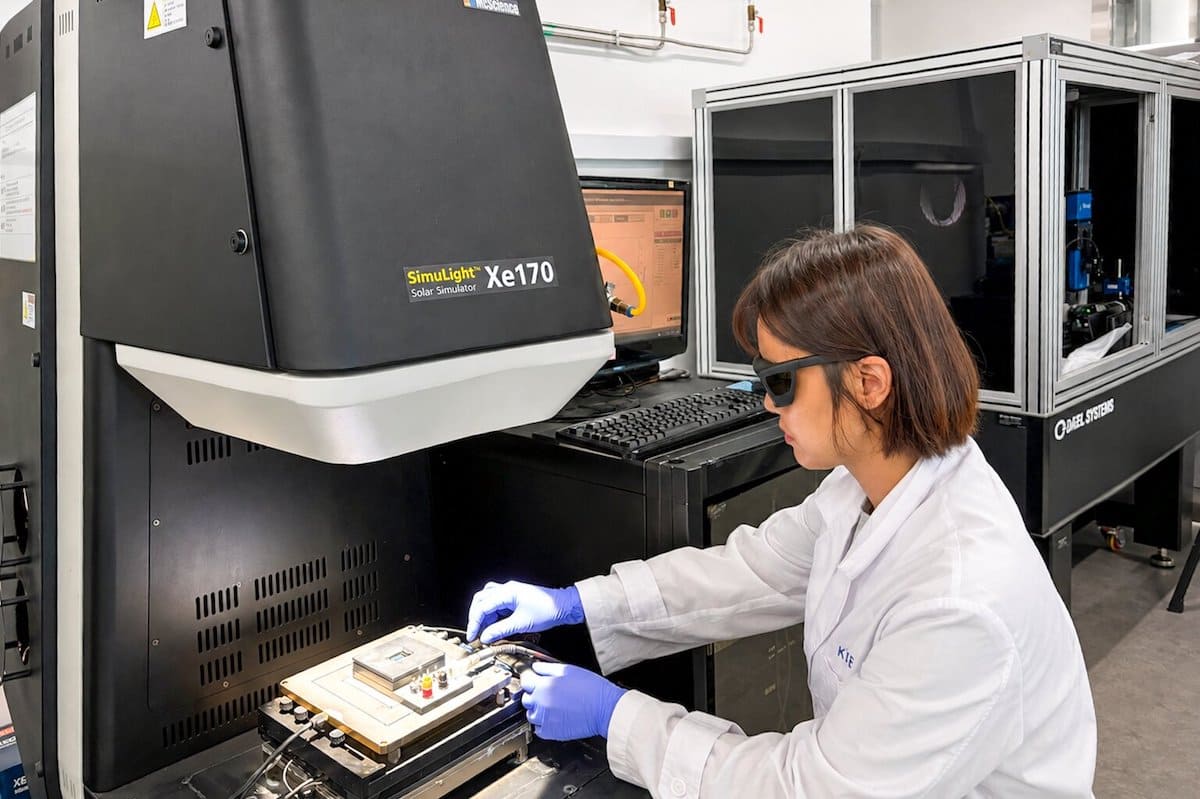
Perovskite solar cells pass the damp-heat test
A new generation of perovskite solar cells capable of withstanding sauna-like conditions has emerged from South Korea. Researchers at the Korea Institute of Energy Research (KIER) have developed a catalytic process designed to overcome one of the most persistent weaknesses of conventional perovskite solar cells, their poor resistance to heat and humidity.
The breakthrough could open a new path toward commercial applications for conventional perovskite photovoltaics. In laboratory testing, the cells retained nearly all their initial power conversion efficiency after 1,000 hours of exposure to extreme heat and humidity under a standardized damp-heat test.
For now, the innovation remains confined to KIER’s photovoltaic research laboratories. Nevertheless, the findings represent a significant advance for a technology that has progressed at an extraordinary pace since perovskites first attracted attention in solar energy research.
Despite these advances, the commercial prospects for single-junction perovskite solar cells remain uncertain. Although their power conversion efficiency has nearly caught up with that of crystalline silicon, further improvements are increasingly constrained by the theoretical Shockley-Queisser limit.
As a result, much of the industry’s attention has shifted toward multijunction technologies, particularly tandem solar cells that combine perovskites with silicon or other perovskite materials.
Understanding why the new South Korean research matters, however, requires a closer look at how these solar cells are built.
Perovskite solar cells: conventional vs. inverted architectures
Perovskite solar cells (PSCs) generally use one of two architectures, distinguished by the order in which their functional layers are arranged: the conventional (n-i-p) architecture, developed first, and the inverted (p-i-n) architecture.
Conventional cells typically achieve higher open-circuit voltages (Voc) and continue to deliver some of the highest power conversion efficiencies. Inverted cells, by contrast, generally offer substantially better operational stability and are better suited to the textured surfaces of silicon solar cells in tandem configurations.
Beyond the challenges of ensuring proper adhesion between layers, the limited durability of conventional perovskite solar cells has long been a major obstacle. Researchers at KIER may now have found a way to address it by identifying the underlying degradation mechanisms and developing a process that avoids them.
During the fabrication of conventional perovskite solar cells, lithium salts and chemical additives are introduced into the hole transport layer to improve charge transport and overall device performance.
The problem is that some of these additives can evaporate under real-world operating conditions, leaving microscopic voids between the cell’s layers. These gaps undermine structural integrity and shorten the device’s lifespan.
Heat and moisture introduce another complication. At elevated temperatures and humidity levels, lithium ions released from the salts can migrate uncontrollably through the cell, accelerating degradation.
Until now, researchers have faced a difficult trade-off: maintaining high efficiency, traditionally supported by lithium salts and additives, while extending the operational lifetime of the cells.
That is precisely the challenge KIER’s research team set out to solve.
How researchers improved the durability of perovskite solar cells
The scientists developed an innovative nickel oxide-based catalytic process followed by filtration.
Instead of allowing lithium salts to remain in the finished device, the process uses them only to initiate the necessary chemical reactions. Nickel oxide then captures the lithium ions along with residual lithium salts, eliminating the need for conventional additives.
Because the nickel oxide particles are relatively large, the catalyst and the lithium ions bound to it can subsequently be removed together through filtration.
The result is a fabrication process that preserves high photovoltaic performance while removing materials associated with long-term instability.
The researchers achieved a power conversion efficiency of 25.24%, exceeding the 25.21% obtained using conventional additive-based processing by 0.03 percentage points.
More importantly, the cells demonstrated remarkable durability under severe environmental conditions.
When exposed to 85°C (185°F) and 85% relative humidity, the devices retained 95% of their initial efficiency after 1,000 hours of damp-heat testing.
The findings suggest that eliminating residual lithium and volatile additives could substantially improve the long-term stability of conventional perovskite devices without sacrificing efficiency.
According to the researchers, the approach could also help address durability challenges in perovskite-based tandem solar cells, potentially paving the way for commercialization.
The study, Redox-Active NiOx-Catalyzed Li+ Capture-Extraction Strategy for tBP-Free Spiro-OMeTAD Enables Exceptional Damp-Heat Stability in Perovskite Solar Cells, was published in Advanced Science in 2026.