US emissions increase as higher natural gas prices drive a return to coal in 2025
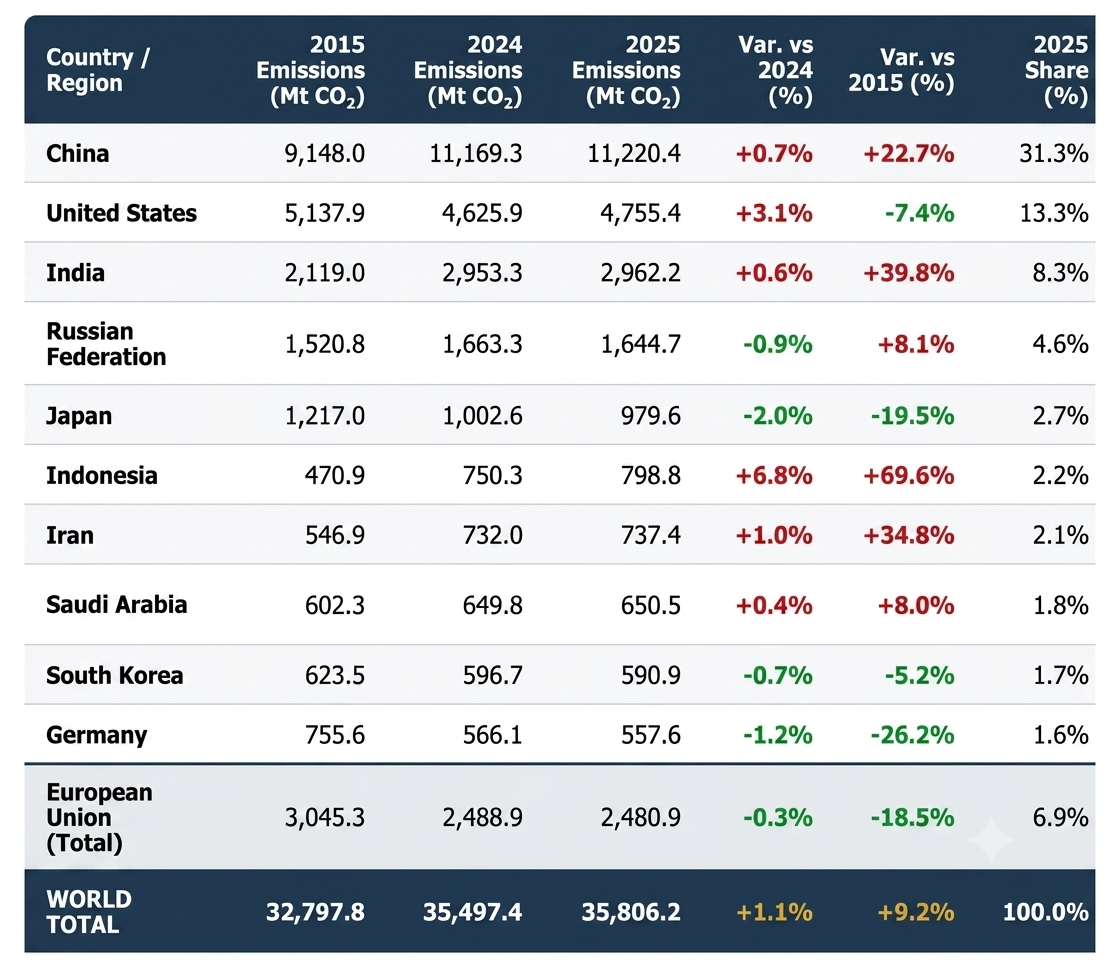
The latest Statistical Review of World Energy 2026, prepared by the Energy Institute in collaboration with Ember, KPMG and Kearney, provides a comprehensive overview of the global energy transition. In 2025, global energy-related carbon dioxide emissions increased by 1.1% compared with 2024, reaching a record 35,806.2 million metric tons. When gas flaring, methane emissions and industrial processes are included, total emissions climbed to 41 billion metric tons. Within this broader trend, the US emissions increase marked a sharp reversal, ending a decade of steady progress.
US emissions increase highlights the impact of domestic energy markets
According to the report, US emissions increased by more than 3% last year. This represents a clear break from the long-term trend in the United States, where emissions had declined by an average of 0.7% per year over the previous decade.
Several factors contributed to the rebound. First, US natural gas prices surged by 50% in 2025. As gas became significantly more expensive, many power generators shifted back to coal-fired electricity generation. As a result, US coal consumption rose by 10% in 2025 alone.
According to the study, these developments made the United States responsible for 36% of the global increase in energy-related emissions during 2025.
US emissions increase outpaces China despite higher Chinese emissions
Although China’s total carbon dioxide emissions remain more than twice those of the United States, the report shows that the country followed a markedly different trajectory in 2025.
China’s coal consumption remained broadly unchanged from the previous year, while solar power generation expanded by a record 40%, limiting the overall growth in national emissions. In absolute terms, the report states that the annual increase in US emissions was four times larger than the increase recorded by China during the same period.
How global energy emissions changed in 2025
Comparing the 2024 and 2025 energy balances reveals significant shifts in global energy-related emissions.
North America recorded emissions growth of 2.7% in 2025, the second-highest regional increase worldwide after Africa, where emissions rose by 2.8%, albeit from a much smaller base. In absolute terms, North American emissions increased by 152.3 million metric tons of CO₂, interrupting the region’s decade-long trend of declining emissions.
Meanwhile, the European Union recorded a slight reduction in emissions compared with 2024. Although the Asia-Pacific region remained the world’s largest source of energy-related emissions, it also achieved meaningful improvements in the carbon intensity of domestic energy production during 2025.